Panera Bread Logo History: Meaning, Symbolism & Brand Heritage
Among American fast-casual restaurant chains, Panera Bread occupies a distinctive space shaped by craft, ritual, and an unusually strong connection between product philosophy and visual identity. While many food brands rely on abstract mascots or purely typographic marks, Panera built its branding around a deeply symbolic metaphor rooted in the actual process of breadmaking. This decision gave its logo a narrative depth rarely seen in large-scale restaurant chains.
Much like the ingredient-driven storytelling found in the Starbucks logo history and the heritage-focused evolution explored in the Subway logo history, Panera’s visual identity reflects more than marketing intent. Within the broader landscape of restaurant logo heritage, Panera Bread stands out for translating an internal baking tradition into a universally recognizable symbol.
Meaning and History: The Origin of the Panera Bread Identity
Panera Bread was founded in 1987 and gradually evolved into one of the most successful bakery-café chains in the United States. From its earliest days, the brand emphasized freshly baked bread, traditional methods, and a sense of continuity across locations.
This philosophy directly influenced the logo meaning. Rather than centering the identity on speed, convenience, or mass production, Panera framed itself around care, nourishment, and repetition. The visual identity was designed to reflect the company’s internal baking culture, where each new batch of bread is linked to the previous one.
At the heart of this identity lies the concept of “Mother Bread,” a metaphor that defines both Panera’s production process and its branding narrative.
Logo Meaning: Bread as Continuity and Care
The Panera Bread logo meaning is inseparable from the sourdough tradition used by the company’s bakers. In sourdough baking, a small portion of dough from a previous batch, known as the “mother,” is used to start the next one. Panera institutionalized this ritual, ensuring continuity across time and geography.
When a new Panera location opens, it receives a portion of the original starter traced back to the brand’s early years. This practice transforms breadmaking into a symbolic lineage, and the logo reflects that idea visually. The woman holding bread is not merely a decorative figure, but a personification of the “Mother Bread,” embodying origin, care, and renewal.
Logo Symbolism: The Mother Bread Figure
In terms of logo symbolism, Panera’s emblem is unusually narrative-driven for a restaurant chain. The central figure is a smiling woman holding a loaf of bread as if it were a child. Her posture, expression, and gentle curves communicate warmth, protection, and continuity.
This symbolism positions Panera not as an industrial food provider, but as a steward of tradition. The bread becomes something nurtured rather than produced, reinforcing the brand’s emphasis on craft and responsibility. Unlike cartoon mascots designed for instant appeal, the Mother Bread figure conveys calm authority and timelessness.
Panera Bread Logo History Timeline
1987–2011: The Foundational Mother Bread Emblem
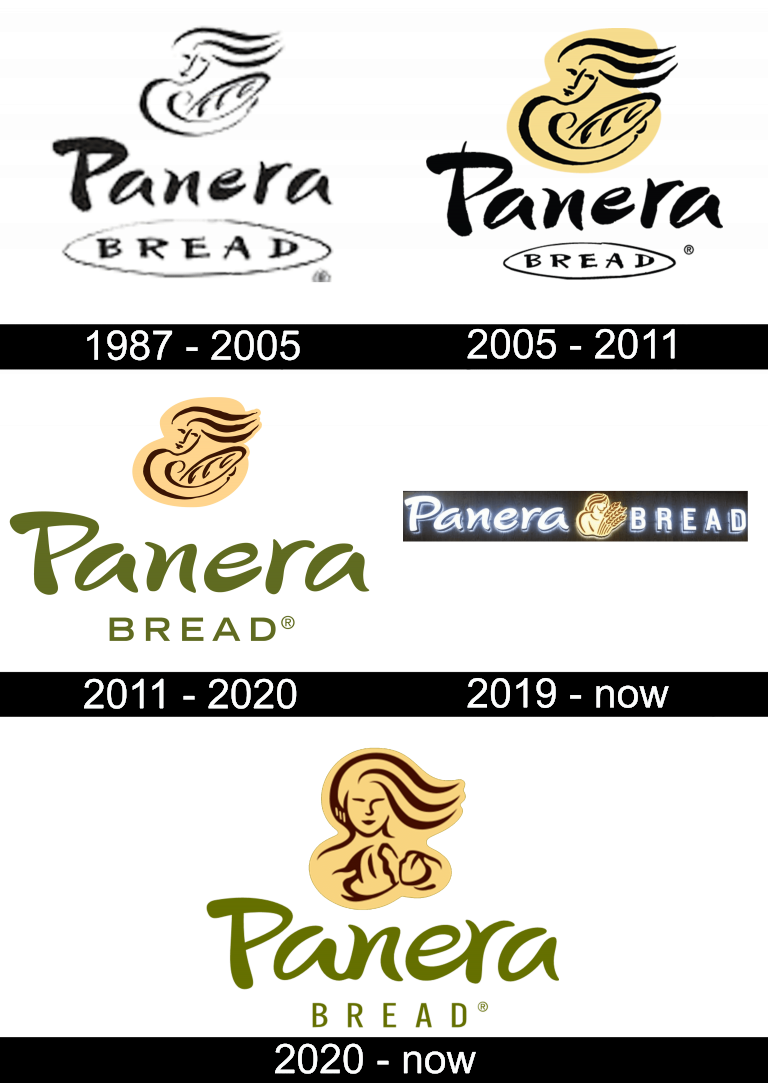
The original Panera Bread logo introduced in 1987 established the brand’s core visual language. It featured a black emblem depicting the Mother Bread figure above a lowercase wordmark rendered in a custom, soft-edged typeface.
Beneath the wordmark sat an oval frame resembling the shape of a baguette, enclosing the word “Bread” in a handwritten style that evoked calligraphy. This composition combined emblem, wordmark, and metaphor into a cohesive identity that remained recognizable for more than two decades.

2005–2011: Subtle Structural Refinement
During this period, the logo underwent minor adjustments. The baguette-shaped oval and the “Bread” lettering were reduced in size, improving balance and legibility. The overall structure remained unchanged, signaling Panera’s commitment to visual consistency.
2011–2020: Warm Color Modernization
In 2011, Panera introduced a refined version of its logo that shifted from monochrome to a warm brown-and-beige palette. The Mother Bread figure was placed within a smooth, abstract beige shape that echoed her silhouette, adding visual cohesion.
The wordmark was slightly modernized, while the “Bread” text transitioned to uppercase sans-serif lettering and lost its enclosing oval. This update preserved the brand’s symbolism while adapting the logo to contemporary design standards.
2019–Today: Secondary Linear Identity
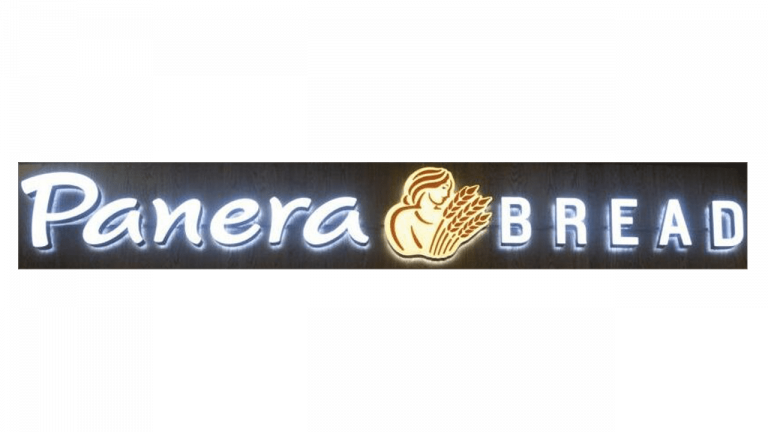
A secondary logo system introduced in 2019 presented a horizontal composition primarily used for storefront signage. In this version, “Panera” appears first, followed by the emblem and then the word “Bread.”
The emblem itself was modified, depicting the woman holding three wheat ears instead of a loaf, subtly emphasizing ingredients and agriculture. This variation complements the primary logo without replacing it.
2020–Today: Refined Green Wordmark
The most recent update retained the structure of the 2011 design but adjusted typographic weight and color. The word “Bread” became thinner, and the entire logo adopted a dark green color palette, aligning the brand more closely with freshness, sustainability, and modern food culture.
Typography and Color Palette
Typography plays a central role in the Panera logo description. The main wordmark is rendered in a bespoke script that resembles casual handwriting. Its uneven strokes and flowing curves convey authenticity and approachability, reinforcing the handcrafted narrative.
The color palette has evolved carefully. Early black-and-white versions emphasized seriousness and clarity. Later brown and beige tones evoked baked goods and warmth, while the current green palette signals freshness and modern sensibilities. Across all iterations, the colors remained rooted in natural, food-associated hues.
Logo Heritage and Brand Trust
Panera Bread’s logo heritage demonstrates how visual identity can reinforce operational philosophy. By embedding a real production ritual into its branding, Panera created a symbol that resonates internally with bakers and externally with customers.
Within studies of fast-casual restaurant logo history, Panera stands as a rare example where symbolism is not metaphorical marketing alone, but a reflection of actual process. This alignment between practice and design contributed significantly to long-term brand trust.
Panera Bread Logo as a Living Metaphor
The Panera Bread logo is more than an emblem; it is a visual embodiment of continuity, care, and craft. Rooted in the tradition of sourdough baking and expressed through the Mother Bread figure, the logo connects past and present through a single, enduring symbol. In an industry often driven by speed and scale, Panera’s logo heritage proves that authenticity and storytelling can be powerful foundations for lasting brand identity.
FAQ: Panera Bread Logo Meaning and History
What does the Panera Bread logo represent?
The logo represents “Mother Bread,” symbolizing continuity, care, and the sourdough tradition used by Panera bakers.
Why is there a woman holding bread in the Panera logo?
The woman personifies the sourdough starter, treated as a living “mother” passed from batch to batch and location to location.
Has the Panera Bread logo changed over time?
Yes, but changes have been evolutionary rather than radical, preserving the core symbol since 1987.
Why did Panera switch to green in recent logos?
Green emphasizes freshness, natural ingredients, and alignment with modern food values.