
Omega Logo History: Meaning, Symbolism & Brand Heritage

Few emblems in the world of luxury design have enjoyed the quiet permanence and universal recognition of the Omega logo. Introduced more than a century and a half ago, the emblem has evolved gently rather than dramatically, carrying the same sense of balance, proportion, and precision that defines the timepieces it represents. Omega’s identity is built on refinement rather than reinvention, and its symbol—lifted from the last letter of the Greek alphabet—stands today as one of the most prestigious insignias in watchmaking history.
Meaning & Symbolism: Why Omega Chose the Last Greek Letter
The name Omega has profound meaning in Greek tradition. Representing “the ultimate,” “the final,” or “the pinnacle,” the letter Omega (Ω) symbolizes completion and perfection. For a watchmaker whose brand promise revolves around precision, mastery, and the quest for excellence, the symbolism could not be more appropriate.
By choosing the Omega letter as its emblem, the company aligned itself with the idea of mechanical and philosophical completeness. In the world of horology, this “final letter” became the beginning of a new language—one that communicates mastery, precision engineering, and the pursuit of the ultimate standard. Even today, the Omega logo evokes a feeling of harmony between engineering artistry and timeless design.
Omega Logo Evolution – A Heritage of Minimalism and Precision
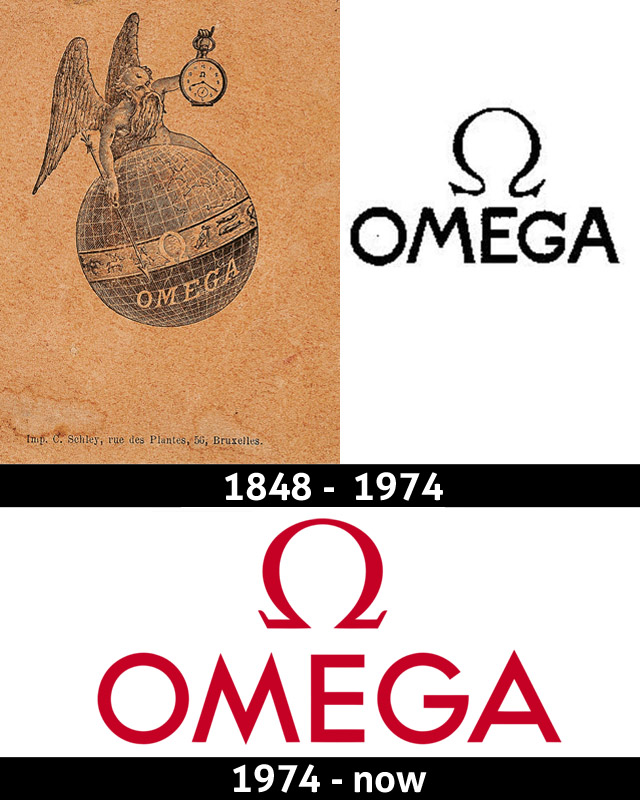
1848–1974: The Original Omega Emblem
The first Omega logo, introduced in 1848, defined nearly everything that would follow. It featured the Greek letter Omega drawn with thin, elegant curves—an emblem that balanced refinement and confidence—placed above a bold uppercase wordmark. The lettering was largely sans-serif, with the exception of the “G,” whose sharp serif echoed the pointed tips of the symbol above it. The monochrome palette reinforced a sober, timeless authority, suitable for a growing maker of scientific instruments and precision timepieces. For over seventy years, this mark remained untouched, demonstrating early on that simplicity was central to Omega’s identity.

1974–Today: A Modernized Classic
Only in 1974 did Omega dare to adjust its iconic logo. Yet even this change remained subtle. The designers refined the contours of both the emblem and the wordmark, slightly emboldening their lines and smoothing out the geometry to achieve a more contemporary silhouette. The typography became a strong, balanced sans-serif, free of the earlier serif on the “G,” which created a more unified look. At this time, Omega also adopted scarlet red as its signature color—a bold, energetic tone meant to highlight innovation, dynamism, and the brand’s increasing presence across sports timing and global events. Though still available in black or metallic finishes on watch faces, the red wordmark became the hallmark of Omega’s public-facing identity.
Font & Typography
Typography plays a key role in preserving the brand’s tone: authoritative, modern, and impeccably balanced. The Omega wordmark is based on a custom sans-serif that combines circular forms with angular precision. The “O” and “G” rely on near-perfect circular geometry, while the “M” and “A” introduce sharper forms, creating a visual relationship that mirrors the dual nature of Omega’s watches—technical yet elegant, rational yet expressive. The simplicity of the typeface deliberately places emphasis on the Ω emblem above, allowing the symbol to take precedence while the wordmark reinforces clarity and brand presence.
Color Palette
Omega’s color palette has traveled through multiple eras but has maintained an unchanging personality: authoritative, luxurious, and timeless. Today, scarlet red on white is considered the brand’s official corporate palette. Red evokes energy, innovation, and passion—values deeply associated with Omega’s involvement in Olympic timekeeping, space exploration, and deep-sea engineering. On watch dials, the logo typically appears in gold, silver, black, or white, harmonizing with the materials used in each model. The restraint of the palette, whether monochrome or metallic, reflects Omega’s devotion to understated elegance rather than fleeting trends.
Omega’s Logo as a Symbol of Perfection
The Omega logo is more than a mark—it is a distillation of the brand’s philosophy. The graceful geometry of the Ω symbol captures a belief in mastery, precision, and timeless craftsmanship. By remaining nearly unchanged for more than a century, the emblem itself has become synonymous with Swiss horological excellence. In a landscape where brands constantly reinvent their identities, Omega stands apart by demonstrating that true luxury emerges from confidence, continuity, and the ability to perfect a symbol once—and never again.
Omega Logo FAQ: Heritage, Meaning & Design Insights
What does the Omega logo represent?
The Omega logo features the Greek letter Omega (Ω), symbolizing “the ultimate” or “the pinnacle.” It reflects the brand’s pursuit of precision, excellence, and completion in watchmaking.
Why is the Omega logo red?
Scarlet red became Omega’s official color in the 1970s. It symbolizes energy, passion, and innovation, aligning with the brand’s growing role in sports, space missions, and technological advancements.
Has the Omega logo changed over time?
Only slightly. Since its introduction in 1848, the logo has remained largely the same, with a single refinement in 1974 that modernized the typeface and strengthened the symbol’s contours.
Why is the Omega symbol used in luxury watches?
The Omega symbol conveys a sense of perfection and finality. It represents the company’s promise to craft watches that achieve the highest standards in engineering and design.
What color is the official Omega logo?
The official corporate logo is scarlet red on white, though black, gold, and silver versions are used on watch faces and packaging.