Nurofen Logo History: Meaning, Symbolism & Brand Heritage
In the global analgesics market, few brands have managed to translate speed, targeting, and relief into a visual language as clearly as Nurofen. Introduced in the early 1980s, Nurofen quickly moved beyond being just another ibuprofen-based medication and became a reference point for fast, targeted pain relief. Its visual identity played a decisive role in this rise, helping the brand stand out in a crowded pharmaceutical landscape where trust, immediacy, and recognition are critical.
The Nurofen logo history reflects the evolution of modern consumer healthcare branding. Unlike older pharmaceutical marks that relied heavily on clinical restraint, Nurofen embraced expressive symbolism while remaining medically credible. Its logo meaning is tightly connected to its promise: not just relieving pain, but aiming directly at it. This positioning places Nurofen alongside other globally recognized analgesic brands explored across pain relief logo history, where clarity and impact are essential.
Meaning and History: The Origin of the Nurofen Identity
Nurofen was introduced in 1983 by Boots, a historic British company founded in the 19th century and long known for pharmaceutical innovation. At the time, Boots was actively developing branded medications designed not only to work effectively but also to communicate clearly with consumers.
The active ingredient in Nurofen is ibuprofen, a nonsteroidal anti-inflammatory drug that reduces pain, inflammation, and fever by inhibiting prostaglandin synthesis. While many ibuprofen products existed, Nurofen differentiated itself through positioning and presentation, emphasizing fast and targeted relief rather than generic pain control.
In 2005, the Nurofen brand was acquired by Reckitt Benckiser, marking a turning point in its global expansion. Under Reckitt Benckiser’s stewardship, Nurofen evolved into one of the fastest-growing analgesic brands worldwide, supported by a refined and increasingly iconic visual identity.
Nurofen Logo History Timeline
1983–2005: Foundational Identity and Early Recognition.
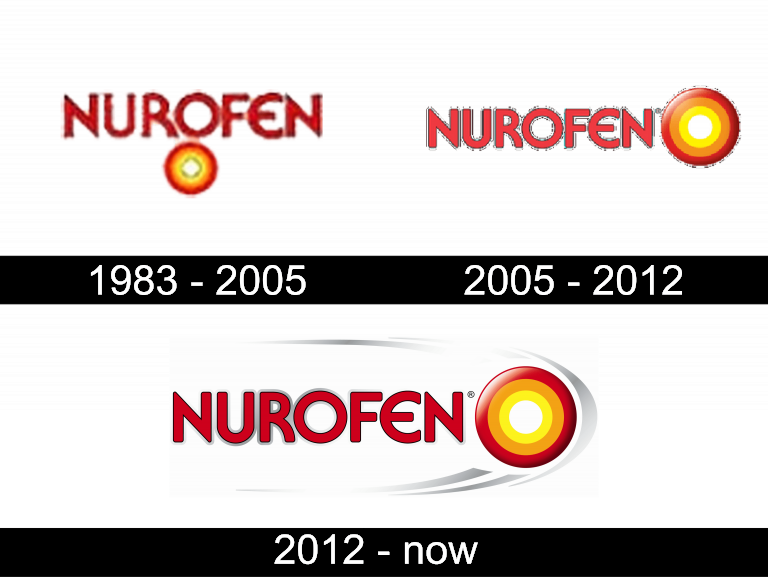
The original Nurofen logo introduced in 1983 established the visual DNA that still defines the brand today. The wordmark appeared in bold red uppercase letters with rounded, fluid contours. This softness helped humanize the brand while maintaining strong shelf visibility.
Beneath the wordmark sat a circular emblem composed of concentric layers in white, yellow, orange, and red. This multicolored ring hinted at pain radiating outward, while also suggesting warmth and intensity. Even in this early phase, the idea of pain as a localized target was visually implied, laying the groundwork for future symbolism.
This version accompanied Nurofen throughout its years under Boots, helping the medication gain strong recognition in the UK and other markets.
2005–2012: Ownership Transition and Visual Refinement.
Following the acquisition by Reckitt Benckiser in 2005, the logo underwent subtle but meaningful adjustments. The red of the wordmark became slightly paler and more controlled, aligning with broader consumer healthcare aesthetics.
The circular emblem was repositioned from beneath the wordmark to its right side, creating a more compact and modern composition. This shift improved adaptability across packaging formats and advertising materials, especially as Nurofen expanded internationally.
While the structure evolved, the core elements—rounded typography, red dominance, and circular symbolism—remained intact, preserving brand continuity.
2012–Today: Targeted Relief as Visual Language.
The modern Nurofen logo introduced in 2012 represents the most explicit expression of the brand’s promise. The wordmark remains bold and red, now placed on a light grey background that enhances contrast and legibility.
The circular emblem evolved into a clear target motif. Red and orange outer rings symbolize pain and inflammation, while a grey central pattern visually suggests penetration and neutralization. This graphic metaphor directly communicates fast, targeted relief, making the logo instantly understandable even without text.
This version of the logo became iconic across global markets, particularly in Europe, Australia, and North America, reinforcing Nurofen’s positioning as a specialist rather than a generic analgesic.
Logo Symbolism: Pain, Targeting, and Relief
Nurofen logo symbolism is unusually direct for a pharmaceutical brand. The circular target icon visually represents pain as something localized and treatable, reinforcing the idea that Nurofen works where it is needed most.
Red and orange are used deliberately to evoke pain, heat, and inflammation. These intense colors are not softened or hidden; instead, they are confronted head-on, reinforcing confidence in the product’s effectiveness. Grey plays an equally important role, symbolizing calm, control, and relief, visually interrupting the intensity of the pain colors.
The combination creates a narrative: pain exists, it is identified, and it is neutralized.
Typography and Color as Brand Signals
Typography defines the Nurofen logo description. The uppercase sans-serif wordmark features rounded contours that balance strength with approachability. While bold and assertive, the letterforms avoid sharp aggression, ensuring the brand feels supportive rather than harsh.
Color is the emotional engine of the identity. Red signals urgency, power, and effectiveness. Grey introduces medical credibility and calmness, while yellow and orange accents amplify the sensation of pain being addressed. Together, these colors allow Nurofen to stand out visually while remaining firmly anchored in healthcare branding conventions.
Nurofen Logo Heritage and Analgesic Authority
The Nurofen logo history demonstrates how pharmaceutical branding can evolve without losing its core message. By consistently reinforcing the concept of targeted pain relief, Nurofen built a logo heritage that is both functional and symbolic.
Within the broader field of analgesic logo heritage, Nurofen stands as a benchmark for clarity and impact. Its identity shows that when design aligns closely with product purpose, logos become more than identifiers—they become explanations. Readers interested in comparable branding strategies may also explore Advil logo history and Motrin logo heritage, where pain relief is similarly translated into visual language.
FAQ: Nurofen Logo Meaning and History
What does the Nurofen logo represent?
The logo represents fast, targeted pain relief, using a target-shaped symbol to visualize how the medication works.
Why is red used in the Nurofen logo?
Red symbolizes pain, inflammation, and urgency, reinforcing the effectiveness of the medication.
Has the Nurofen logo changed over time?
Yes. While the core elements remained consistent, the logo was refined in 2005 and significantly modernized in 2012.
Who owns the Nurofen brand today?
Nurofen is owned by Reckitt Benckiser, which acquired the brand in 2005.