
Nissan Logo History: Meaning, Symbolism & Brand Heritage
Few automotive brands have carried their national symbolism as proudly and consistently as Nissan. From its earliest decades in Japan to its global ascent as a leader in engineering and electric mobility, the company has relied on a visual identity rooted in heritage, resilience, and innovation. Across nearly a century of change, the Nissan logo has remained inseparable from the brand’s philosophy: a blend of Japanese tradition and forward-looking technology.
Founded in 1933, Nissan emerged in a rapidly modernizing Japan, a country redefining its industrial future. Over time, the company became one of the world’s major automotive players, marking technological milestones, expanding globally, and embracing electrification earlier than most competitors. Through all of this, its visual identity evolved in tandem with its values, gradually refining the emblem of the “rising sun” into one of the most recognizable marks in contemporary car culture.
The Meaning Behind the Name Nissan
The name “Nissan” carries a poetic weight rooted in the Japanese language. Derived from “ni” (sun) and “ssan” (birth/product), it can be interpreted as “product of the sun” or “the sun’s creation.” The symbolism reaches far beyond linguistics. It reflects Japan’s identity as The Land of the Rising Sun and communicates optimism, energy, and renewal — concepts that have shaped Nissan’s visual expression since its earliest logotype.
From the beginning, Nissan positioned itself as a brand committed not only to engineering excellence but also to aesthetic clarity. Its logos have consistently referenced the circular form of the sun, integrating geometry, color, and typography to express the company’s mission: bringing new ideas and technology to the world.
Nissan Logo Evolution Timeline
1933–1940: The Birth of the Rising Sun Emblem
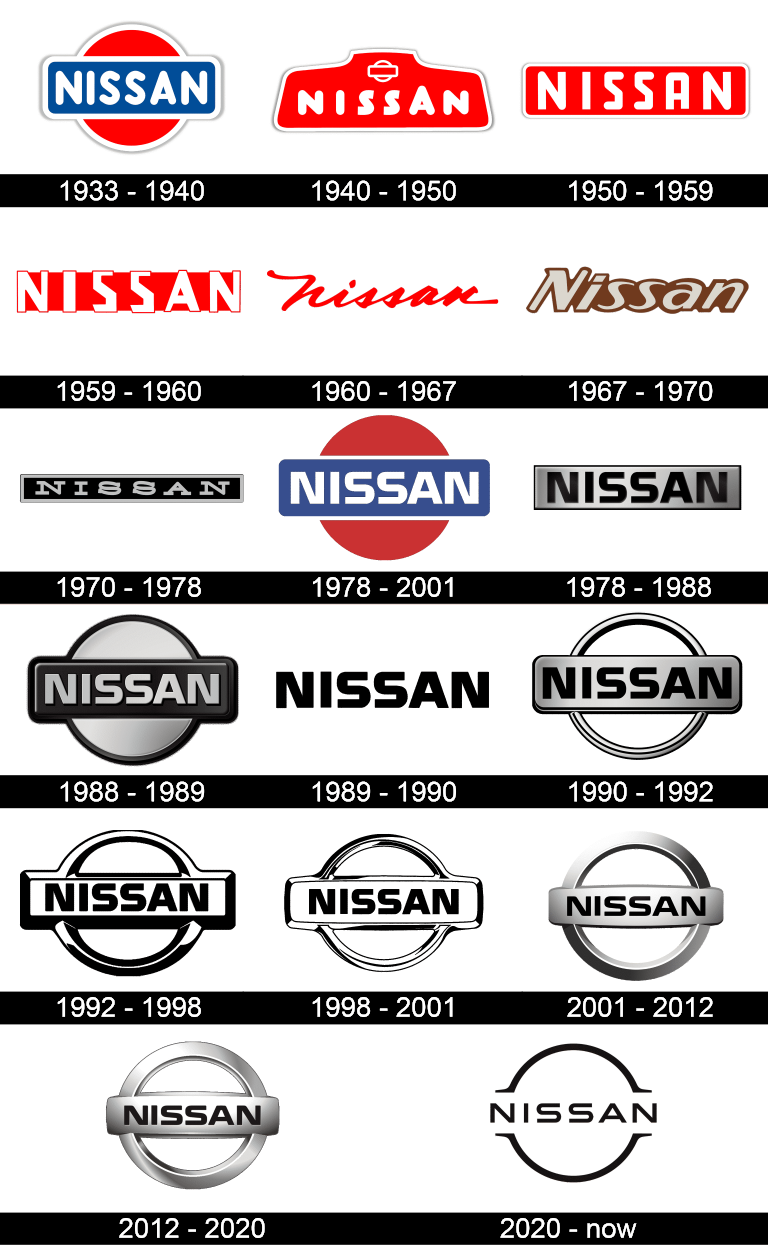
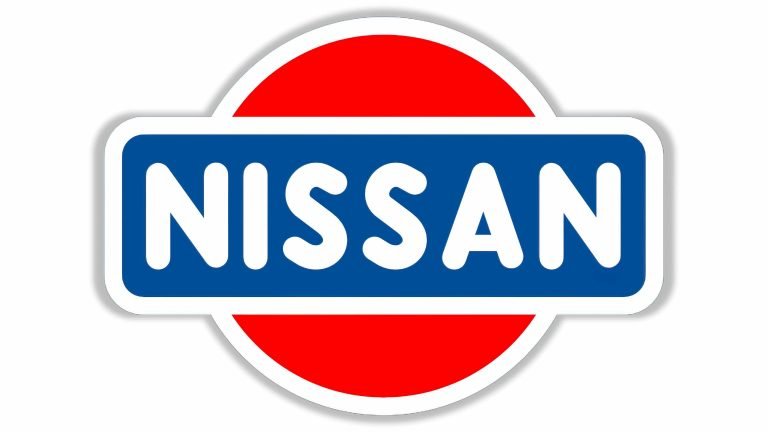
Nissan’s first logo immediately embraced national symbolism. A deep red circle — the rising sun — formed the backdrop for a horizontal blue rectangle carrying the company name in white, bold, rounded lettering. The softened outline and high-contrast palette made the emblem striking and modern for its time. Although used for only seven years, this original badge established the geometric blueprint that would influence every redesign to come.
1940–1950: A Geometric Experiment
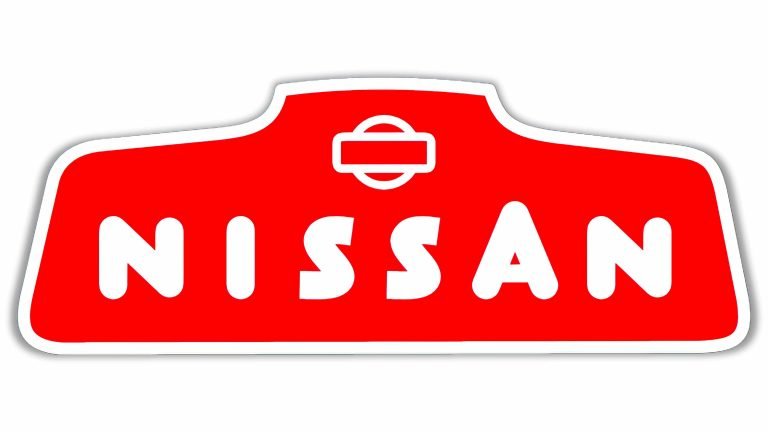
The 1940s brought a dramatic departure. Nissan introduced a six-angled shape with softened corners and two pointed peaks, conveying dynamism and modernity. The wordmark became handwritten and expressive, with a playful enlargement of the letter “A” and clipped serifs on the “S” characters. Above the inscription, a delicate rising sun returned in outline form. The palette remained patriotic: bold red framed in white.
1950–1959: Simplification and Confidence
In the early 1950s, Nissan shifted toward clarity and strength. The logo became a simple rounded rectangle with a firm, all-caps wordmark. Red and white remained the core colors, but the typography grew bolder, signaling the company’s increasing industrial power. The badge projected confidence and precision.
1959–1960: Sharper Forms, Stronger Identity
A refinement arrived in 1959. The rectangular form stayed, but the font became sharper and more angular. The frame disappeared, lending the design a more contemporary, minimalistic feel. This brief iteration reflected Nissan’s technological ambitions at the end of the decade.
1960–1967: A Cursive Expression of Motion
Nissan surprised the industry in 1960 with a sleek cursive logotype. Its extended initial and final strokes created a sense of movement and continuity. Rendered in vibrant red, it conveyed passion, innovation, and technological progress — values that would define the company’s product designs in the years ahead.
1967–1970: A Softened Transitional Phase
For a short time, Nissan experimented with a rounded italic typeface and a muted brown palette. Although visually appealing, the design lacked the assertiveness the company sought, and it remained an atypical, transitional moment in the brand’s identity.
1970–1978: The Return to Industrial Strength
Nissan returned to structure in the 1970s, reintroducing a rectangular frame and adopting a traditional serif typeface in bold uppercase letters. Clean lines and technical clarity defined this era, aligning the logo with Nissan’s increasingly engineering-driven image.
1978–1988: Heritage Reborn
Nissan embraced its origins once again with a design that reintroduced the circular sun motif paired with a horizontal banner. Rendered in metallic black and silver, the logo acquired a modern, industrial presence. The typeface became more geometric, reinforcing the brand’s movement toward technological sophistication.
1988–1989: A Bold Industrial Badge
A short-lived yet powerful redesign came in 1988, emphasizing solid geometry: a circular form and rectangular bar executed in matte silver and deep black. It embodied strength, confidence, and Japanese industrial precision.
1989–1990: The Minimalist Wordmark
In 1989, Nissan stripped its logo to the essentials: bold black uppercase letters on a white field. This stark typographic identity echoed corporate minimalism and reflected the company’s confidence in its global recognition.

1990–1992: A Return to the Emblem Structure
The emblematic circle-and-rectangle construction returned in 1990 with matte silver shapes outlined in black. The badge balanced modernity with heritage and signaled a visual consolidation for the brand.
1992–1998: Clean Geometry in Monochrome
In 1992, Nissan removed metallic shading and returned to a pure black-and-white palette. The simplified emblem looked professional, architectural, and globally contemporary.

1998–2001: Depth and Dimension
The 1998 badge introduced 3D shading and metallic textures. A three-dimensional silver ring and a black banner with embossed lettering created a bold, masculine aesthetic suitable for Nissan’s expanding international portfolio.

2001–2012: Precision and Modern Engineering
A refined matte-silver badge arrived in 2001. The typography became more futuristic, with streamlined shapes and extended curves on the “S” characters. The emblem projected calm precision and modern engineering.
2012–2020: Warm Metallic Modernity
The 2012 redesign softened the metallic finish with warm silver tones, smoothing gloss into a more understated matte finish. The banner subtly curved, adding a sense of refined volume and depth.
2020–Today: The Minimalist Digital Identity
Nissan’s 2020 logo marked a dramatic shift toward simplicity. The emblem was flattened into a two-dimensional black-on-white composition, reducing the ring to two open arcs framing the Nissan wordmark. The new design is sharp, digital-friendly, and elegant, preserving the circle-and-bar heritage in a form suited perfectly for electric vehicles, mobile interfaces and modern brand applications.
The Emblem: A Tribute to the Rising Sun
Nissan’s emblem originates from its sister brand Datsun, which used the red sun as a nod to Japan’s national flag. The circle symbolized precision, energy and national pride. The rectangular bar conveyed structure, forward motion and technological purpose. Together, they formed a powerful fusion of heritage and industrial ambition — an identity Nissan has preserved through nearly a century of refinements.
Typography and the 2020 Nissan Font
The current Nissan logotype, introduced in 2020, is a custom uppercase sans-serif designed around the brand’s core principle: shisei tenjitsu o tsuranuku, translated as “perceiving the truth of things.” The letterforms are open, balanced and futuristic, echoing the brand’s commitment to precision, EV technology, and refined minimalism.
Though proprietary, the typeface resembles Ultra System Sans, Metaluna Bold and Distancia Bold, but with custom modifications that create cleaner angles, more symmetrical curves and a geometric rhythm aligned to Nissan’s new design language.
What the Nissan Logo Represents
The Nissan emblem is a visual tribute to Japan’s identity as the Land of the Rising Sun. The circular sun symbol expresses optimism, renewal and origin. The rectangular bar signifies motion, continuity and engineering discipline. When combined with Nissan’s commitment to innovation, the symbol becomes a representation of energy and forward momentum — a design perfectly aligned with the brand’s accelerating transition into electric mobility.
The 2020 redesign emphasized openness and minimalism, reflecting Nissan’s goal to merge digital clarity with traditional heritage and prepare the identity for decades of technological evolution.
A Legacy Illuminated by the Rising Sun
The story of Nissan’s logo is inseparable from the story of Nissan itself. From its early geometric experiments to its gleaming metallic badges and its current minimalist mark, every iteration reflects the brand’s balance of heritage and innovation. The rising sun remains a constant reminder of the company’s origins, while the evolving forms reveal a manufacturer unafraid to embrace change. Today’s emblem — clean, digital, confident — continues the visual legacy of a brand that has shaped global automotive culture for nearly a century.
FAQ Nissan logo
What does the Nissan logo symbolize?
It symbolizes Japan’s rising sun, representing energy, origin and renewal, combined with a bar that signifies motion and engineering structure.
Why did Nissan change its logo in 2020?
To align the brand with digital interfaces, electric vehicles and a modern minimalist aesthetic while preserving its historical emblem structure.
What is the meaning of the name Nissan?
“Nissan” means “sun product” or “birth of the sun,” a reference to the company’s Japanese origins and its connection to the rising sun symbol.
What font does Nissan use?
The 2020 wordmark uses a custom minimalistic sans-serif typeface influenced by geometric precision and Nissan’s design philosophy.