
Nirvana Logo History: Meaning, Symbolism & Brand Heritage
Few bands have altered the course of popular music as decisively as Nirvana. Emerging from the underground music scene of the Pacific Northwest, the band reshaped the sound and attitude of an entire generation. Nirvana did not merely popularize grunge; it disrupted the polished aesthetics of late-1980s rock culture, replacing excess with raw emotion and authenticity.
This philosophy extended beyond music into visual identity. The Nirvana logo never aimed for perfection or corporate refinement. Instead, it embraced imperfection, irony, and ambiguity. Much like the stripped-down authority behind the Ramones logo history or the anti-commercial stance reflected in the Sex Pistols logo heritage, Nirvana’s visual language rejected polish in favor of immediacy. The Nirvana logo heritage stands as a visual reflection of a band that refused to conform to established industry norms.
Meaning and History: The Origin of the Nirvana Identity
Nirvana was formed in the late 1980s in Seattle by Kurt Cobain and Krist Novoselic. The two musicians had known each other since school, though their collaboration only took shape years later through shared exposure to the local underground music scene, particularly the band Melvins.
After several lineup changes and early recordings, Nirvana released its debut single “Love Buzz” in 1988, followed by the album Bleach. While the band initially operated on the fringes of mainstream music, everything changed in 1991 with the release of Nevermind. The album’s success catapulted Nirvana into global consciousness and permanently altered the music industry’s relationship with alternative rock.
The band name “Nirvana” was chosen by Cobain, who favored words that sounded peaceful and transcendent, contrasting sharply with the aggression of the music. This tension between serenity and chaos would later become central to the band’s visual identity and logo meaning.
Nirvana Logo History Timeline
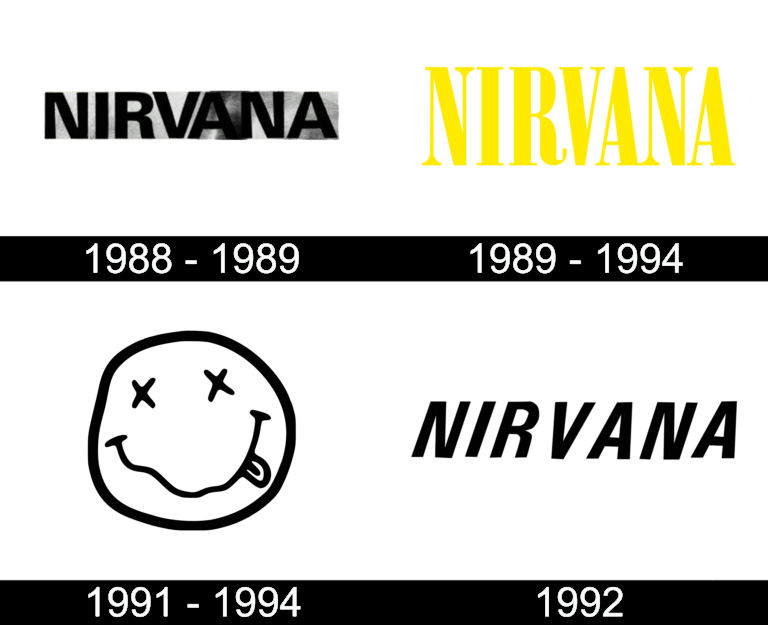
1988 – 1989: Early Simplicity
The earliest Nirvana logo consisted of a stark, uppercase sans-serif wordmark rendered in black. The letterforms were heavy, geometric, and restrained, conveying seriousness and stability. This version reflected the band’s early period, before widespread recognition and commercial pressure.

1989 – 1994: Yellow Wordmark Era
In 1989, Nirvana introduced a more distinctive logo featuring an uppercase serif wordmark in bright yellow. The typeface was narrow, with elegant curves and confident proportions. Set against a white background, the logo conveyed energy and visibility, standing out sharply from the darker visual aesthetics of many contemporaries.
The yellow-and-black color scheme became closely associated with the band during this period, reinforcing memorability and contrast.

1991 – 1994: The Smiley Face Icon
In 1991, the most iconic element of Nirvana’s visual identity appeared: the now-famous Smiley Face emblem. Introduced on promotional materials for Nevermind, the graphic depicted a distorted smile with crossed-out eyes, rendered in simple black lines.
The emblem was placed beneath the wordmark and quickly became inseparable from the band’s identity. Its rough execution and ambiguous expression captured the irony, detachment, and emotional dissonance that defined Nirvana’s music. From that point forward, the wordmark and Smiley Face functioned together as the band’s definitive logo system.

1992: Italicized Experimentation
In 1992, an alternate logo appeared featuring italicized uppercase sans-serif lettering. The slanted characters introduced a sense of motion and urgency, while retaining the stark simplicity of earlier designs. Though short-lived, this variation reflected the band’s resistance to fixed branding.

Logo Symbolism: Ambiguity as Identity
The meaning of the Nirvana logo has never been officially defined, and that ambiguity is central to its power. Numerous interpretations of the Smiley Face have emerged over time, ranging from references to Seattle strip clubs to parodies of mainstream rock imagery.
Some believe the face represents the expression of fans during performances, while others see it as commentary on excess, intoxication, or disillusionment. There are also theories linking the symbol to underground graffiti or acid house culture. Each interpretation adds another layer to the logo symbolism, reinforcing its openness rather than diminishing it.
This refusal to clarify meaning aligns perfectly with Nirvana’s ethos. The logo does not instruct the viewer; it invites interpretation.
Typography and Color Palette
The Nirvana wordmark is set in the Onyx typeface, a condensed serif font with strong vertical emphasis. The choice of type was reportedly pragmatic rather than conceptual, yet it became iconic through repetition and association.
Color plays an equally important role. The contrast between yellow and black creates immediate visual impact, conveying energy and tension. Yellow suggests intensity and attention, while black anchors the composition with gravity and seriousness.
Together, typography and color form a visual system that feels urgent, raw, and unmistakably Nirvana.
Nirvana Logo Heritage and Cultural Legacy
The Nirvana logo heritage transcends music branding. Long after the band’s dissolution, the Smiley Face remains one of the most recognizable symbols in popular culture, appearing on clothing, posters, and contemporary art.
This endurance mirrors patterns seen across alternative music logo history, where authenticity and emotional resonance outweigh formal design discipline. Nirvana’s logo did not age because it was never designed to follow trends. It remains relevant precisely because it captured a cultural moment without trying to define it.
For readers interested in how anti-establishment identities become timeless, further insight can be found within the rock band logo heritage archive and the broader collection of music culture branding history.
FAQ: Nirvana Logo Meaning and History
Who created the Nirvana logo?
The logo is often attributed to Kurt Cobain, though Lisa Orth, art director at Sub Pop Records, played a key role in shaping the band’s early visual identity.
What does the Nirvana Smiley Face represent?
There is no official explanation. The symbol is intentionally ambiguous and has been interpreted in many ways.
Why is the Nirvana logo yellow and black?
The high-contrast color scheme creates strong visual impact and reflects the band’s intense, confrontational aesthetic.
When was the Nirvana Smiley Face introduced?
The Smiley Face emblem first appeared in 1991 on promotional materials for the album Nevermind.