New Orleans Pelicans Logo History: Meaning, Symbolism & Brand Heritage
The New Orleans Pelicans logo history reflects the identity of one of the NBA’s youngest franchises, a team still shaping its long-term legacy while remaining deeply tied to regional culture. Established in 2002, the franchise has experienced multiple identity phases in a relatively short span of time, first as the New Orleans Hornets and later as the Pelicans. This compressed timeline makes the evolution of its visual identity especially revealing, as each redesign closely mirrors moments of transition, ambition, and repositioning.
Unlike legacy franchises whose logos evolved over decades, the Pelicans were forced to define themselves quickly. Their visual language shifted from inherited symbolism to something distinctly local, a move similar to what can be observed in the Charlotte Hornets logo history, where relocation and naming rights played a decisive role, and the Memphis Grizzlies logo history, another young franchise that built strong identity through regional symbolism. Within the broader NBA logo history category, the Pelicans stand out for how deliberately their logo heritage was constructed rather than inherited.
Meaning and History: The Origin of the Pelicans Identity
The franchise’s roots trace back to the Charlotte Hornets, who relocated to New Orleans in 2002. For over a decade, the team retained the Hornets name, effectively borrowing an identity that was never fully aligned with the city. While competitive moments emerged during this period, the brand lacked a sense of cultural ownership.
That changed in 2013, when the organization adopted the New Orleans Pelicans name. The pelican is a state symbol of Louisiana, deeply embedded in local iconography and civic identity. By choosing it as the core emblem, the franchise made a clear statement: this was no longer a transplanted team, but one grounded in place. The logo meaning shifted decisively from generic NBA branding to regional representation, a pattern often seen in basketball logo heritage when franchises seek deeper emotional connection with their fan base.
New Orleans Pelicans Logo History Timeline

2002–2008: Inherited Identity and Hornets Symbolism
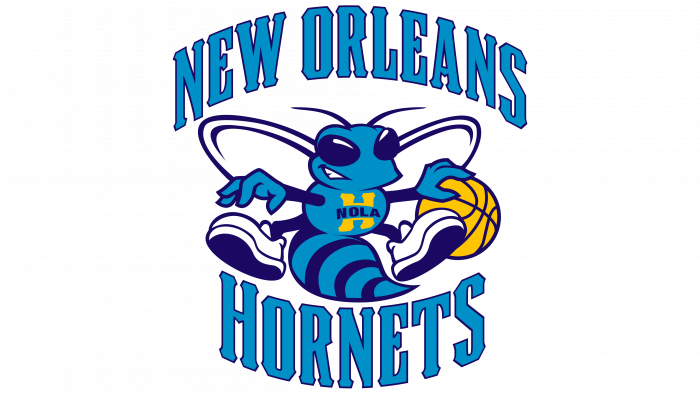
The original logo introduced in 2002 belonged to the New Orleans Hornets era. A cartoon-style hornet, rendered in light and dark blue tones, occupied the center of the badge. The insect was positioned between two parts of a bold, uppercase sans-serif wordmark. This design leaned heavily on energy and motion, but it reflected Charlotte’s legacy more than New Orleans’ character, reinforcing the sense of a temporary visual identity.

2008–2013: Sharpened Aesthetics and Transitional Refinement
The 2008 redesign retained the hornet concept while modernizing its execution. Typography became sharper and more angular, adopting a slightly gothic tone, while the hornet illustration gained definition and attitude. The color palette deepened into darker blues, increasing contrast and seriousness. Though visually improved, the logo still represented a transitional phase rather than a true expression of local identity.
2013–2023: Birth of the Pelicans and Regional Symbolism
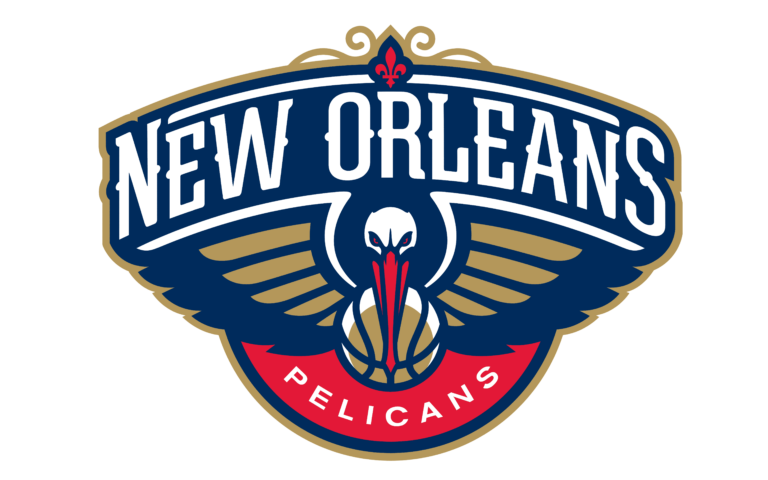
The 2013 rebrand marked a defining moment in Pelicans logo history. The hornet was replaced by a stylized pelican holding a basketball in its beak, set within a dark blue crest. Gold and red accents added authority and warmth, while arched typography framed the emblem above and below. This logo established the foundation of New Orleans Pelicans logo heritage, embedding state symbolism and civic pride into the franchise’s visual identity.
2023–Today: Digital Simplification and Modern Clarity
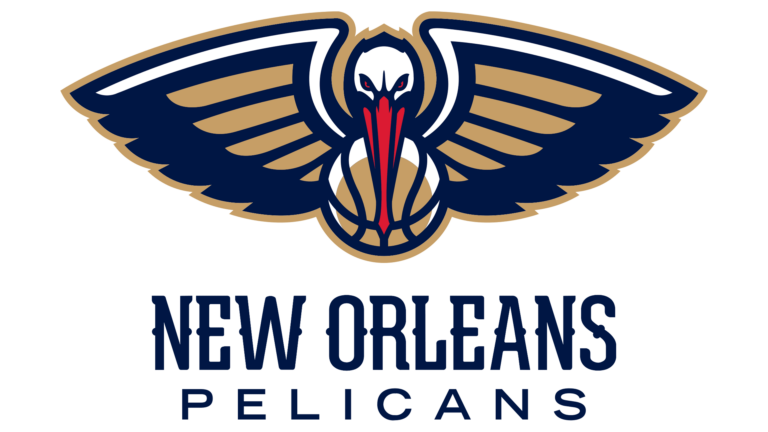
The 2023 update refined the Pelicans logo for digital-first environments. The crest was removed, leaving the pelican emblem placed directly on a transparent background. Clean blue typography now sits beneath the symbol without framing elements. This redesign improved scalability and versatility while preserving the core imagery introduced a decade earlier, signaling maturity rather than reinvention.
Logo Symbolism: Identity, Protection, and Place
The New Orleans Pelicans logo symbolism is rooted in guardianship and resilience. The pelican, traditionally associated with protection and sacrifice, reflects both Louisiana heritage and the team’s aspirational role within the city. The basketball held in the beak grounds the symbol firmly in sport, while the bird’s posture conveys vigilance rather than aggression.
Color plays a crucial symbolic role. Navy blue communicates stability and seriousness, gold introduces tradition and value, and red adds intensity and emotional energy. Together, these elements create a balanced visual system that feels civic rather than commercial, aligning the franchise more closely with the city it represents.
A Young Logo Heritage with Strong Foundations
The New Orleans Pelicans logo history may be short, but it is remarkably intentional. Rather than relying on frequent experimentation, the franchise made a decisive break from its inherited past and committed to a symbol rooted in place and meaning. This clarity has allowed the Pelicans logo heritage to develop coherence quickly, something many young franchises struggle to achieve.
Within NBA logo history, the Pelicans illustrate how thoughtful symbolism can accelerate brand maturity. As the team continues to define itself competitively, its visual identity already stands as a confident declaration of belonging, culture, and long-term ambition.
FAQ: New Orleans Pelicans Logo Meaning and History
What does the New Orleans Pelicans logo represent?
The logo represents Louisiana heritage, protection, and resilience, symbolized by the pelican holding a basketball.
Why did the team change from Hornets to Pelicans?
The change allowed the franchise to adopt a name and identity rooted in local culture rather than inherited branding.
When was the current Pelicans logo introduced?
The current simplified version was introduced in 2023.
How many major logos have the franchise used?
The franchise has used two primary identity systems: the Hornets era logos and the Pelicans era logos.