New Balance Logo History: Meaning, Symbolism & Brand Heritage
Few athletic brands can claim the kind of cultural longevity and credibility that New Balance has earned over more than a century. While many sportswear companies chase trends, New Balance has always followed a quieter, more deliberate path—one rooted in function, balance, and uncompromising quality. This philosophy is visible not only in its footwear but also in its visual identity, where the logo has evolved carefully, never abandoning its original purpose or symbolism.
From orthopedic insoles inspired by the anatomy of a chicken’s foot to some of the most iconic running shoes ever produced, New Balance represents a rare fusion of engineering precision and understated design. Its logo, instantly recognizable on running tracks, city streets, and premium sneakers alike, is a reflection of this identity: fast, stable, and timeless.
Origins of New Balance: Function Before Fashion
The story of New Balance begins in Boston in 1906, when British immigrant William J. Riley founded the New Balance Arch Support Company. According to one of the most enduring legends in brand history, Riley’s inspiration came from observing chickens in his backyard. He noticed how their three-point foot structure provided exceptional balance and stability. This simple observation led him to develop orthopedic arch supports designed to improve posture and comfort.
For decades, New Balance focused almost exclusively on insoles and orthopedic solutions. Shoes came later, and only when the company felt it could improve performance rather than merely follow existing designs. In 1938, New Balance produced its first athletic shoes—custom-made baseball cleats for the Boston Brown Bag Harriers. This moment marked the beginning of a transition from medical footwear to performance athletics.
The real turning point arrived in the late 1950s and early 1960s, when running surged in popularity. New Balance introduced the Trackster, the first running shoe available in multiple widths. This innovation alone set the brand apart, reinforcing a core belief that performance begins with fit, not marketing.
The Philosophy Behind the New Balance Logo
Unlike many athletic brands that rely on abstract symbols or aggressive imagery, New Balance chose clarity and motion. The logo was never meant to dominate—it was designed to support the product, much like the shoes support the runner.
The visual identity reflects speed, balance, and technical precision. Its structure has remained remarkably consistent for over five decades, evolving only through refinement rather than reinvention. This continuity has helped establish New Balance as a brand associated with trust, durability, and authenticity.
New Balance Logo History and Evolution Timeline
1972–2006: The Birth of an Icon
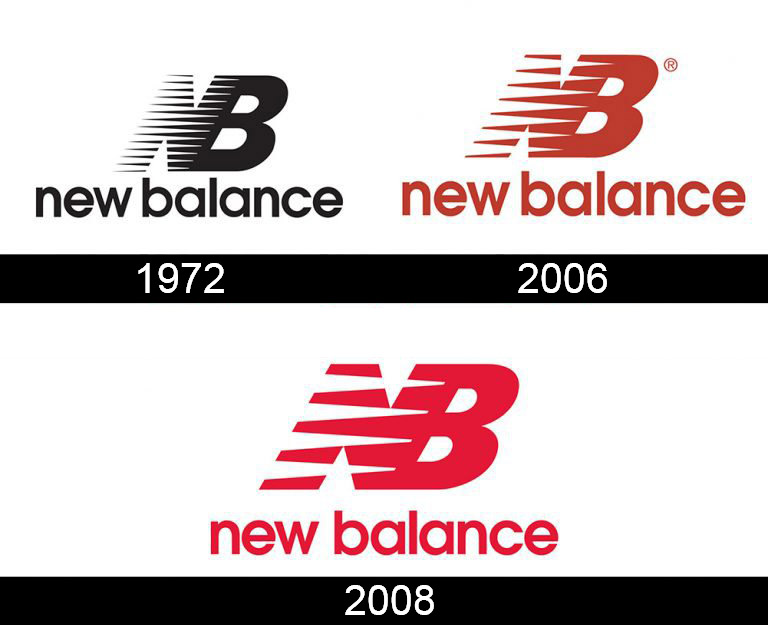
Although New Balance had existed for more than sixty years, it was not until 1972 that the brand introduced its first truly distinctive logo. Designed by legendary American graphic designer Terry Heckler, the emblem combined the capital letters “N” and “B” into a bold, unified mark.
What set this logo apart were the horizontal speed lines slicing through the letter “N.” Originally twelve in number, these lines conveyed motion, energy, and athletic performance. The emblem felt fast without being aggressive, technical without being cold. Beneath the symbol, the full “New Balance” wordmark appeared, grounding the dynamic mark with clarity and confidence.
This version of the logo coincided with the brand’s rapid ascent in the running world and remained largely unchanged for more than three decades, becoming synonymous with quality athletic footwear.
2006–2008: Refinement and Color Introduction
In 2006, New Balance introduced a refined version of its iconic logo. The most noticeable change was the reduction of the speed lines from twelve to seven, creating a cleaner, more contemporary look.
Color also became a more prominent feature. The emblem adopted a bold red “NB,” paired with a black “New Balance” wordmark. This update preserved the brand’s identity while making it more visually striking in retail environments and global marketing campaigns.
2008–Today: Modern Minimalism with Heritage Intact
Two years later, the logo underwent another subtle evolution. The number of speed lines was reduced once more, this time to five. This version remains the primary New Balance logo today.
The streamlined design improved legibility at smaller sizes and enhanced versatility across digital platforms, footwear, and apparel. While the emblem is often accompanied by the full wordmark, New Balance frequently uses the standalone “NB” symbol—a testament to its strong brand recognition.
Despite these refinements, the core concept introduced in 1972 remains untouched. The logo still communicates speed, balance, and performance, just as it did half a century ago.
The Designer Behind the Logo
The original New Balance logo was created by Terry Heckler, one of the most influential commercial designers of the 20th century. His portfolio includes iconic identities for brands such as Starbucks, Cinnabon, Panera Bread, and K2. Heckler’s ability to create symbols that balance clarity with emotion is evident in the New Balance logo, which remains one of the most enduring marks in athletic branding.
Typography and Visual Structure
The New Balance wordmark is set in a typeface closely resembling ITC Avant Garde Gothic Demi Bold, a geometric sans-serif designed by Herb Lubalin. The font’s clean lines and strong structure complement the logo’s technical and performance-oriented character.
The slightly extended letterforms enhance stability, while the bold weight reinforces durability—qualities deeply embedded in the brand’s DNA.
Color Palette and Brand Meaning
Throughout its logo history, New Balance has relied on a restrained color palette of red, black, and white. Black and white emphasize clarity, precision, and neutrality, while red introduces energy, motion, and competitive spirit.
This limited palette reflects the brand’s philosophy: performance over excess, function over decoration. Even as fashion trends evolve, New Balance’s visual identity remains grounded and purposeful.
The Meaning of the New Balance Logo
At its core, the New Balance logo is a visual metaphor for motion and stability. The speed lines represent forward momentum, while the solid letterforms symbolize balance and support. Together, they mirror the brand’s original mission: helping people move better, more comfortably, and more efficiently.
It is a logo that does not shout, yet commands respect—much like the brand itself.
Frequently Asked Questions About the New Balance Logo
Who designed the New Balance logo?
The original New Balance logo was designed in 1972 by American graphic designer Terry Heckler, who also created iconic identities for Starbucks and Cinnabon.
Has the New Balance logo changed over time?
Yes, but only through subtle refinements. The core structure introduced in 1972 has remained intact, with changes mainly involving the number of speed lines and color usage.
What do the speed lines in the logo represent?
The speed lines symbolize motion, performance, and athletic momentum, reinforcing New Balance’s focus on running and functional footwear.
Is New Balance owned by another sportswear company?
No. New Balance is privately owned and operates independently. It is not owned by Adidas, Nike, or any other major sportswear corporation.
Why is the New Balance logo considered timeless?
Its strength lies in simplicity and purpose. By avoiding trends and focusing on performance symbolism, the logo has remained relevant for more than five decades.