
Mitsubishi Logo History: Meaning, Symbolism & Brand Heritage
Few corporate emblems in the world combine heritage, symbolism, and industrial ambition as elegantly as the Mitsubishi logo. The three-diamond mark—minimalist, geometric, instantly recognizable—has endured for a century and a half as a symbol of Japanese precision and global engineering excellence. Behind its polished surfaces lies a story that begins in the 1870s with one visionary entrepreneur, two feudal family crests, and a name that carries both poetry and power.
Mitsubishi’s origins trace back to Yataro Iwasaki, a man who began as a shipping entrepreneur long before the company became one of the world’s most respected automotive and industrial groups. Today, Mitsubishi is part of the Renault–Nissan–Mitsubishi Alliance and operates across continents, but its emblem still communicates the same values it did in the early Meiji era: reliability, progress, integrity, and craftsmanship.
Meaning & Symbolism: The Origin of the Three Diamonds
The Mitsubishi name is a union of two Japanese words. “Mitsu” means “three,” and “hishi” refers to the water chestnut, a diamond-shaped leaf commonly used in heraldry. Together they form “Mitsuhishi,” or “three diamonds,” later refined into the pronunciation “Mitsubishi.” Unlike Western brands that often reverse-engineer symbolism into their marks, Mitsubishi built its identity around a name with a clear visual echo.
The emblem merges two historical crests. The Iwasaki family used a rhombus-based insignia, while the Tosa Clan—early patrons of Yataro Iwasaki—employed a crest of three oak leaves arranged in a triangular form. Overlaid, simplified, and distilled, these two symbols created a timeless geometric icon whose clarity lends itself to engineering, technology, and design.
Each diamond carries its own unspoken meaning, traditionally interpreted as “reliability,” “success,” and “integrity,” the three pillars that shaped Mitsubishi’s business philosophy. The red used in the emblem amplifies these qualities. In Japanese culture, red evokes strength, courage, and good fortune, while also alluding to the rising sun—an unmistakable reference to national identity and industrial pride.
Logo History and Evolution Timeline
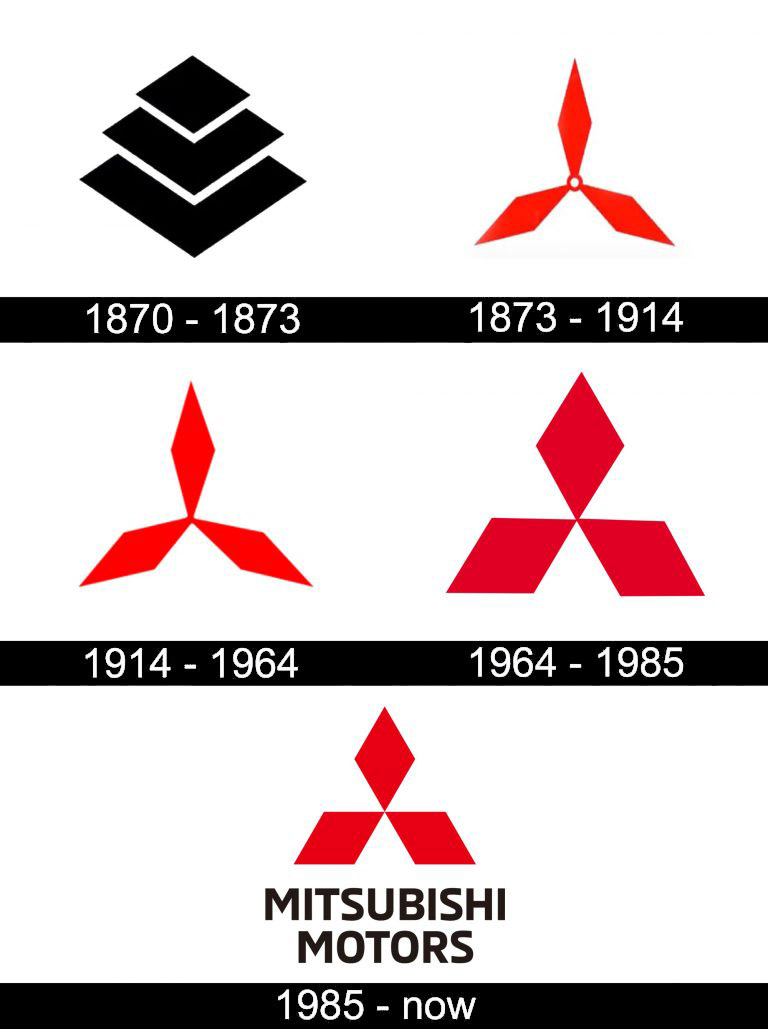
1870–1873: The Age of the Crests
During Mitsubishi’s earliest years, the young company used both the Iwasaki family crest and the crest of the Tosa Clan. These symbols appeared without any formal branding or lettering, functioning as signs of lineage rather than logo design. It was a period when Mitsubishi was less a corporation and more a merchant house built on loyalty and heritage.

1873–1914: The Birth of the Triple Diamond
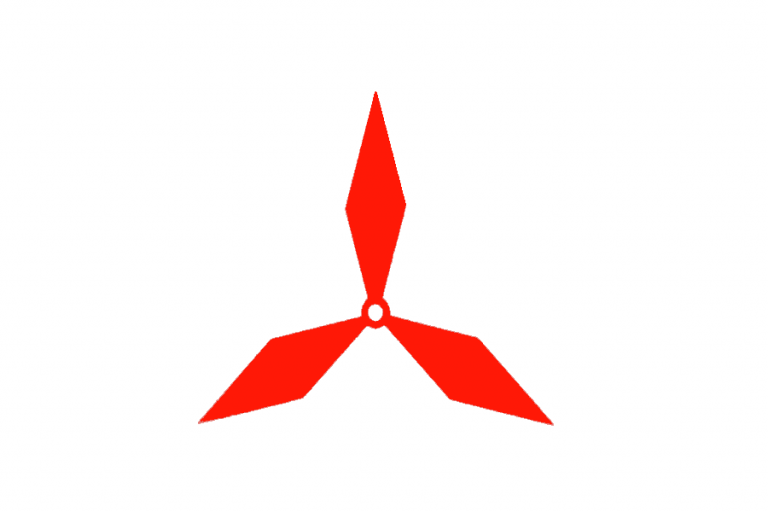
In 1873, the three-diamond emblem appeared for the first time. Thin rhomboids radiated outward from a small connecting circle, forming a delicate geometric mark whose structure already closely resembles the modern Mitsubishi logo. The design communicated refinement and quiet confidence, a perfect reflection of a young but rapidly modernizing company.
1914–1964: Strengthening the Symbol
The central circle was replaced with a solid dot in 1914, a seemingly subtle shift that nonetheless strengthened the emblem’s visual weight. Over time, Japanese lettering was added in a Mitarashi-ryu script, and the early red-and-black palette began appearing across documents, signage, and machinery. It was during this era that Mitsubishi fully embraced modern branding principles, pairing the emblem with identity, philosophy, and messaging.

1964–1985: Refinement and Modern Balance
In 1964, the emblem was redrawn with bolder geometry and precise proportions. The diamonds grew at once heavier and more aerodynamic, bringing the emblem closer to its present form. Mitsubishi also introduced a Japanese motto above the mark—“with you today and tomorrow”—reflecting a brand that was steadily becoming international but still deeply rooted in Japanese values.

1985–Today: The Global Mitsubishi Identity
The wordmark “MITSUBISHI” first appeared below the emblem in 1985, using a bold all-caps sans-serif with sharply cut lines and confident spacing. It marked the transition from a domestic industrial brand to a global automotive powerhouse. Later, “Motors” was added for the automotive division, and the red symbol paired with black lettering became a universal signature across dealerships, vehicles, and corporate materials. Yet despite this evolution, the emblem itself has remained nearly unchanged for over a century, a testament to the power of its original design.
Font & Typography
The Mitsubishi logotype uses a strong, stable sans-serif typeface, built on wide, confident proportions and extended forms that convey precision and authority. It resembles families such as Neo Sans Std Bold or ED Northridge Sans Extra Bold, with slight refinements that make the lettering feel both global and unmistakably industrial. The type is purposeful, modern, and engineered with the same clarity that characterizes the emblem above it.
Color Palette
The brand’s enduring palette is led by an uncompromising scarlet red. It is energetic, commanding, and deeply symbolic in Japanese culture, associated with vitality, forward motion, and the rising sun. When paired with black lettering, the contrast becomes striking and authoritative—perfect for a company whose identity is built on engineering discipline and industrial strength.
The Timeless Power of Three Diamonds
The Mitsubishi logo is more than an icon; it is a compressed history of family tradition, cultural symbolism, industrial ambition, and design clarity. Few global brands preserve such a long and unbroken lineage of visual identity. The three diamonds have weathered Japan’s modernization, industrialization, global expansion, and technological shifts without losing their meaning or form.
What remains today is a symbol that speaks with remarkable simplicity. It stands for reliability, integrity, and innovation—the same values Yataro Iwasaki embedded into Mitsubishi over 150 years ago. The emblem’s elegance lies in its geometry, but its longevity lies in its story.
Mitsubishi Logo FAQs: History, Meaning & Symbolism of the Three Diamonds
What does the Mitsubishi logo represent?
The logo represents the meaning of the name “Mitsubishi”—“three diamonds.” It also merges the crests of the Iwasaki family and the Tosa Clan, forming an emblem that symbolizes heritage, reliability, integrity, and success.
Why is the Mitsubishi logo red?
Red is a powerful color in Japanese culture, linked to the rising sun, good fortune, confidence, energy, and strength. It reinforces the brand’s national identity and industrial spirit.
Who designed the Mitsubishi emblem?
The original three-diamond configuration was created in the early 1870s based on the crests of Yataro Iwasaki’s family and his first employers, the Tosa Clan.
Has the Mitsubishi logo changed much over the years?
The emblem itself has changed very little since the 19th century. Modern adjustments have refined its proportions, but its core form remains virtually identical to the original.