Minolta Logo History: Meaning, Symbolism & Brand Heritage

For much of the 20th century, Minolta stood at the forefront of photographic innovation. From pioneering early 35 mm cameras to introducing the first autofocus system in a 35 mm SLR, Minolta helped define how the modern world captures images. While the brand later merged with Konica to form Konica Minolta, the Minolta name and logo remain deeply respected symbols of Japanese precision, optical excellence, and technological ambition.
The evolution of the Minolta logo closely mirrors the company’s transformation—from a small photography shop with German influence to a globally recognized imaging powerhouse. Its logo heritage is rooted in clarity, science, and a forward-looking worldview.
Meaning and History: The Origin of the Minolta Brand
Minolta’s story begins in 1928, when Kazuo Tashima founded a company in Osaka under the name Nichi-Doku Shashinki Shoten, meaning Japanese-German Photography Shop. The name reflected early cooperation with German optical engineers, whose expertise heavily influenced Minolta’s technical foundations.
In 1929, the company produced its first camera, the Nifcarette. The name combined abbreviations referencing Japan and Germany with a suffix inspired by popular German camera models of the era. As the company matured and its ambitions grew, it adopted the name Minolta—a word often interpreted as combining Mechanism, Instruments, Optics, and Lenses by Tashima.
For decades, Minolta became synonymous with innovation, especially in optics and camera automation. In 2003, facing increasing competition in the digital era, Minolta merged with Konica, forming Konica Minolta. While the Minolta brand name was phased out commercially, its visual and technological legacy endures.
Minolta Logo History Timeline
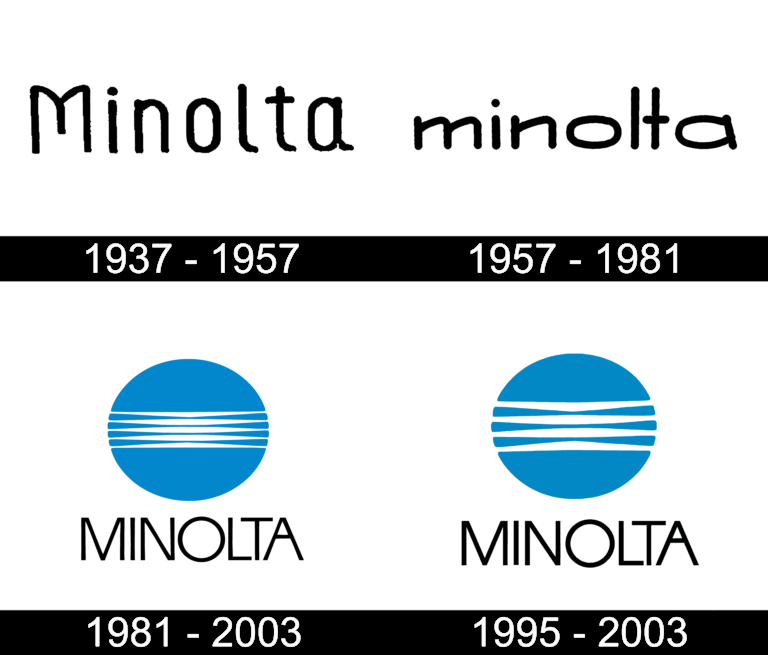
1937–1957: Handcrafted Beginnings
The first recognizable Minolta logo appeared in 1937. It was a simple black wordmark featuring the brand name in a blocky yet handwritten style. The “M” was capitalized, while the remaining letters were lowercase, creating a balance between authority and approachability.
This logo reflected Minolta’s early identity: a technically skilled but still human-scale manufacturer, grounded in craftsmanship rather than mass production.

1957–1981: Functional Modernism
In 1957, the logo was refined into a more minimalist wordmark. The lettering became cleaner and more uniform, losing the handwritten feel of the earlier version. Notably, the “M” was now lowercase, and rounded letter endings were removed.
This redesign aligned with post-war industrial modernism and Minolta’s growing reputation as a serious, engineering-driven company. The logo communicated efficiency, reliability, and technical competence.
1981–2003: The Blue Globe Emerges
A major shift occurred in 1981, when Minolta introduced its most iconic visual element: the blue circle. Positioned above the wordmark, the circle immediately distinguished the brand in a crowded global market.
The typography beneath the symbol was modernized, becoming more geometric and precise. This period coincided with Minolta’s rise as a global leader in camera technology, including its groundbreaking autofocus systems.

1995–2003: Symbolism and Global Vision
In the final stage of Minolta’s independent identity, the logo’s meaning was formally articulated. The blue circle was explicitly defined as a globe, symbolizing Minolta’s worldwide presence and limitless expansion.
Five white lines crossing the globe represented beams of light—an elegant metaphor for imaging, optics, and technological expertise. The wordmark, rendered in black using a custom sans-serif typeface, emphasized precision, quality, and professionalism.
The blue used in the emblem later became known as Konica Minolta Blue, reinforcing continuity after the merger.
Logo Symbolism: Light, Earth, and Innovation
The symbolism of the Minolta logo is deeply tied to photography itself. The globe represents universality and global reach, while the light beams reference the fundamental principle of image creation.
Unlike logos built on mascots or decorative motifs, Minolta’s emblem is conceptual and scientific. It communicates ideas rather than emotions—innovation, accuracy, and technological leadership—qualities essential to professional imaging equipment.
Typography and Color in the Minolta Logo
Minolta’s typography evolved toward clarity and neutrality. The final wordmark used a clean sans-serif typeface with balanced proportions and medium-weight strokes, avoiding ornamentation.
The color palette was equally deliberate. Blue conveyed intelligence, innovation, and trust; white symbolized clarity and light; black added authority and contrast. Together, these colors created a visual system that felt both advanced and dependable.
Minolta Logo Heritage and Technological Legacy
Minolta’s logo heritage reflects a rare balance between consistency and progress. While its early logos were modest and typographic, later designs embraced symbolism without sacrificing restraint.
Even after the Minolta name disappeared from consumer cameras, its visual language lived on through Konica Minolta. The globe motif, blue palette, and emphasis on light continue to influence the group’s corporate identity, ensuring that Minolta’s legacy remains visible in the digital age.
Minolta Logo Meaning and Evolution: Conclusion on Brand Heritage
The Minolta logo history tells the story of a brand that evolved alongside photography itself. From handcrafted beginnings to global technological leadership, its logos chart a clear path toward abstraction, science, and universality.
Its meaning—precision guided by innovation—never changed, only its expression did. As a result, Minolta stands as a powerful example of logo heritage shaped not by marketing trends, but by genuine technological progress.
FAQ: Minolta Logo Meaning, Symbolism, and History
What does the Minolta logo represent?
It represents global reach, optical science, and innovation through light-based symbolism.
Who founded Minolta?
Minolta was founded in 1928 by Kazuo Tashima.
Why does the Minolta logo feature a globe?
The globe symbolizes worldwide expansion and universal technological value.
What do the five lines in the Minolta logo mean?
They represent beams of light and Minolta’s expertise in imaging technology.
Does Minolta still exist as a brand?
Minolta merged with Konica in 2003 to form Konica Minolta.