Minnesota Timberwolves Logo History: Meaning, Symbolism & Brand Heritage
Among NBA franchises shaped by regional symbolism, the Minnesota Timberwolves occupy a distinctive place within NBA logo history. From the moment the team entered the league, its visual identity was inseparable from the image of the wolf—a creature deeply rooted in Minnesota’s natural landscape and cultural imagination. Much like the disciplined continuity seen in San Antonio Spurs logo history or the identity-driven restraint explored in Utah Jazz logo history, the Timberwolves brand evolved through refinement rather than constant reinvention.
While the wolf remained a constant presence, its portrayal shifted significantly over time. Each redesign reflected broader changes in sports branding, gradually moving away from illustration-heavy storytelling toward a cleaner, more symbolic visual language. This evolution places the Timberwolves firmly within the wider context of modern NBA logo heritage, where clarity, scalability, and long-term recognition outweigh short-lived visual trends.
Meaning and History: The Origins of the Timberwolves Identity
The Minnesota Timberwolves were established in 1989 following a public naming contest designed to ground the franchise in regional authenticity. The timber wolf, native to the northern forests of Minnesota, was selected as the team’s defining symbol. From the outset, the logo meaning centered on endurance, intelligence, and a deep connection to nature rather than aggression or spectacle.
Unlike franchises that leaned heavily into urban or abstract imagery, the Timberwolves embraced the environment as identity. Cool tones of blue, green, and gray evoked forests, lakes, and winter landscapes, establishing a visual narrative tied directly to place. Over time, this foundation allowed the logo heritage to evolve stylistically without losing its symbolic core.
Minnesota Timberwolves Logo History Timeline
1989 – 1996: The Original Expansion Identity
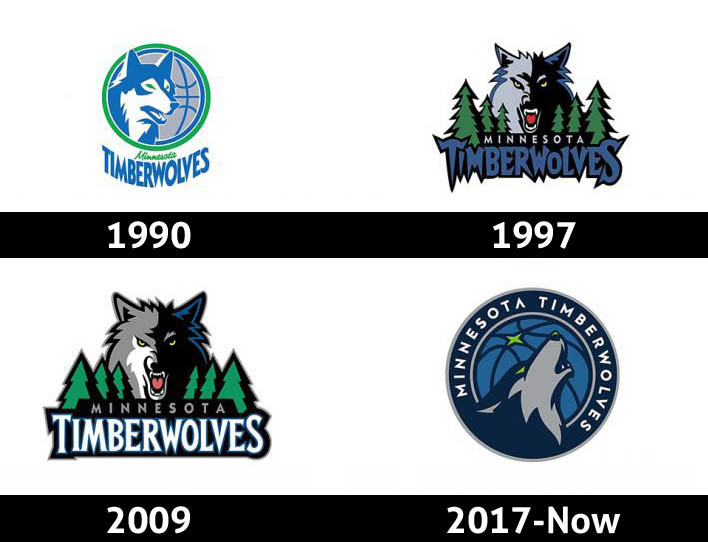
The original Timberwolves logo debuted in 1989 and reflected late-1980s sports design sensibilities. A gray and blue basketball, outlined in green, served as the backdrop for a calm, observant wolf positioned along its edge. Rather than appearing aggressive, the animal conveyed alertness and quiet strength.
Typography played a supporting but important role. “Minnesota” appeared in a smaller cursive green script, while “Timberwolves” was rendered in tall, condensed sans-serif capitals. This contrast emphasized the team name while maintaining geographic grounding.
1996 – 2008: Aggression and Attitude
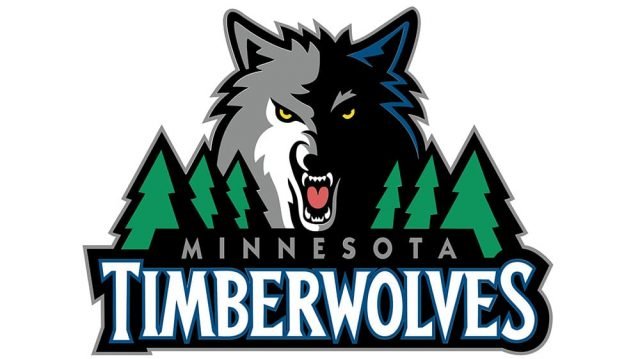
In 1996, the franchise introduced a dramatically different logo designed by Peter Thornburgh. The new emblem featured a snarling wolf head with exposed teeth, positioned above stylized pine trees. The composition was dense, layered, and emotionally charged.
The wordmark became sharper and more expressive, with elongated letterforms outlined in white to increase visual impact. This redesign aligned with a league-wide shift toward more intimidating sports identities during the late 1990s.
2008 – 2017: Refinement and Balance
The 2008 update retained the aggressive wolf imagery but refined the execution. Colors were brightened, white was introduced more prominently, and the overall composition became cleaner. The wordmark transitioned to a bold serif typeface, tightly spaced and double-outlined in blue and black.
This version marked a step toward balance. The logo still projected intensity, but with greater control and legibility, signaling a maturing brand seeking stability rather than shock value.
2017 – Today: Symbolic Modernization
The current Timberwolves logo, introduced in 2017, represented a decisive shift toward minimalism and symbolism. The wolf was simplified and placed partially over a basketball within a circular badge. A small green four-pointed star appears inside the ball, referencing Minnesota’s “North Star” identity.
The wolf’s expression became calm and focused, abandoning overt aggression. This redesign prioritized scalability, digital clarity, and timelessness, aligning the franchise with contemporary NBA branding standards.
Minnesota Timberwolves Logo Symbolism: Nature, Direction, and Control
Throughout its evolution, the Timberwolves logo symbolism remained anchored in nature. The wolf represents intelligence, loyalty, and endurance—traits associated with both the animal and the franchise’s aspirational identity.
The introduction of the star in the modern logo added a new layer of meaning, symbolizing guidance, direction, and regional pride. Circular geometry reinforces unity and continuity, while the restrained posture of the wolf communicates control rather than chaos.
Typography and Color Evolution
Typography has consistently reinforced the Timberwolves’ identity. Earlier wordmarks emphasized sharp angles and elongated forms, subtly echoing claws and teeth. These choices supported the franchise’s intimidating image during the late 1990s and early 2000s.
The current sans-serif typeface is intentionally restrained. Its clean geometry reflects confidence and modernity, with the distinctive bar-less “A” offering a subtle nod to earlier angular designs without replicating them directly.
Color continuity remains one of the franchise’s strongest assets. Shades of blue, green, gray, black, and white have defined the Timberwolves identity since 1989. The modern palette—Aurora Green, Midnight Blue, Lake Blue, Moonlight Grey, and Frost White—balances vibrancy with restraint, reinforcing a contemporary yet regionally grounded identity.
Minnesota Timberwolves Logo Heritage and Brand Identity
The Timberwolves logo heritage illustrates how a franchise can evolve visually while preserving symbolic continuity. Each redesign responded to cultural context and design trends without abandoning the wolf as the emotional anchor.
This approach reflects broader patterns seen across NBA logo history, where enduring brands prioritize refinement over reinvention. Minnesota’s visual identity today feels cohesive, modern, and unmistakably tied to its origin.
Minnesota Timberwolves Logo History and Visual Continuity
The Minnesota Timberwolves logo history stands as a clear example of controlled transformation in professional sports branding. From an illustration-driven expansion-era emblem to a modern, symbol-focused badge, the franchise refined its identity without severing ties to its origin. This deliberate evolution mirrors the philosophy evident in San Antonio Spurs logo heritage, where consistency and restraint become defining strengths rather than creative limitations.
By embracing simplicity, regional symbolism, and visual discipline, the Timberwolves positioned their logo alongside other thoughtfully developed identities documented throughout NBA logo history and the broader landscape of sports logo heritage. The current mark reflects confidence through clarity, proving that strong logo heritage is built not through constant redesign, but through a deep understanding of meaning, origin, and continuity.
FAQ: Minnesota Timberwolves Logo Meaning and History
What does the Minnesota Timberwolves logo represent?
The logo represents intelligence, resilience, and a deep connection to nature, expressed through the wolf symbol and regional color palette.
Why has the Timberwolves logo always featured a wolf?
The wolf reflects Minnesota’s natural heritage and has been central to the franchise’s identity since its founding.
When was the current Timberwolves logo introduced?
The current logo was introduced in 2017 as part of a modern rebranding effort.
What do the colors in the Timberwolves logo symbolize?
The blues, greens, and grays reference Minnesota’s forests, lakes, and northern climate.