
MetLife Logo History: Meaning, Symbolism & Brand Heritage

The visual identity of Metropolitan Life Insurance Company, better known today as MetLife, reflects a long-standing commitment to stability, professionalism, and institutional trust. Unlike brands that rely on frequent redesigns to stay relevant, MetLife has followed a disciplined visual strategy built on consistency and gradual refinement. Its logo history reveals how a strong corporate identity can evolve without losing its core meaning, reinforcing credibility across generations.
As a global provider of insurance and financial services, MetLife operates in a sector where visual clarity and trustworthiness are non-negotiable. The brand’s logo heritage demonstrates how typography, color, and restrained symbolism can work together to communicate reliability and authority, while still adapting to modern digital demands.
Meaning and History of the MetLife Logo
The original MetLife logo was created by American designer Don Ervin and immediately established the tone for the company’s visual communication. The early design featured a blue wordmark accompanied by a star symbol, an element that carried multiple layers of meaning. The star could be interpreted as a sign of guidance and security, or as a stylized abstraction of the letters “M” and “L,” subtly reinforcing the brand name through form.
From the beginning, the MetLife logo meaning was rooted in confidence and expertise. Rather than relying on illustrative imagery, the brand emphasized typographic strength and geometric balance. This approach aligned with the broader visual language of American financial institutions in the late twentieth century, where simplicity and restraint were synonymous with trust.
MetLife Logo Evolution Timeline
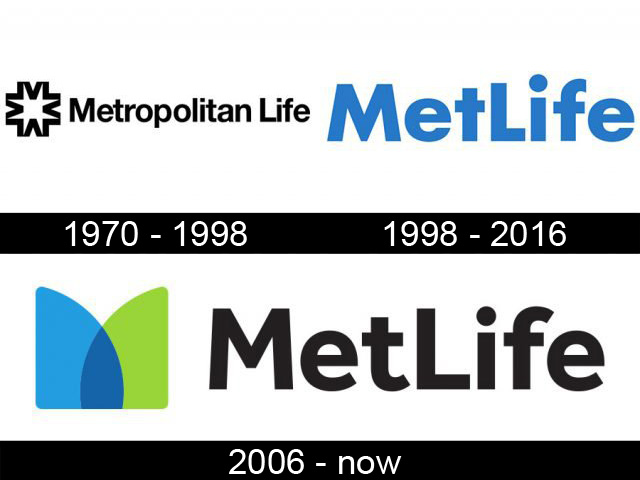
1970 – The Birth of Metropolitan Life’s Corporate Identity
The first official MetLife logo was introduced in 1970, coinciding with the company’s establishment under the Metropolitan Life name in its modern corporate form. This early identity consisted of a bold black logotype paired with an abstract geometric emblem positioned to the left. The composition was formal and balanced, designed to project authority and permanence.
The typography was executed in a traditional sans-serif typeface set in title case, prioritizing legibility and seriousness. The monochrome palette reinforced a sense of institutional stability. This version laid the foundation of MetLife’s logo history, establishing visual principles that would guide every future redesign.
1998 – The MetLife Name and a Shift Toward Modern Simplicity
In 1998, the company officially shortened its name to MetLife, a strategic rebranding decision that required a corresponding update to its visual identity. The redesigned logo replaced the earlier configuration with a bold blue wordmark, signaling a move toward a more contemporary and approachable corporate image.
The modern sans-serif lettering featured thick, confident strokes, while the capitalized “M” and “L” were visually unified into a single, cohesive mark. The introduction of blue strengthened the logo meaning by associating the brand with reliability, intelligence, and professionalism. This redesign modernized the identity without breaking continuity with MetLife’s established logo heritage.
2016 – Introducing a Symbol for a Digital-First Brand Era
The 2016 redesign marked the most significant evolution in MetLife’s visual identity. For the first time, a dedicated graphic symbol was introduced alongside the wordmark. The new emblem was formed by two mirrored triangular shapes in blue and green, with one side subtly arched.
This update reflected MetLife’s transition into a digital-first global brand. The simplified geometry improved scalability across digital platforms while adding visual depth to the identity. Despite the introduction of color and symbolism, the logo preserved its typographic strength and institutional tone, ensuring continuity within the broader MetLife logo history.
Logo Symbolism
Symbolism in the MetLife logo has always been subtle and intentional. The triangular emblem introduced in 2016 suggests balance, protection, and partnership, concepts closely tied to insurance and financial security. Its mirrored structure reinforces ideas of mutual support and long-term stability.
Earlier symbolic elements, such as the original star, conveyed guidance and reliability without explicit illustration. Across all versions, MetLife avoided literal imagery, relying instead on abstract forms and proportion to communicate meaning. This restraint strengthens the brand’s logo heritage by allowing symbolism to feel timeless rather than trend-driven.
Typography and Color
Typography plays a central role in defining the MetLife logo meaning. The brand consistently uses bold sans-serif letterforms characterized by smooth curves, strong contours, and excellent readability. The current wordmark closely resembles fonts such as Steam Text Bold and Hartwell Bold, both known for their confident yet neutral appearance.
Color has evolved alongside typography. The modern palette combines blue and green to represent growth, well-being, and long-term success. These tones are balanced by black typography, which reinforces authority and trust. Together, color and type create a visual language that feels both modern and dependable.
MetLife and the Power of Consistent Logo Heritage
The MetLife logo history demonstrates how disciplined evolution can build lasting brand equity. Rather than reinventing its identity, MetLife refined its visual language over time, preserving recognition while adapting to new markets and technologies. This strategy has allowed the brand to remain credible and relevant in a highly competitive global industry.
As an example of strong logo heritage, MetLife proves that clarity, consistency, and symbolic restraint are often more powerful than dramatic redesigns. Its logo stands as a visual promise of stability, one that continues to define the brand’s identity today.
MetLife Logo FAQ
What does the MetLife logo represent?
The MetLife logo represents trust, stability, and long-term security through strong typography, balanced geometry, and a restrained color palette.
Who designed the original MetLife logo?
The original MetLife logo was designed by American graphic designer Don Ervin.
How many major redesigns has the MetLife logo had?
The MetLife logo has undergone three major redesigns, in 1970, 1998, and 2016.
Why did MetLife introduce a symbol in its logo?
The symbol was introduced in 2016 to improve digital scalability and modernize the brand while maintaining continuity with its visual heritage.
What do the colors in the MetLife logo symbolize?
Blue and green symbolize growth, well-being, and reliability, while black conveys authority and trust.