
Medium Logo History: Meaning, Symbolism & Brand Heritage

From its earliest days, Medium positioned itself as something fundamentally different from traditional social media. It was not built for speed, virality, or short bursts of attention. Medium was conceived as a place for thinking in public—a platform where ideas could unfold at their own pace, where writers and readers would meet in a shared intellectual space shaped by text rather than noise.
That philosophy has always been reflected in Medium’s visual identity. Unlike platforms driven by illustration, mascots, or decorative symbols, Medium anchored its branding in typography and editorial restraint. Its logo history is not a story of radical reinvention, but of careful refinement—each iteration responding to shifts in the platform’s mission, business model, and cultural role.
Medium did not emerge in a vacuum. Its editorial-first philosophy and typographic restraint place it in direct dialogue with other platforms and institutions that treat text as the primary carrier of meaning. Similar to the long-established visual discipline seen in The New York Times or the minimalist authority of The Guardian, Medium positions writing itself as the product, not the interface around it. This shared commitment to typography-driven identity helps frame Medium’s logo heritage within a broader tradition of serious publishing brands.
Meaning and History: The Origin of the Medium Logo
The logo origin of Medium is inseparable from its editorial ambition. Founded in 2012 by Evan Williams, one of the creators behind Blogger and Twitter, Medium was envisioned as a corrective to the limitations of social platforms. At a time when Twitter enforced a 140-character limit, Medium encouraged longer, more thoughtful writing.
This editorial intent shaped the brand from the beginning. Medium did not need a symbol that explained what it was; it needed one that stayed out of the way. The earliest logo embraced the most elemental unit of language: the letter. A single “M,” placed with typographic confidence, communicated that this was a platform built on words, not features.
As Medium evolved—from a publishing experiment into a subscription-based ecosystem supporting professional writers—the logo evolved alongside it, always returning to the same core idea: Medium as a blank page for thought.
Medium Logo History Timeline: From Letterform to Editorial Symbol
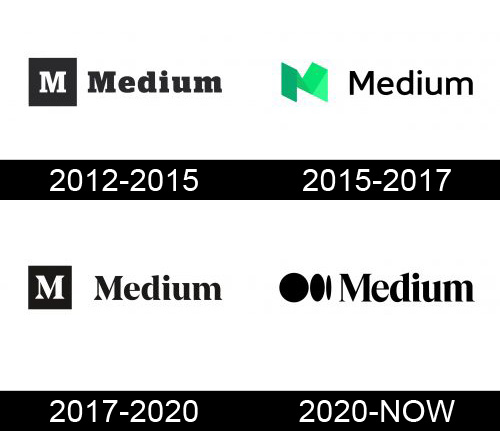
2012–2015: The Typographic Foundation
The original Medium logo appeared alongside the platform’s beta launch in 2012. It consisted of a white capital “M” set inside a black square, accompanied by the word “Medium” in a serif typeface reminiscent of traditional print publishing.
This design carried strong newspaper associations, subtly aligning Medium with long-established editorial institutions. The visual language was intentionally austere: no color accents, no gradients, no embellishments. It reinforced the idea of Medium as a space for serious writing rather than casual posting.
2015–2017: Flexibility and Experimentation
As the platform expanded, Medium sought a more expressive identity. In 2015, the logo was redesigned to feature a stylized green “M” composed of modular shapes, almost resembling folded paper or origami.
This version symbolized interconnected ideas and creative flexibility. The segmented form suggested that thoughts are built from multiple parts, assembled into something new. While conceptually rich, this logo marked the most experimental phase in Medium’s logo evolution—and also the shortest-lived.

2017–2020: Return to Editorial Authority
With the introduction of a paid subscription model in 2017, Medium repositioned itself as a premium publishing environment. The logo reverted to black and white, reinstating the iconic “M” in a black square.
This time, however, the letterform was more expressive: sharp triangular serifs, dramatic contrast between thick and thin strokes, and a distinctly editorial character. The accompanying wordmark echoed the visual language of legacy newspapers, reinforcing trust, seriousness, and authority.
The logo heritage here became explicit—Medium was no longer just a platform, but a modern extension of print culture.
2020–Today: The Ellipsis as Identity
In 2020, Medium introduced its most conceptually sophisticated logo to date. The iconic “M” was replaced by a stylized ellipsis: a black circle followed by two progressively narrower ellipses, receding into space.
This symbol represents an unfinished thought—a pause rather than a conclusion. In writing, an ellipsis implies continuation, reflection, and openness. As a logo, it perfectly encapsulates Medium’s mission: ideas are never final; they evolve through dialogue.
The wordmark remained typographic and restrained, with refined serifs and improved legibility. The result is a logo that asserts identity while leaving interpretive space for the content itself.
Logo Symbolism: Medium as a Space for Thought
The symbolism of the Medium logo is deliberately understated. Where many platforms rely on overt metaphors, Medium communicates through absence and suggestion.
The early “M” symbolized language at its most basic level. The green modular “M” represented creative assembly. The return to black-and-white typography signaled editorial credibility. Finally, the ellipsis introduced in 2020 embodies incompletion—an invitation rather than a statement.
This progression mirrors the platform’s intellectual stance. Medium does not claim to deliver definitive answers. It positions itself as a medium—literally and philosophically—through which ideas pass, evolve, and are refined.
Typography and Color: Editorial Discipline Over Decoration
Typography has always been the backbone of Medium’s identity. Each wordmark iteration draws from the tradition of print publishing, using serif letterforms to evoke seriousness, depth, and trust.
The current typeface is custom-built, with restrained serifs and carefully balanced proportions. It is designed to feel familiar without being derivative, modern without losing its editorial roots.
Color has remained intentionally minimal. The black-and-white palette reinforces the metaphor of a blank page—white space for ideas, black text for clarity. This neutrality ensures that the logo never competes with the voices it represents.
Medium Logo Heritage and Intellectual Restraint
The Medium logo heritage is a rare example of branding aligned perfectly with purpose. Rather than chasing trends or visual noise, Medium has consistently refined a visual language rooted in typography, editorial tradition, and conceptual subtlety.
From a single letter to a punctuation mark, the logo evolution reflects Medium’s belief that ideas matter more than imagery. In an attention-driven digital landscape, this restraint is not a weakness—it is Medium’s greatest strength.
FAQ: Medium Logo Meaning and History
What does the Medium logo symbolize?
The current logo symbolizes an unfinished thought, representing ongoing dialogue and idea development.
Why did Medium replace the “M” with an ellipsis?
The ellipsis reflects the platform’s focus on open-ended thinking and intellectual exploration.
Has Medium always used black and white branding?
Mostly yes. Apart from a brief green phase, Medium has consistently relied on black-and-white editorial aesthetics.
Who founded Medium?
Medium was founded in 2012 by Evan Williams.