
Loewe Logo History: Meaning, Symbolism & Brand Heritage

Loewe occupies a rare position in the global luxury landscape: a house both anchored in one of Europe’s richest artisanal traditions and simultaneously regarded as one of the most progressive voices in modern fashion. Its identity rests on a foundation built in Madrid in 1846, at a time when leather craftsmanship was still a guild-based art. Over more than a century and a half, the brand has transformed from a local workshop into the oldest luxury maison within the LVMH Group, celebrated worldwide for uncompromising craftsmanship, architectural silhouettes, and an avant-garde visual language that merges past and present with striking clarity.
While Loewe’s collections have evolved dramatically — particularly under modern creative leadership — the brand has preserved a meticulous reverence for its origins. This dual philosophy is also present in its logo history, which mirrors the larger story of Loewe itself: a journey from traditional Madrid leather ateliers to a global luxury powerhouse rooted in heritage, meaning, and modern symbolism.
The Loewe logo is not merely a decorative signature. It is an emblem of continuity in a house that treats its identity as carefully as its materials, a graphic narrative of how craftsmanship, culture, and contemporary design coexist within a single brand system.
Meaning and Symbolism
Loewe’s visual identity has always been built around two conceptual pillars: heritage and craftsmanship. The classic serif wordmark evokes nineteenth-century typography, paying homage to the brand’s early years in Madrid. Its shapes reference the meticulous discipline of leatherwork, where sharp cuts and sweeping curves must exist in perfect equilibrium.
The “four-L” emblem, often referred to as the Anagram, is the strongest symbolic motif of the house. Formed by four intertwined calligraphic letters, it represents the weaving, looping, and folding gestures of leather artisans. Its mirrored structure underscores balance and symmetry, while its ornamental character reflects Loewe’s Spanish artistic roots, recalling iron gates, decorative filigree, and the intertwined motifs found in traditional craftsmanship.
Across all eras, the Loewe logo conveys sophistication, artistry, and a deep respect for materiality — essential themes in a brand defined by its leatherworking excellence.
Loewe Brand Heritage
The heritage of Loewe begins with its founding workshop in Madrid in 1846, created by José Silva and Florencio Rivas. When Heinrich (Enrique) Loewe Rössberg arrived from Germany and joined the business in 1872, the maison took on the name it still carries today. Under his leadership, Loewe quickly became a supplier of fine leather goods to Spanish aristocracy and enjoyed international exposure as the century turned.
By the early twentieth century, Loewe had established boutiques in cultural capitals and cultivated a reputation for precision, refinement, and unmistakable Spanish elegance. Through the decades, the house distinguished itself with impeccable handbags, fine leather accessories, and a timeless yet innovative approach to fashion craft.
Loewe’s integration into LVMH brought renewed global visibility, yet its Spanish identity remained central. Today, the brand continues to manufacture its leather goods in its Madrid-area workshops, maintaining a direct lineage between the past and the present.
Loewe Logo History and Evolution Timeline
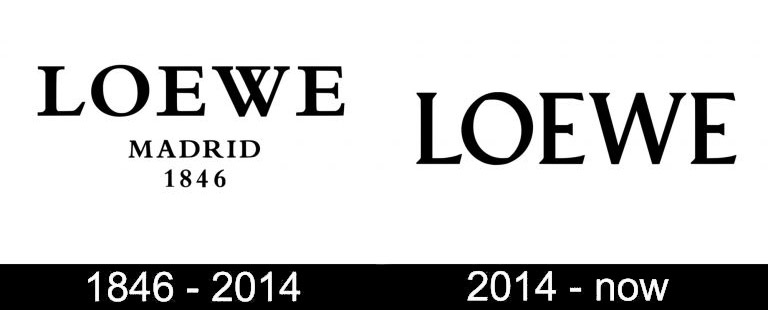
1846–2014: The Heritage Wordmark and Early Anagram
The earliest recognizable Loewe logo embraced the visual language of nineteenth-century typography. Strong serif lettering, pronounced contrast in stroke width, and an elegant classical construction communicated the brand’s established presence and artisanal roots. The inscription “Madrid 1846” reinforced its heritage, positioning Loewe as a house defined by tradition and excellence.
During the second half of the twentieth century, Loewe also introduced an emblem that would become one of the most iconic symbols in luxury branding: the four interlocking L’s, designed by Vicente Vela in the late 1970s or early 1980s. This ornamental stamp appeared on leather goods, packaging, and storefronts, becoming a key part of Loewe’s visual vocabulary.

2014–Today: The Modernized Wordmark and Refined Anagram
In 2014, Loewe underwent a major identity overhaul led by the design agency M/M (Paris). The updated wordmark retained its serif structure but adopted a more sculptural and expressive style. Each glyph carries a distinctive rhythm, with the tilted “O” and refined serifs demonstrating a sophisticated re-engineering of the historical forms.
The Anagram was also redrawn with greater precision, elevating its fluid, calligraphic quality. It is now a standalone icon in fashion branding, immediately recognizable and reflecting the maison’s commitment to the artistry of craft.
This modern logo synthesizes heritage and innovation, enabling the brand to speak both to its legacy and to new generations of luxury consumers.
Typography and Color
Typography plays a central role in Loewe’s identity. The modern serif used in the wordmark is inspired by the work of typographer Berthold Wolpe, blending classical proportions with subtle contemporary interventions. The letters feel hand-crafted rather than digitally manufactured, echoing the textures and precision of leatherwork.
The color palette is deliberately restrained. Black on a white or smoky-white Humo background is the house standard, expressing timeless luxury, neutrality, and versatility. The refined simplicity ensures the logo adapts effortlessly to packaging, product labeling, editorial layouts, and architectural signage.
The Enduring Legacy of the Loewe Logo
The Loewe logo stands as an emblem of European craftsmanship and modern luxury. Its evolution reflects a dialogue between centuries-old artisanal traditions and the contemporary sensibility that defines the maison today. Both the wordmark and the Anagram remain timeless symbols of precision, artistry, and Spanish cultural heritage.
In an industry often driven by rapid reinvention, Loewe’s identity shows that the most powerful logos emerge when history and innovation coexist. Its logo continues to serve not just as a brand signature, but as a visual tribute to the hands, materials, and creative vision that shaped the house from its earliest days in Madrid to its current place on the global stage.
FAQ
What does the Loewe logo represent?
The Loewe logo symbolizes the brand’s roots in Spanish craftsmanship. Its serif wordmark reflects nineteenth-century heritage, while the intertwined four-L Anagram represents the techniques, interwoven materials, and artistic finesse of traditional leatherworking.
Who designed the modern Loewe logo?
The contemporary Loewe logo, introduced in 2014, was created by Michael Amzalag and Mathias Augustyniak of M/M (Paris), drawing inspiration from typographer Berthold Wolpe.
Why does Loewe use four L’s in its emblem?
The four L’s form a decorative Anagram introduced by Vicente Vela. They symbolize elegance, symmetry, and the artisanal movements involved in crafting leather goods.
What is the historical significance of Loewe’s identity?
The brand’s identity is deeply connected to its origin as a Madrid leather workshop founded in 1846. Its logo reflects this heritage, emphasizing craftsmanship and timeless design.
Does Loewe’s logo change across products?
While the core logo remains consistent, Loewe applies variations of the wordmark and Anagram across packaging, accessories, and fashion collections, always maintaining its refined aesthetic.