
Kia Logo History: Meaning, Symbolism & Brand Heritage

The story of Kia is inseparable from the industrial development of South Korea itself. What began in 1944 as Kyungsung Precision Industry—a small producer of steel tubing and bicycle parts—would eventually become one of the world’s most dynamic automotive manufacturers. Over the decades, Kia evolved from crafting Korea’s first domestic bicycles to manufacturing scooters, motorcycles, trucks, and ultimately passenger vehicles for a growing global market. Today, Kia stands as part of the Hyundai–Kia Automotive Group and operates as the second-largest automobile manufacturer in South Korea, with millions of vehicles sold annually across more than 165 countries.
As the company transformed from a local industrial workshop into a global automotive force, its visual identity evolved alongside it. Kia’s logos have reflected each major transition in the company’s history—its early engineering roots, its emergence as a transport innovator, its global expansion, and finally, its repositioning as a modern design-forward automotive brand.
The Kia logo is more than a badge; it is a timeline of ambition, reinvention, and increasingly bold design strategy.
Kia Meaning and Symbolism
The name Kia encapsulates the brand’s worldview and ambition. Derived from Sino-Korean characters, “Ki” means “to rise” or “to come out,” while “A” refers to Asia. Interpreted together, Kia signifies “to rise from Asia to the world.” This powerful meaning anchors the brand’s identity and informs the symbolism woven into its history of logos.
Throughout its visual evolution, Kia’s emblems consistently referenced motion, engineering, global reach, and progress. From the early industrial diamond-and-gear symbols to the later ellipses suggesting global ambition, the logos reflected a company striving beyond its domestic boundaries.
The 2020 redesign pushed this ambition even further. Its angular, continuous strokes evoke movement, electricity, and technological modernity, positioning Kia not simply as a traditional automaker, but as a mobility brand representing future-forward innovation.
Kia Logo History & Evolution Timeline
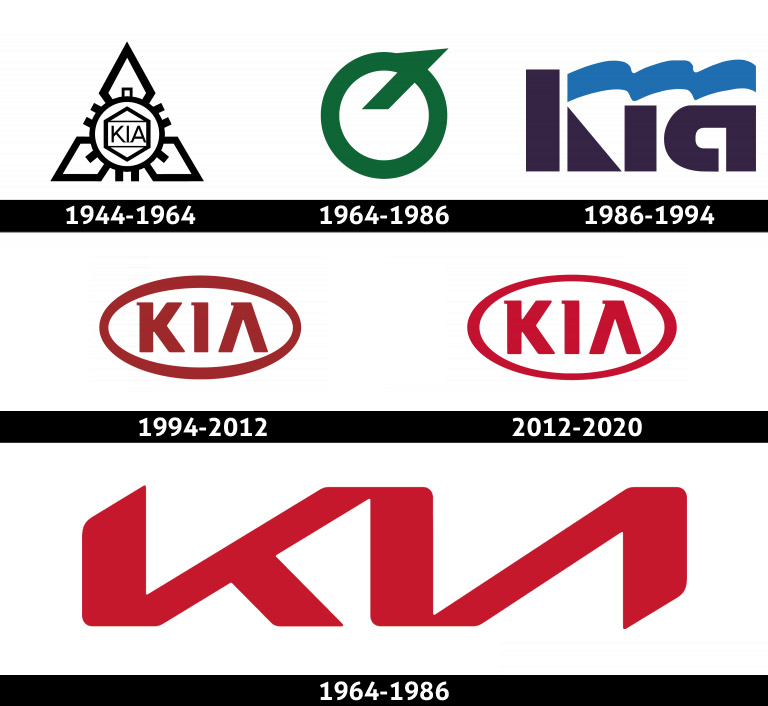
1944–1964: The Industrial Diamond & Gear
The earliest Kia logo reflected the company’s origins in precision engineering. Designed when the company manufactured bicycle components, the emblem showcased three diamonds intersecting around a central gear, with the company’s name framed inside. This monochrome, geometric composition communicated mechanical craftsmanship and industrial rigor. Symbolically, the gear represented machinery, while the benzene-ring-like central element subtly referenced the chemical processes integral to metalworking. For a young engineering brand, the emblem conveyed seriousness and technical competence.

1964–1986: The Green Circle and the Emerging Automotive Identity
As Kia shifted toward licensed automotive production, its 1964 logo marked a conceptual transformation. The emblem featured a green circle pierced by an upward diagonal stroke, forming a symbol reminiscent of an inverted letter “Q.” The design carried deeper meaning: the diagonal line referenced the first character of the Korean term for the automobile industry, while the circle signified a wheel. Together, the symbol represented movement, mechanization, and the brand’s entry into vehicle manufacturing. Its modern simplicity marked a significant departure from the industrial density of its predecessor.

1986–1994: The Flag of Progress
Kia’s 1986 redesign embraced symbolism through a stylized flag-shaped emblem featuring bold lettering intersected by three horizontal waves. These waves represented the company’s corporate philosophies: social development, excellence in automotive engineering, and global expansion. The design was dynamic, forward-facing, and illustrative of the optimism fueling Kia’s ambitions during a period of rapid corporate growth and international collaboration.

1994–2012: The Oval Era
In 1994, Kia entered a new era of global recognition with an emblem that would remain familiar to consumers for nearly two decades. The logo featured a red wordmark set inside a horizontal ellipse. Its typography was distinctive, eliminating the crossbar in the letter “A” and adding a small decorative stroke at the top of certain letters. The surrounding ellipse symbolized the global sphere, a fitting metaphor as Kia began exporting vehicles worldwide.
The color palette shifted significantly: red and white were chosen not only for their visibility but also for their cultural symbolism. Red represented passion, determination, and energy; white conveyed transparency and integrity. The simple, bold configuration allowed Kia to present itself as a modern global automaker.
2012–Present (Elliptical Version): Modern Refinement
In 2012, Kia refined its longstanding emblem by brightening the red tone and adjusting the oval outlines to appear thinner and more even. The improvements gave the badge greater balance and visual sophistication, reflecting the company’s improved design language, higher manufacturing standards, and increasing presence in competitive international markets.
2020–Today: The Futuristic Script
Kia’s most dramatic visual transformation arrived in 2020. Moving away from the oval for the first time in decades, the brand introduced an aggressively modern wordmark built from connected angular strokes. The new design merges all three letters into a continuous motion, as if drawn in a single energetic gesture. The resulting form resembles a pair of Cyrillic characters (“КИ”), adding to its visual intrigue while preserving brand recognition.
The angled cuts at the upper left and lower right edges give the impression of cropped vision—as though the logo has been zoomed in—enhancing its dynamic, sporty aesthetic. This new mark reflects Kia’s positioning for the electric and next-generation mobility era, presenting the company as innovative, bold, and design-centric.
The Korean Market Logo
One of the most fascinating aspects of Kia’s visual identity is the existence of a separate domestic emblem. In South Korea, Kia uses a completely different logo: a blue circle outlined in black, featuring an elegant white “K” at its center. The company name appears around the perimeter of the roundel.
This symbol has a distinctly traditional appearance and reflects local corporate conventions rather than global aesthetics. Its ongoing use reinforces Kia’s heritage while allowing the company to maintain a more progressive, minimalist identity abroad.

The Automotive Emblem
On actual vehicles, Kia uses a metallic silver rendering of its logo, giving the badge depth and dimension. The chromed finish enhances the impression of quality and complements the diverse styling of the brand’s global models. The simplicity of the logo’s shape ensures strong compatibility with model nameplates and trim-level typography.
Design Analysis
Typography has played a crucial role in Kia’s identity. Before 2020, the brand’s logo employed a bold geometric typeface comparable to Posterama Pro 1945 Bold or CocoBikeR Heavy, though heavily modified — particularly in the distinctive “A.” This typographic DNA expressed reliability and solidity.
The 2020 redesign abandons classical typography entirely in favor of a custom logotype with no comparable commercial typeface. Its angular continuity suggests speed, ambition, and a futuristic outlook consistent with Kia’s shift toward electric mobility.
Color remains a defining element. Red and white have been central to Kia’s branding since the 1990s, associating the company with energy, passion, and clarity. The newer black variants used in the 2020 era underscore modernity and adaptability across digital environments.
Kia’s evolution demonstrates how visual identity can mirror technological shifts. From gears and wheels to flags and ellipses, and finally to abstract kinetic motion, each redesign corresponds to a distinct chapter in the brand’s automotive journey.
A New Era of Korean Automotive Identity
Kia’s logo history is a narrative of transformation—from an industrial bicycle parts manufacturer to a global automotive innovator. Each iteration of the visual identity documented a significant step in the company’s evolution, reflecting changes in its mission, technology, and global ambitions.
The dramatic 2020 redesign represents more than a stylistic refresh. It signals Kia’s intent to redefine itself for the era of electric vehicles, technological mobility solutions, and international design leadership. With bold angular lines and a futuristic aesthetic, the new logo abandons tradition in favor of momentum.
Yet at its foundation remains the same core meaning embodied in the name Kia: rising beyond Asia to reach the world. The brand’s logo continues to symbolize progress — a fitting emblem for a manufacturer that has consistently reinvented itself while building one of the fastest-growing footprints in modern automotive history.
FAQ: Kia Logo & Brand Identity
What does the name Kia mean?
Kia comes from Sino-Korean characters meaning “to rise” and “Asia,” interpreted together as “to rise out of Asia to the world.”
Why did Kia redesign its logo in 2020?
The 2020 redesign reflects Kia’s shift toward electric vehicles, futuristic mobility solutions, and a more design-forward brand strategy.
Why does the 2020 logo look connected?
The continuous strokes symbolize movement, innovation, and the seamless transition into next-generation mobility technology.
Is the Korean Kia logo different from the international one?
Yes. In Korea, Kia uses a blue roundel with a stylized white “K,” a design distinct from the global wordmark.
What colors does Kia use in its branding?
Kia traditionally uses red and white, symbolizing passion and transparency. The newest era also uses black for a more minimalist, modern look.