John Deere Logo History: Meaning, Symbolism & Brand Heritage
Few industrial symbols have achieved the global recognition and cultural resonance of the John Deere leaping deer. More than a logo, it is an emblem of American innovation, agricultural resilience, and frontier spirit. Across nearly two centuries, it has evolved with the company’s technological leaps while preserving a singular identity rooted in its founder’s vision. Today, the John Deere mark is not just a corporate symbol — it is a part of agricultural history, a cultural icon of the American Midwest, and one of the longest-running trademarks in continuous use.
Origins of the John Deere Legacy
To understand the evolution of the logo, one must return to the life of the founder. Born in 1804 in Vermont, John Deere was a blacksmith whose craftsmanship and ingenuity quickly became evident through simple tools like shovels and pitchforks. His move to Illinois placed him at the edge of the expanding agricultural frontier, where farmers struggled with sticky prairie soil. In 1837, Deere devised his historic polished steel plow, a tool that changed American agriculture forever and became the foundation of what would grow into Deere & Company.
By 1868, as the company incorporated, Deere’s invention had already reshaped farming practices across the Midwest. His son, Charles Deere, expanded production and established a dealership network, turning a regional workshop into a national agricultural powerhouse. Today, Deere & Company operates in more than 130 countries, generating over $40 billion annually — the emblem of the leaping deer now representing one of the world’s most trusted industrial brands.
Logo History and Evolution Timeline
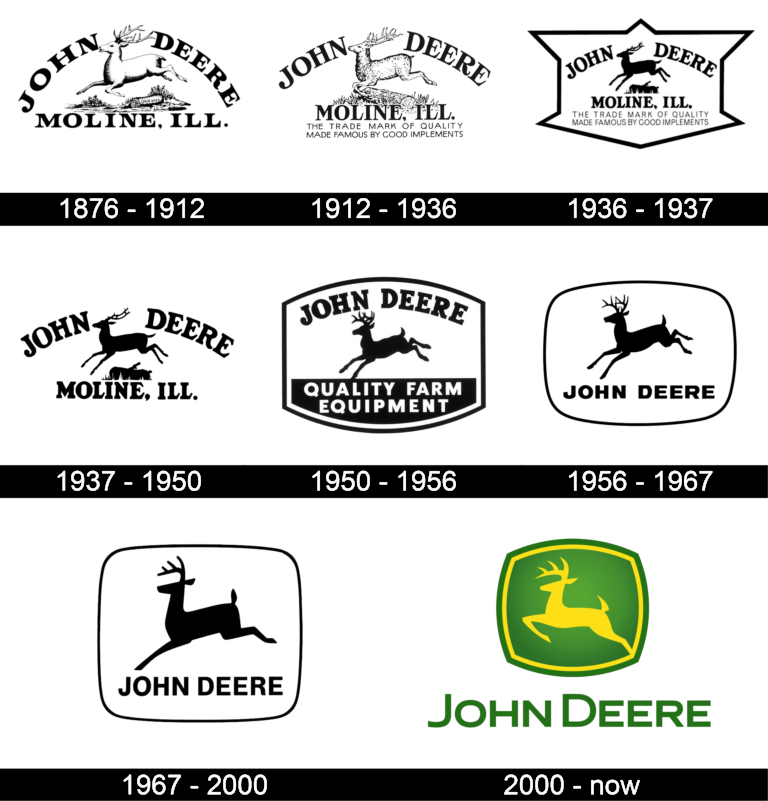
The John Deere logo holds the distinction of being among the oldest continuously used trademarks in American commerce. Across nearly 150 years, it has undergone thoughtful refinements while preserving the brand’s identity.
1876 — The First Registered Mark
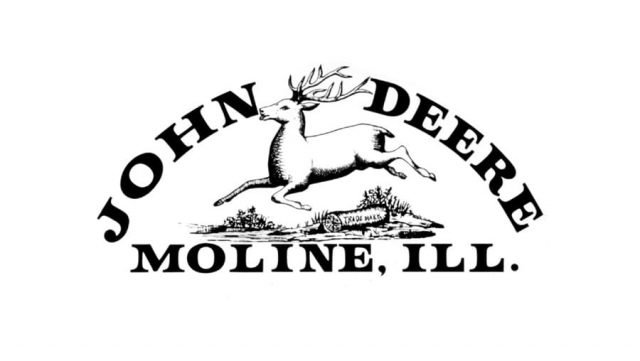
The earliest registered logo, in use since 1873 and officially filed in 1876, depicted a deer bounding over a fallen log. The aesthetic echoed 19th-century engraving styles, with careful linework and a sense of movement. Beneath the deer appeared the words “Moline, ILL.”, marking the manufacturing location and reinforcing the association with the famously named “Moline Plows.”
1912 — A More Detailed Symbol
In 1912, the basic layout remained, but the artwork became more detailed and expressive. Most importantly, the logo introduced its first slogan, beginning with “The Trade Mark of Quality…”, establishing the early theme of durability — a brand promise still central to Deere today.
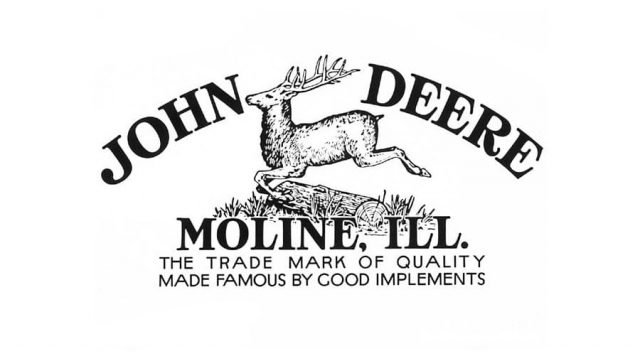
1936 — Toward Practical Standardization
As production expanded to new machinery lines, John Deere’s standardization committee recommended a cleaner emblem that would reproduce easily on equipment. The deer was simplified, its anatomy less ornamental, and the mark was enclosed within a twelve-sided border. The added border, though distinctive, made the logo visually heavy.
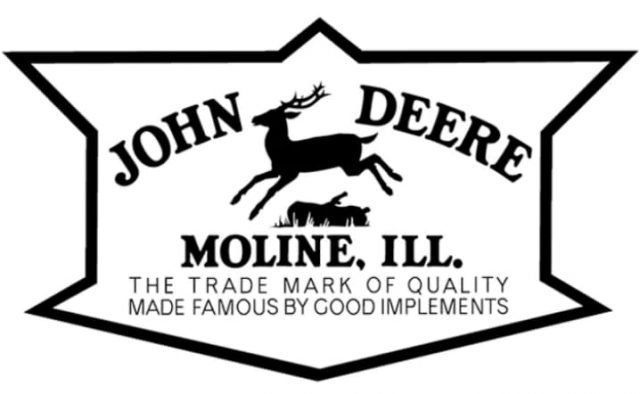
1937 — Centennial Simplification
One year later, in honor of the company’s centennial and its expanding product catalog, the border and slogan disappeared. What remained was a streamlined deer silhouette — easier to cast, stamp, and stencil onto equipment. This clean 1937 emblem marked the beginning of the modern John Deere aesthetic.
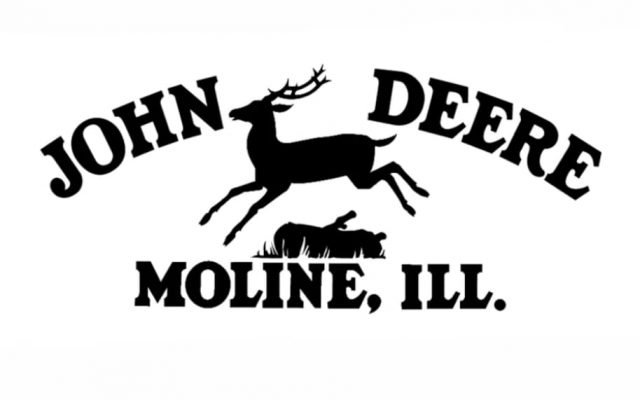
1950 — A Redrawn, More Modern Deer
In 1950, the iconic log beneath the deer was removed entirely, signaling a shift toward minimalism. The animal’s form grew leaner and more dynamic, foreshadowing future redesigns.
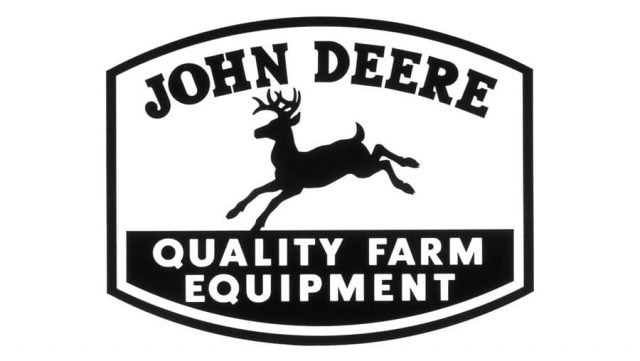
1956 — Removing the Slogan
A small update removed the remaining slogan text, leaving only the deer and framing. The logo’s emphasis moved fully toward the visual emblem as John Deere solidified global recognition.
1968 — The Return of the Modernist Line
By 1968, the logo adopted a sharper geometric balance. The deer stood taller and more abstract. Both the typography and the frame were simplified further to evoke modern engineering precision. This redesign coincided with the company’s expansion into industrial machinery and global agriculture.
2000 — The Leaping Deer
At the turn of the millennium, Landor Associates reimagined the emblem for a digital and international era. For the first time, the deer was shown leaping upward rather than landing — a symbolic shift from heritage to forward motion, progress, and innovation. The green shield became a curved, modern badge with a bright yellow outline, and the deer’s anatomy was redrawn with confident, fluid geometry. Today, this remains the official global logo of Deere & Company.
Meaning & Symbolism
The John Deere emblem carries layers of symbolic weight built over generations. At its core, the deer references agility, speed, and grace — qualities that reflect precision machinery designed to navigate rugged terrain. Its leap upward embodies progress, advancement, and optimism. Earlier versions depicted the deer landing, a visual rooted in a 19th-century engraving tradition, while the contemporary version presents the animal in mid-ascent, symbolizing Deere’s transition from industrial heritage to technological leadership in automation, AI-powered agriculture, and sustainable farming.
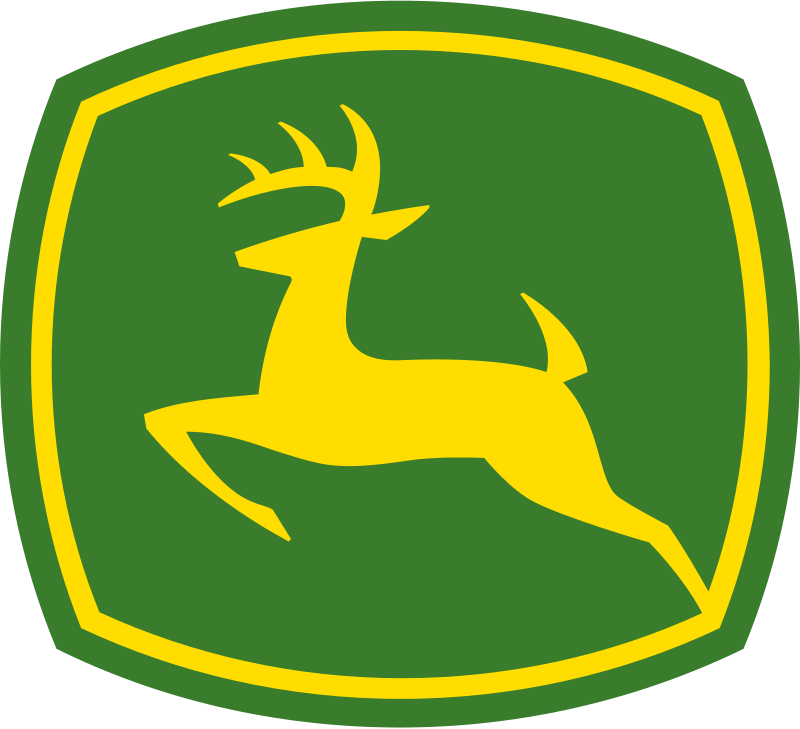
The emblem’s shield shape evokes reliability and protection, underscoring the brand’s commitment to durability and the safety of its operators. Its green and yellow palette connects directly to the agricultural landscapes the machinery inhabits: fertile fields, crops, sunlight, and growth. Few brands manage to embed their environmental origins so deeply in their identity — for John Deere, the connection is inseparable.
Font & Typography
The typography accompanying the John Deere emblem is a custom sans-serif designed for clarity, strength, and high visibility on large machinery. The letters are wide, stable, and subtly extended, offering a technical aesthetic without losing a sense of warmth. Several typefaces come close, such as Syncopate Pro Bold or Organetto Bold Semi Extended, but the official wordmark remains proprietary. The strokes are consistent and confident, ensuring legibility on equipment that often moves through dust, sunlight, and long distances.
The spacing is carefully measured so the wordmark sits comfortably beneath the emblem, offering balance without detracting from the deer itself — a considered relationship that has become one of the most recognizable configurations in global industrial branding.
Color Palette
John Deere’s signature green and yellow color palette is among the most iconic in corporate history. The green tone evokes the cultivated fields, environmental stewardship, and agricultural heritage that define the company’s purpose. Yellow brings warmth, sunlight, energy, and high visibility — critical for safety in industrial environments.
Though the shades have been refined digitally over the years, the underlying symbolism remains constant: growth, vitality, innovation, and dependability.
Conclusion: The Enduring Power of a Leaping Icon
The John Deere logo is not merely a design — it is an American industrial heirloom. Its evolution mirrors the transformation of agriculture itself, from horse-drawn plows to AI-powered tractors that navigate fields autonomously. Across these extraordinary shifts, the emblem has remained remarkably consistent, preserving its heritage while embracing modernity.
A leaping deer enclosed in green and yellow has come to signify more than machinery. It embodies craftsmanship, innovation, and a cultural bond between land and people — a brand that has grown into a global symbol without ever abandoning its roots.
Few logos achieve this level of timelessness. Even fewer evolve with such grace.
John Deere Logo FAQ
What does the John Deere logo represent?
It symbolizes motion, strength, and progress through the leaping deer, while the green and yellow palette reflects agriculture, growth, and reliability.
Why is the John Deere deer leaping upward today?
The upward leap, introduced in 2000, represents innovation, technological progress, and the brand’s forward-looking vision.
Who designed the modern John Deere logo?
The 2000 redesign was created by Todd True at Landor Associates, marking the first time the deer was shown leaping upward.
How many versions of the John Deere logo have existed?
Since 1876, eight major versions have shaped the logo’s evolution, each reflecting the company’s growth and the design sensibilities of its era.
Are John Deere colors trademarked?
Yes. The signature green and yellow combination is legally protected as part of the brand’s identity.