
Jeep Logo History: Meaning, Symbolism & Brand Heritage

Few automotive names have crossed the boundary between brand and category as completely as Jeep. Over decades, the word itself became synonymous with four-wheel-drive vehicles, a rare achievement rooted not in aggressive marketing or constant visual reinvention, but in mechanical credibility and cultural timing. Unlike many manufacturers that rely on frequent logo updates to signal progress, Jeep built its identity through consistency. Its logo history reflects this philosophy, favoring clarity and restraint over ornamentation. Similar patterns can be observed in the Ford logo history and the durability-driven evolution explored in the Land Rover logo history, where engineering substance ultimately shaped visual identity. Within the broader context of off-road vehicle logo history, Jeep stands apart for how little it needed to explain itself graphically.
The Jeep logo meaning has always been inseparable from the vehicle itself. Rather than creating an abstract symbol detached from product reality, the brand allowed function, performance, and reputation to define its visual presence.
Meaning and History: The Origin of the Jeep Identity
Jeep traces its origins to the early 1940s, when the United States military sought a lightweight, versatile off-road vehicle capable of operating in extreme conditions. Engineers from several companies, including Willys-Overland, Bantam, and Ford, contributed to the development of what would become the first Jeep prototypes. Vehicles such as the Willys MA, Bantam BRC, and Ford GPW laid the technical foundation for the brand.
The name “Jeep” emerged organically. One widely accepted explanation links it to the abbreviation “GP,” meaning “General Purpose,” which soldiers pronounced phonetically as “Jeep.” Another theory references Ford’s internal GPW designation, while a more cultural interpretation points to Eugene the Jeep, a cartoon character known for extraordinary mobility and resilience. Regardless of origin, the name quickly entered common language, long before it was formally registered as a trademark in 1950.
Initially, vehicles were sold under the Willys name due to legal disputes surrounding ownership. Once the Jeep brand was officially established, its visual identity followed a clear principle: legibility above all else. This approach defined the logo meaning from the start, emphasizing reliability, approachability, and functional honesty.
Jeep Logo History Timeline
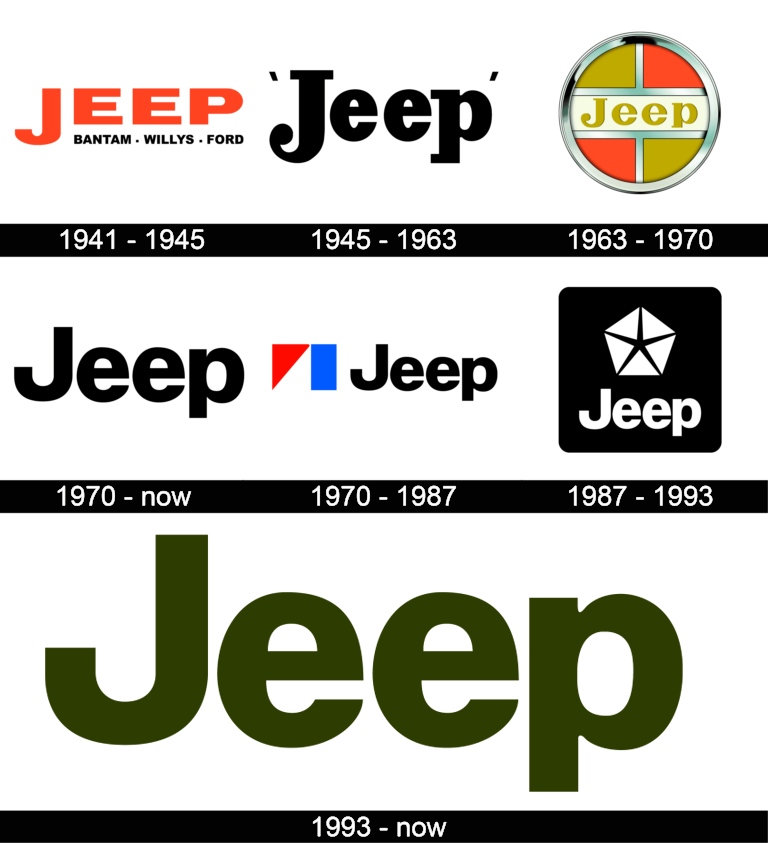
1941–1945: Wartime Identification and Functional Branding
The earliest Jeep badge appeared during World War II. It consisted of a two-line typographic composition using red and black lettering. The word “Jeep” was set prominently in uppercase, with an enlarged “J,” while a secondary line listed “Bantam. Willys. Ford,” acknowledging the manufacturers involved. This logo was informational rather than expressive, designed for identification rather than brand storytelling.

1945–1963: Post-War Recognition and Typographic Confidence
Following the war, Jeep adopted a monochrome wordmark that marked its transition into civilian markets. The logo featured the name “Jeep” in title case, rendered in an extra-bold serif typeface with smooth curves and elongated geometric serifs. Decorative quotation marks framed the wordmark, adding a subtle sense of character without compromising readability. This version reflected a growing confidence as Jeep vehicles gained popularity beyond military use.

1963–1970: Color Experimentation and Emblematic Exploration
In 1963, Jeep briefly experimented with a more decorative emblem. A circular badge with metallic framing contained four colored segments in red and dark yellow, divided by silver lines. The Jeep wordmark sat centrally on a light background. This design represented a rare departure from minimalism, coinciding with a period when automotive brands explored more expressive visual identities.
1970–1987: Geometric Modernism and Corporate Influence
The 1970 redesign introduced a geometric logo combining abstract shapes and typography. A red triangle intersected a blue rectangle, accompanied by a bold sans-serif “Jeep” wordmark in black. The composition reflected modernist design trends of the era and suggested movement and progress. While visually striking, this version still placed typography at the center of brand recognition.

1987–1993: Chrysler Pentastar Integration
After Jeep became part of Chrysler, the logo incorporated the Pentastar symbol. A black square with rounded corners housed the white Jeep wordmark at the bottom, while the Pentastar appeared above it. This phase acknowledged corporate ownership while maintaining Jeep’s typographic clarity. The Pentastar remained part of the logo for several years before being removed.

1993–Today: Radical Simplicity and Iconic Restraint
In 1993, Jeep eliminated all graphical elements except the wordmark. The resulting logo was a minimalist typographic signature, available in monochrome or a distinctive khaki green. This decision marked a return to absolute simplicity, reinforcing the idea that the product itself was the symbol. Later refinements introduced a metallic silver finish in certain applications, emphasizing modern engineering without altering form.
Logo Symbolism: Function as Identity
Jeep’s logo symbolism is defined by absence rather than excess. The brand deliberately avoided mascots, crests, or abstract icons, relying instead on the vehicle’s silhouette and performance to communicate meaning. The Jeep name itself became the symbol, representing mobility, endurance, and independence.
A secondary visual element, often used independently of the logo, is the seven-slot grille flanked by circular headlights. This configuration, derived directly from vehicle design, functions as a non-graphic emblem that reinforces recognition without formal logo treatment.
Typography and Visual Language
Typography is the foundation of the Jeep logo heritage. The wordmark uses a bold, rounded sans-serif typeface designed for immediate legibility. Sharp angles were intentionally avoided to convey safety, reliability, and approachability. Fonts similar to Helvetica Bold or Europa Grotesk SH SemiBold capture the essence of the Jeep lettering, though the brand’s version was customized to suit its identity.
This typographic strategy proved psychologically effective. Studies later confirmed that rounded, stable letterforms foster trust, particularly in industries where safety and durability are essential. Jeep’s early design instincts anticipated these findings by decades.
Color Strategy and Brand Consistency
For most of its history, Jeep relied almost exclusively on black. This choice reflected practicality rather than aesthetic experimentation. Black ensured visibility, adaptability, and neutrality across military, industrial, and civilian contexts. As the brand matured, metallic silver was introduced to emphasize precision and modern manufacturing.
The restrained color palette reinforces the logo meaning by keeping focus on substance rather than style. Jeep never attempted to appear luxurious through color; instead, it communicated seriousness and dependability.
Jeep Logo Heritage and Cultural Impact
The Jeep logo heritage demonstrates how a brand can achieve cultural dominance without visual complexity. By prioritizing engineering excellence and functional clarity, Jeep allowed its name to become a linguistic and cultural reference point. The logo’s stability played a critical role in this process, ensuring uninterrupted recognition across generations.
Within broader analyses of logo history, Jeep stands as an example of how minimalism, when aligned with authentic product performance, can outperform even the most elaborate visual systems.
Jeep Logo History and Enduring Authority
The Jeep logo history is a testament to the power of restraint. From wartime identification marks to a globally recognized minimalist wordmark, the brand’s visual identity evolved only when necessary. Its strength lies not in graphic innovation, but in unwavering alignment with purpose. By allowing function to define form, Jeep created one of the most enduring logos in automotive history.
FAQ: Jeep Logo Meaning and History
What does the Jeep logo represent?
The Jeep logo represents durability, reliability, and functional mobility, conveyed through a minimalist typographic wordmark.
When was the Jeep logo officially registered?
The Jeep name and logo were officially registered as an independent brand in 1950.
Why does Jeep use such a simple logo?
The simplicity reflects the brand’s focus on engineering and usability, allowing the product itself to serve as the primary symbol.
What is the seven-slot Jeep grille?
It is a secondary visual identifier derived from vehicle design, representing the front grille and headlights of Jeep vehicles.