
Intel Logo History: Meaning, Symbolism & Brand Heritage

Few logos in the world of technology carry the same weight, legacy, and recognizability as the Intel logo. For more than half a century, Intel has shaped the digital age—powering the rise of personal computing, accelerating the microprocessor revolution, and becoming the beating heart behind the world’s most influential technologies. The company’s visual identity has evolved far more slowly than the innovations it produces, but each redesign has served a purpose: to communicate reliability, performance, and the authority of a global semiconductor leader.
This is the full story of Intel’s logo heritage—its origins, symbolism, evolution, and the deeper meaning behind one of the most enduring marks in modern tech history.
Where Intel Began: The Early Days of a Silicon Valley Giant
Intel Corporation was born in 1968, the brainchild of Gordon Moore and Robert Noyce—two pioneers whose contributions helped create the modern computing landscape. Originally founded as “NM Electronics,” derived from their initials, the company soon adopted the name Intel, short for INTegrated ELectronics, capturing the essence of the company’s mission even before its first microprocessor was produced.
After discovering that the name “Intel” was already trademarked by a hotel chain, the founders purchased the rights, securing the name that would soon become synonymous with innovation. The same year, Intel began its journey in Mountain View before relocating to Santa Clara—unintentionally helping define the future of what would become Silicon Valley.
From memory chips to microprocessors, the company’s trajectory changed dramatically in the early 1980s when CEO Gordon Moore shifted Intel’s focus almost entirely toward CPUs. That decision would shape not only Intel’s future but also the future of personal computing itself.
The Origin of the Intel Logo: The Dropped ‘e’
When Intel was founded in 1968, Robert Noyce and Gordon Moore designed the company’s very first logo themselves. The now-famous dropped-e logo featured clean, geometric lettering with a distinctive quirk: the “e” sat noticeably lower than the “t” and “l,” giving the wordmark a dynamic, slightly unconventional rhythm. Rendered in Intel’s now-iconic shade of blue, the logo was minimalist, modern, and perfectly aligned with the streamlined aesthetic of emerging technology.
For nearly four decades—an eternity in the fast-moving tech world—the dropped-e mark remained untouched. It symbolized precision, trust, and innovation, shaping Intel’s identity during the era when the company powered the rise of the personal computer.
Meaning Behind the Intel Identity
At its core, Intel’s visual identity has always been about clarity, technology, and reliability. Unlike brands with symbolic or figurative emblems, Intel’s logo relies entirely on typography—perfectly echoing its role as an invisible but essential force behind the world’s most important digital devices.
Blue has always been central to the Intel brand. Avoiding warm emotional tones, Intel chose a clean, technological blue that communicates intelligence, trust, and innovation. Its consistent use across decades has helped cement Intel Blue as a universally recognizable corporate color.
Meanwhile, the simplicity of the wordmark represents transparency and precision—values deeply embedded in Intel’s engineering culture.
The Intel Logo Evolution: A Heritage of Subtle Transformation
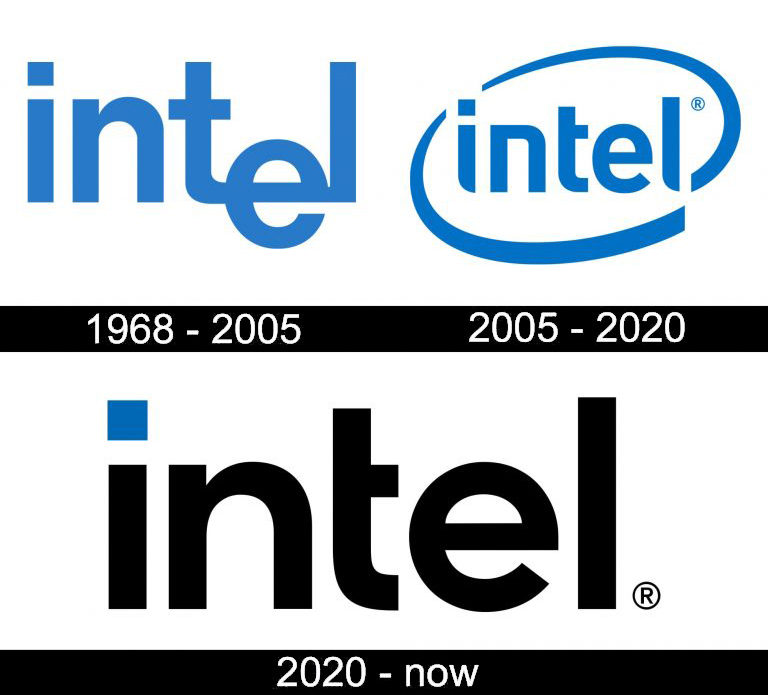
Although Intel remained loyal to its original wordmark for nearly 40 years, the company eventually began refining its identity to reflect new technological eras.
1968–2005: The Dropped-e Era
The original wordmark became a symbol of early Silicon Valley innovation. Its unconventional baseline gave it personality, yet it remained clean and modern. In the early 1990s, Intel launched the Intel Inside campaign—one of the most famous marketing initiatives in tech history—cementing the dropped-e wordmark as a global icon.

2005–2020: The Swoosh Redesign
In 2005, Intel introduced a more corporate, global identity. The logo was wrapped in an elliptical swoosh, representing acceleration, motion, and technological leadership. The typeface was modernized, the iconic dropped e was corrected to align with the baseline, and the logo embraced a polished, international look.
This era coincided with major product launches and partnerships, including Apple’s historic decision to transition to Intel processors.
2020–Today: A Return to Simplicity
The 2020 rebrand ushered Intel into a new design era. The swoosh disappeared. The letters were redrawn with squared corners and precise geometry. The dot above the “i” was transformed into a small blue square—now a symbolic element called The Spark, representing the power inside Intel processors.
The result is a refined, balanced, confident logo that embraces Intel’s heritage while conveying modernity, stability, and technological endurance.
Symbolism Within the Intel Mark
While Intel’s wordmark is deliberately minimalist, its symbolism is profound. The squared-off geometry evokes engineered precision. The blue square above the “i” represents energy, possibility, and the spark of innovation that Intel processors enable for billions of people worldwide.
The removal of embellishments—the swoosh, curved edges, varied fonts—reflects the company’s focus on clarity and sophistication. The logo tells a story of technological evolution and corporate maturity, echoing Intel’s core identity: powerful, with a legacy of dependability.
Intel’s Sonic Logo: A Brand Sound as Iconic as the Visual Mark
Beyond the visual mark, Intel is also famous for one of the most recognizable audio logos in the world. Composed by Walter Werzowa, the Intel Bong—the five-note sonic signature—became instantly universal. Played millions of times across commercials, product launches, and branding materials, it reinforced the Intel identity with every chiming sequence.
Few brands in tech possess both a globally iconic visual logo and an equally famous sonic identity. Intel is one of them.
Branding Legacy: The Endurance of a Tech Icon
The Intel logo is a case study in branding discipline. It rarely changed because it didn’t need to. For decades, consumers trusted Intel not because of flashy design trends but because of the consistency and strength of its engineering legacy. Intel’s wordmark—clean, blue, confident—mirrors the company’s dedication to building the invisible infrastructure of the digital world.
From powering early PCs to enabling cloud computing and AI, Intel’s logo has stood beside every major shift in modern technology. It remains one of the most iconic and respected symbols in the global tech landscape.
Intel’s Visual Heritage: A Legacy That Defines an Industry
Intel’s logo heritage is a testament to the company’s unwavering commitment to innovation, precision, and reliability. Each redesign marks a new chapter in the technological revolution, yet the essence of the brand—clarity, intelligence, and trust—remains unshaken. Today, the Intel logo stands as both a symbol of the past and a beacdon for the future, representing a company that continues to power progress across the globe.
FAQ Intel Logo
What does the Intel logo represent?
It symbolizes technological reliability, precision, and innovation, using clean geometry and Intel Blue to communicate trust and engineering excellence.
Why did Intel change its logo in 2020?
The refresh was designed to embrace simplicity, remove outdated elements, and introduce “The Spark”—a symbol of the power inside Intel technology.
Why is Intel blue?
Blue conveys intelligence, reliability, and technological clarity. It has served as Intel’s primary brand color since 1968.