Indeed Logo History: Meaning, Symbolism & Brand Heritage
Indeed is one of the rare digital platforms whose visual identity feels almost invisible—and that is precisely its strength. In an ecosystem crowded with aggressive colors, icons, and constant redesigns, Indeed built trust by doing the opposite. The brand focused on clarity, restraint, and human-centered design, allowing the service itself to take priority. As the platform grew into the most visited job site in the United States, its logo became a quiet constant, reinforcing reliability rather than chasing attention.
The Indeed logo history aligns closely with the evolution of digital utility brands explored in the LinkedIn logo history and the Glassdoor logo history, where legibility and emotional neutrality matter more than spectacle. Within the wider employment platform logo heritage, Indeed stands as a benchmark for how minimalism, when grounded in meaning, can scale globally without losing credibility.
Meaning and History: The Origin of the Indeed Identity
Indeed was founded in 2004 by Paul Forster and Rony Kahan, with the beta version of the site launching publicly in 2005. The platform introduced a pay-per-click job advertising model that aggregated listings from thousands of sources, including company career pages, recruitment agencies, and job boards. This aggregation-first philosophy shaped the brand’s positioning as a neutral facilitator rather than an intermediary with its own agenda.
By 2010, Indeed surpassed Monster.com to become the highest-traffic employment website in the United States. Later, it became a subsidiary of Recruit Co. Ltd., further reinforcing its global reach. Throughout this rapid growth, the logo meaning remained unchanged: the brand exists to work for people, not to overshadow them.
Logo Symbolism: Human Presence and Quiet Assurance
Indeed logo symbolism is subtle but deliberate. At first glance, the logo appears to be a simple lowercase wordmark. On closer inspection, the customized initial “i” reveals the brand’s core philosophy. The oversized dot and modified stem resemble a human figure, directly referencing the individual job seeker. This interpretation aligns with the platform’s purpose: employment is personal, and careers are built one person at a time.
The small swoosh covering the “i” introduces an additional symbolic layer. It can be read as a shield, suggesting protection, stability, and security—qualities associated with meaningful employment. Rather than using overt icons or mascots, Indeed embeds symbolism directly into typography, allowing the logo to communicate empathy without sacrificing professionalism.
Indeed Logo History Timeline
2004–2021: Human-Centered Wordmark with Iconic “i”
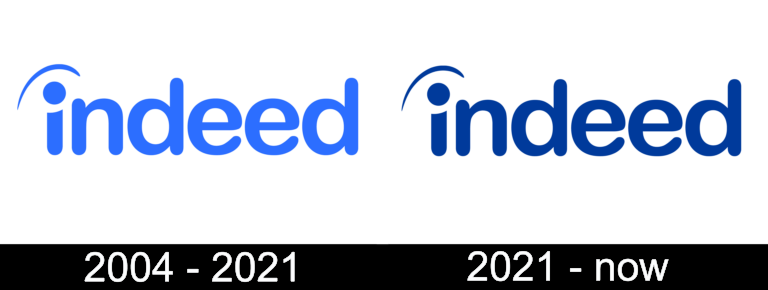
The original Indeed logo, introduced at the time of the brand’s registration in 2004, remained unchanged for more than fifteen years. Executed entirely in lowercase sans-serif lettering, the wordmark featured rounded terminals and slightly varied stroke widths, giving it a soft, almost handwritten quality. This approach conveyed friendliness and accessibility while maintaining business credibility.
The defining feature of this era was the customized “i.” Its exaggerated dot and altered stem created a visual metaphor for a person, reinforced by the swoosh element placed over it. The color palette relied on a bright, optimistic blue, reinforcing approachability and visibility across web interfaces. This version of the logo became deeply associated with trust, consistency, and ease of use during Indeed’s rise to global prominence.

2021–Today: Refined Color for Professional Maturity
In 2021, Indeed introduced a subtle but meaningful update to its visual identity. The structure, typography, and symbolic elements of the logo remained untouched. The only change was color. The lighter blue was replaced with a deeper, calmer shade, shifting the brand’s tone from startup-friendly to institutionally reliable.
This adjustment reflected Indeed’s maturity as a global employment platform. The darker blue reduced visual dominance on the interface, allowing calls to action and job listings to take priority. Rather than signaling reinvention, the update communicated confidence, restraint, and long-term stability—hallmarks of strong logo heritage.
Typography and Color Palette
Typography is the foundation of the Indeed logo description. The custom sans-serif lettering combines rounded forms with balanced proportions, avoiding sharp edges or excessive geometry. This creates a sense of openness without informality. While similar to Arial Rounded Bold, the customized details—particularly in the “i”—give the wordmark a distinct personality.
Color has always centered on blue, a hue associated with trust, calm, and reliability. The transition from a brighter to a darker shade reflects a strategic repositioning rather than aesthetic preference. Blue remains a supporting element, never overpowering the content or user experience.
Indeed Logo as a Case Study in Purposeful Restraint
The Indeed logo history demonstrates that strong branding does not require constant reinvention. By anchoring its identity in human symbolism and typographic clarity, Indeed built a logo heritage that scales effortlessly across cultures, devices, and markets. The brand’s reluctance to redesign aggressively is not conservatism—it is discipline.
In a digital environment where trust is fragile and attention is fleeting, Indeed’s logo proves that consistency, empathy, and restraint can be more powerful than visual noise.
FAQ: Indeed Logo Meaning and History
What does the Indeed logo represent?
The logo represents people and employment security, symbolized through a human-like “i” and subtle protective elements.
Why is the Indeed logo lowercase?
Lowercase lettering conveys approachability and accessibility while maintaining clarity and professionalism.
What changed in the Indeed logo in 2021?
Only the color changed. The brand adopted a darker blue to reflect maturity and reliability while preserving the original design.
Who owns Indeed today?
Indeed is owned by Recruit Co. Ltd., a global human resources and staffing company.