IBM Logo History: Meaning, Symbolism & Brand Heritage
Few corporate identities in the modern world carry the same weight and recognition as IBM. Often referred to as Big Blue, IBM is not only one of the oldest technology companies still operating today, but also one whose visual identity became a benchmark for corporate logo design in the digital age.
The IBM logo history is inseparable from the history of global computing itself. From early mechanical devices to artificial intelligence and quantum computing, IBM’s evolution is mirrored in a logo system that moved from ornate industrial symbolism to one of the most iconic modernist marks ever created.
Meaning and History: The Origin of the IBM Logo
IBM’s origins trace back to the late 19th century, when several companies specializing in timekeeping, scales, and tabulation devices began shaping the foundations of information processing. In 1911, financier Charles Ranlett Flint merged these firms into the Computing-Tabulating-Recording Company (CTR).
The name International Business Machines was officially adopted in 1924, signaling a strategic shift toward large-scale data processing and international ambition. This rebranding marked the moment IBM began to see itself not as a manufacturer of machines, but as a global business infrastructure provider.
From the beginning, IBM treated its logo not merely as a nameplate, but as a statement of trust, precision, and forward thinking—qualities that would later define its role in the technology sector.
IBM Logo History Timeline
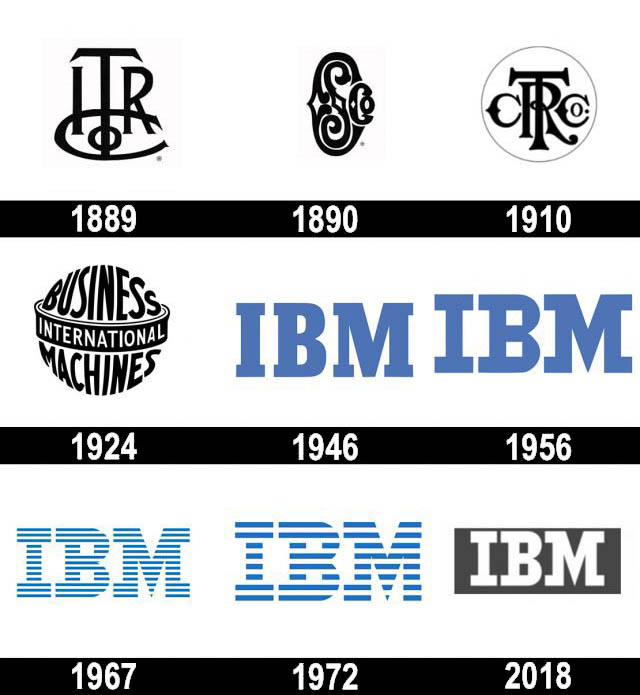
1889–1914: International Time Recording Company (ITRCo)
One of IBM’s earliest predecessors, the International Time Recording Company, introduced a refined serif monogram in 1889. The ITRCo lettering was elegant and conservative, reflecting the precision and reliability expected from industrial time-recording devices.
This logo established a tone of mechanical accuracy and professionalism that would persist across IBM’s early visual identity.
1890–1914: Computing Scale Company (CSCo)
Another foundational company, the Computing Scale Company, used a decorative CSCo monogram. The lettering was ornate, with the central “S” embedded within a wishbone-shaped “C,” followed by a smaller “Co.”
This emblem reflected late-19th-century design sensibilities and emphasized craftsmanship rather than abstraction.
1910–1924: Computing-Tabulating-Recording Company (CTR)
Following the merger into CTR, a new logo was introduced in 1910. The emblem featured a circular frame enclosing the letters CTR, rendered in a custom serif typeface.
The wishbone-style “C,” elongated tail of the “R,” and formal symmetry conveyed institutional authority. This logo marked the transition from independent manufacturers to a unified data-processing enterprise.
1924–1947: The Global Vision of International Business Machines
In 1924, CTR was renamed International Business Machines, and a dramatically new logo followed. The design transformed the company name into a globe-like structure, with “Business” and “Machines” forming the top and bottom arcs, separated by an equatorial band carrying the word “International.”
This globe symbolized IBM’s ambition to operate on a global scale and positioned the company as a worldwide technology leader long before digital globalization became a reality.
1947–1956: The Birth of the IBM Initials
In 1947, the company officially shortened its name to IBM. The new logo reflected this simplification: a bold serif wordmark in light blue, composed of massive, square-like capital letters.
This was IBM’s first truly minimalist logo, signaling a departure from illustrative symbolism toward typographic authority.
1956–1967: Refinement and Structure
The 1956 redesign refined the serif wordmark. The serifs became longer and more pronounced, and the internal shapes of the letters were clarified. The “B” gained two square counters, reinforcing the geometric logic of the design.
This version laid the groundwork for what would soon become one of the most famous logos in design history.
1967–1972: The Striped Experiment
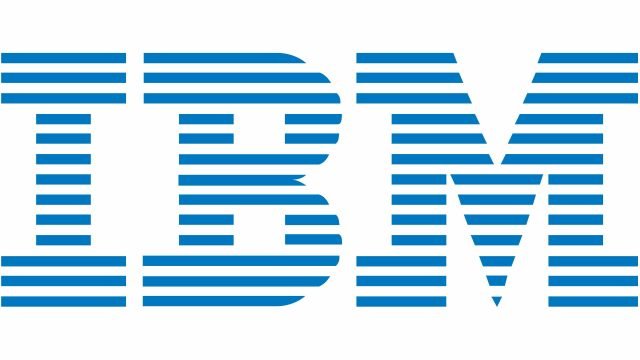
In 1967, IBM introduced a horizontally striped version of its logo. The letters were divided into 13 equal horizontal bars, giving the mark a sense of motion and rhythm.
The stripes reflected the emerging digital era, symbolizing data flow, speed, and technological progress.
1972–2018: Paul Rand’s Eight-Bar Icon
The definitive IBM logo was introduced in 1972, designed by legendary graphic designer Paul Rand. The number of stripes was reduced from 13 to 8, making the logo bolder and more legible.
Rendered in a deep blue, the eight-bar logo became a universal symbol of corporate modernism. It represented innovation, accessibility, and reliability, and later earned a place in the Museum of Modern Art as a design classic.
This version defined IBM’s identity for nearly half a century.
2018–Today: Dual Identity and Corporate Flexibility
In 2018, IBM reintroduced its solid 1956-style wordmark in white, placed on a dark gray rectangular background. Rather than replacing the striped logo, this version exists alongside it.
The dual-logo strategy allows IBM to balance heritage with modern branding needs, using the striped logo as a symbol of legacy and the solid mark for digital and enterprise contexts.
Logo Symbolism: Stripes, Structure, and Trust
The symbolism of the IBM logo is deeply conceptual. The stripes suggest movement, data streams, and technological flow, while the solid letterforms communicate stability and authority.
The eight bars also reinforce accessibility—Paul Rand famously stated that the striped design symbolized IBM’s openness and availability to the public, rather than secrecy or elitism.
Typography and Color in the IBM Logo
IBM’s custom serif typeface is one of its most distinctive features. The square counters of the “B” and the inward-cut serifs of the “M” give the logo a mechanical yet human feel—precision without coldness.
Color plays an equally important role. The iconic blue earned IBM its Big Blue nickname and became synonymous with trust, intelligence, and enterprise reliability. Even when rendered in grayscale, the logo retains its authority.
IBM Logo Heritage and Design Legacy
IBM’s logo heritage is unmatched in corporate branding. Few logos have remained relevant for over 50 years while becoming cultural icons beyond their industry.
Paul Rand’s IBM logo influenced generations of designers and set the standard for how technology companies communicate visually—clear, confident, and conceptually rich.
IBM Logo Meaning and Evolution: Conclusion on Corporate Logo Heritage
The IBM logo history is a study in disciplined evolution. Rather than chasing trends, IBM refined a single idea—strong typography paired with conceptual symbolism—until it became timeless.
Its meaning, rooted in trust, innovation, and global vision, remains as relevant today as it was in the early days of computing. As technology continues to evolve, IBM’s logo stands as proof that strong design can transcend eras.
FAQ: IBM Logo Meaning, Symbolism, and History
Who designed the iconic IBM logo?
The eight-bar IBM logo was designed by Paul Rand in 1972.
Why does the IBM logo have stripes?
The stripes symbolize motion, data flow, progress, and accessibility.
What does “Big Blue” mean?
It refers to IBM’s signature blue color and its corporate identity.
When was IBM founded?
IBM traces its origins to 1889, with the name IBM adopted in 1924.
Is the striped IBM logo still used today?
Yes, it is still used alongside the modern solid wordmark.