Hyatt Logo History: Meaning, Symbolism & Brand Heritage

Hyatt stands among the most influential names in global hospitality, representing a portfolio that spans luxury, lifestyle, wellness, and premium accommodations across dozens of countries. From its origins in postwar America to its current position as a multi-brand international group, Hyatt has cultivated a visual identity that emphasizes elegance, trust, and emotional connection. The Hyatt logo history reflects this journey clearly, evolving from a traditional hotel insignia into a refined corporate wordmark that communicates sophistication through restraint. When examined alongside legacy hospitality identities such as the Hilton logo history and the modernized elegance explored in the Marriott logo heritage, Hyatt occupies a distinct position within global hotel logo history, defined by timeless design rather than frequent reinvention.
The Hyatt logo meaning is deeply connected to the brand’s philosophy of care, continuity, and connection. Rather than relying on literal hospitality symbols, the logo expresses warmth and assurance through typography, color, and a singular, highly symbolic gesture embedded within its wordmark.
Meaning and History: The Origin of the Hyatt Identity
Hyatt was founded in 1957 in Los Angeles, California, when Jay Pritzker acquired the original Hyatt House near Los Angeles International Airport. From the beginning, Hyatt was conceived as a premium hospitality brand focused on comfort, service quality, and architectural distinction. Over the decades, the company expanded steadily, evolving into Hyatt Corporation and later Hyatt Hotels Corporation, with a diverse portfolio spanning luxury, lifestyle, and all-inclusive segments.
This evolution influenced the brand’s visual identity. The logo origin reflected Hyatt’s desire to be perceived not merely as a hotel operator, but as a refined, people-centered hospitality company. While early branding leaned toward traditional hotel symbolism, later iterations placed greater emphasis on emotional resonance and brand recognition.
The logo meaning developed alongside Hyatt’s growth. Each redesign preserved continuity while subtly aligning the visual language with contemporary expectations of luxury and trust, ensuring the brand remained relevant without sacrificing heritage.
Logo Symbolism: Connection, Elegance, and Continuity
The Hyatt logo symbolism is deliberately understated yet deeply intentional. At the center of the modern identity is the distinctive arched line that crosses the letter “A.” This arc functions as the logo’s primary symbolic element, often interpreted as a bridge. It represents connection between past and future, between the brand and its guests, and between destinations and experiences.
Color symbolism reinforces this message. Blue conveys calm, reliability, and professionalism, qualities essential to hospitality trust. Red appears sparingly, emphasizing warmth, care, and emotional engagement rather than dominance. White space enhances clarity and sophistication, allowing the logo to feel open and welcoming.
Unlike logos that rely on ornate crests or architectural motifs, Hyatt’s symbol communicates luxury through simplicity, aligning with modern hospitality expectations while retaining a timeless quality.
Hyatt Logo History Timeline
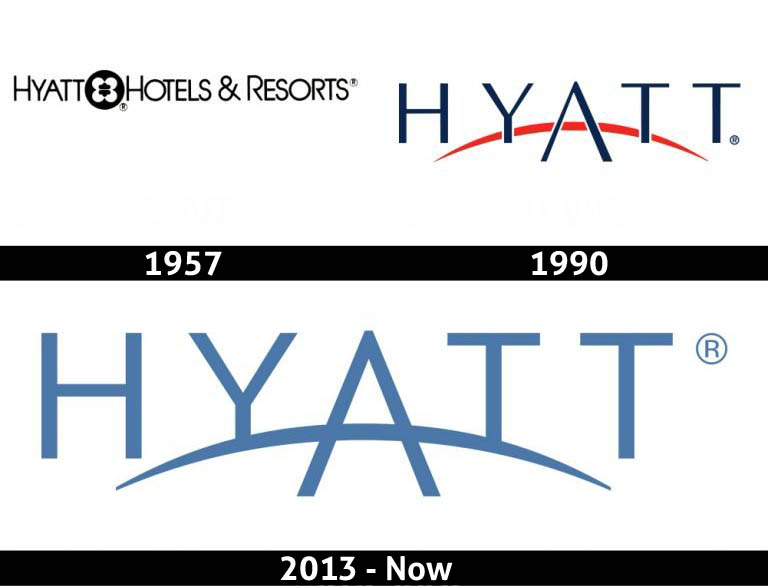
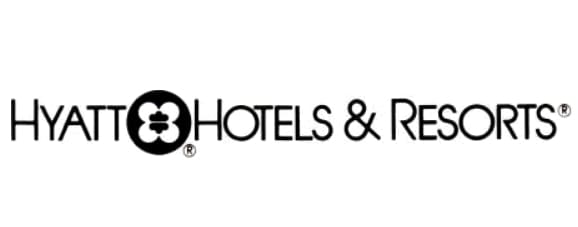
1957–1990: Traditional Hospitality Identity and Floral Symbol
The original Hyatt logo, introduced in 1957, reflected the conventions of mid-century hospitality branding. It featured a clean, monochrome wordmark set in an elegant sans-serif typeface. The name “Hyatt” was visually separated from “Hotels & Resorts” by a circular emblem.
Within this emblem appeared a stylized four-petal flower rendered in white against a dark background. The floral symbol conveyed refinement, welcome, and comfort, aligning with Hyatt’s early positioning as a premium hotel destination. This logo remained in use for nearly three decades, establishing a foundation of trust and recognition.
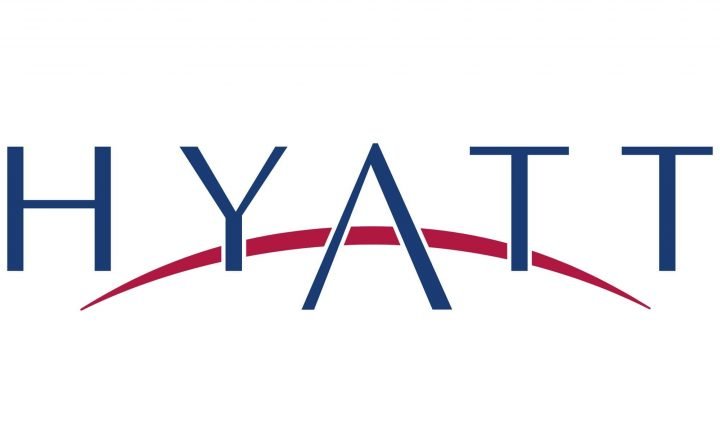
1990–2013: Wordmark-Centered Identity and Symbolic Bridge
The 1990 redesign marked the most significant transformation in Hyatt’s visual identity. The new logo abandoned auxiliary symbols and elevated the brand name itself as the central focus. The wordmark adopted a thin, elegant sans-serif typeface rendered in blue, emphasizing sophistication and clarity.
The defining feature of this redesign was the enlarged letter “A,” crossed by a thin red arched line that replaced its horizontal bar. This arc introduced a powerful yet subtle symbolic element, interpreted as a bridge connecting Hyatt’s heritage with its future and symbolizing the relationship between the brand and its guests.
This redesign established the core visual language that continues to define Hyatt today.
2013–Present: Refined Color Palette and Contemporary Clarity
In 2013, Hyatt refined its logo to enhance legibility and modern appeal. The blue tone was softened into a lighter, more contemporary shade, while the red arc was retained as the brand’s defining accent. The wordmark became slightly bolder and more structured, improving visibility across digital and physical environments.
This update did not alter the logo’s concept, reinforcing Hyatt’s commitment to continuity. The result is a clean, flexible identity that performs effectively across signage, digital platforms, and global brand communications.
Typography and Visual Construction
Typography plays a critical role in the Hyatt logo meaning. The custom typeface, closely related to Optima, features fine, balanced strokes that convey elegance without excess ornamentation. Its clarity ensures instant recognition while supporting a sense of calm and professionalism.
The spacing and proportions of the wordmark are meticulously balanced, allowing the red arc to function as a focal point without overwhelming the composition. This harmony contributes to the logo’s timeless and versatile character.
Hyatt Logo Heritage and Brand Positioning
The Hyatt logo heritage is defined by restraint and confidence. Rather than frequent redesigns, Hyatt chose to evolve its identity through refinement. This approach reinforces trust and positions the brand as stable, reliable, and enduring.
Hyatt’s logo aligns with its broader brand positioning as a hospitality company that values emotional connection and consistent quality. The visual identity supports the perception of Hyatt as both luxurious and approachable, distinguishing it within the competitive global hospitality market.
Hyatt Logo History and Timeless Hospitality Design
The Hyatt logo history demonstrates how a hospitality brand can achieve longevity through simplicity and symbolic clarity. From its early floral emblem to its refined wordmark with a singular, meaningful accent, Hyatt’s visual identity reflects continuity, elegance, and care. Within the broader context of hotel logo heritage, Hyatt stands as a compelling example of how thoughtful design can embody both tradition and modernity without compromise.
FAQ: Hyatt Logo Meaning and History
What does the Hyatt logo represent?
The logo represents connection, trust, and elegance, symbolized by the arched line crossing the letter “A.”
Why does the Hyatt logo include a red arc?
The red arc symbolizes a bridge, representing connection between guests and the brand, as well as Hyatt’s past and future.
Has the Hyatt logo changed significantly over time?
Hyatt redesigned its logo most significantly in 1990, with later updates focused on refinement rather than reinvention.
What does the blue color in the Hyatt logo symbolize?
Blue represents calm, reliability, professionalism, and trust, core values in hospitality.