
Honeywell Logo History: Meaning, Symbolism & Brand Heritage
Few industrial brands have navigated more dramatic shifts in visual identity than Honeywell. Over more than eleven decades, this American powerhouse has transformed from a regional heating-controls company with a dense Gothic wordmark into a global technology leader known for one of the cleanest, most contemporary logotypes in the corporate world. The evolution of its logo is a direct reflection of Honeywell’s own transformation: expanding from thermostats and mechanical systems to aerospace, defense, automation, building systems, and advanced materials.
What makes the Honeywell logo heritage especially compelling is the way it mirrors the growth of the broader American industrial age. From ornate Old-World letterforms to streamlined modernism, the Honeywell wordmark stands today as a symbol of reliability, engineering precision, and forward-looking innovation.
Meaning & Symbolism
The contemporary Honeywell logo is defined by clarity and confidence. Its bold red typography conveys reliability and urgency, a visual language rooted in the company’s presence within high-stakes sectors such as aerospace, safety systems, and critical industrial technologies. Red reflects action, energy, and alertness, elements that align with Honeywell’s mission to create secure, intelligent, and high-performance environments.
In contrast to brands that rely on abstract symbols, Honeywell has consistently used strong wordmarks to express identity. This choice reflects its heritage in engineered systems, where precision and clarity matter more than ornamentation. Over the decades, Honeywell simplified its typography until all traces of decorative flourish were removed, leaving a powerful, modern text-based identity that projects trust and stability.
Logo History and Evolution Timeline
1924–1937 — The Gothic Industrial Era
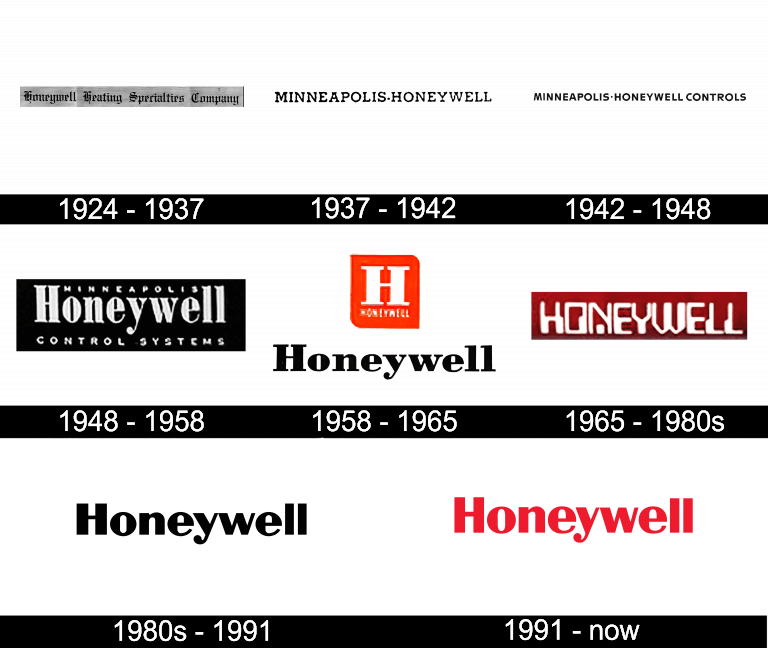
Honeywell’s earliest known wordmark was a long, intricate Gothic inscription reading “Honeywell Heating Specialties Company.” The design reflected early 20th-century industrial America, where Gothic and blackletter scripts were commonly associated with craftsmanship and technical rigor. Its heavy strokes and historic forms conveyed the seriousness of a company specializing in heating technologies.

1937–1942 — A Transition Toward Modern Simplicity
In 1937, the identity shifted from Gothic complexity to a more refined serif wordmark reading “Minneapolis • Honeywell.” The updated lettering was more formal, with shorter serifs and clearer readability, marking Honeywell’s move from a niche manufacturer toward a broader industrial role.

1942–1948 — Functional Modernism Emerges
By 1942, Honeywell embraced a full sans-serif design, replacing decorative strokes with mechanical precision. The inclusion of the word “Controls” reflected the company’s growing leadership in automated and electromechanical regulation systems. This era marked Honeywell’s first true step into modern corporate branding.

1948–1958 — The Framed Industrial Identity
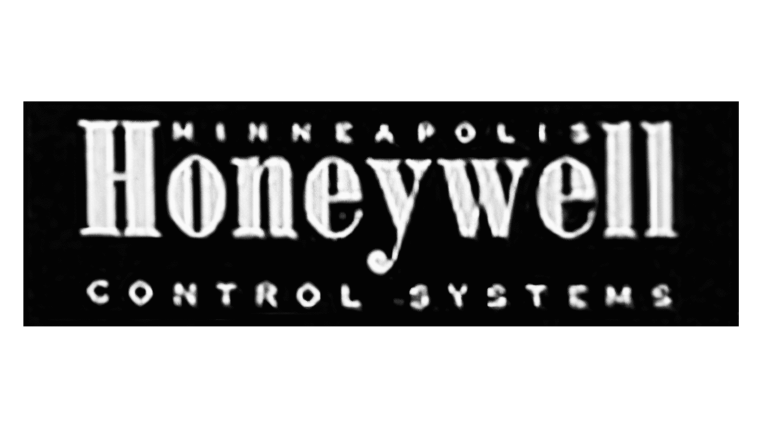
A new direction appeared in 1948: a solid black rectangular block featuring “Honeywell” in bold, serif lettering. The small “Minneapolis” inscription tucked between the “H” and “ll” added specificity without clutter. Beneath the primary name, “control systems” completed the composition. The structured layout reflected strong engineering foundations and expanding product capability.
1958–1965 — The Red Square Monogram
In 1958, Honeywell introduced its first dedicated emblem: a red square with a white “H.” Beneath it sat a reduced wordmark also in sans serif. The use of color for the first time signaled a more confident, corporate approach to visual identity. The monogram became a recognizable symbol across technical documentation and product labels.

1965–1980s — Streamlined Geometry for a New Technological Age
The 1965 redesign placed a bold white wordmark inside a bright red rectangle. The typography became sharper, geometric, and more futuristic, reflecting the company’s deeper involvement in emerging aerospace technology and automation. This design exuded industrial confidence and contained the strongest sense of mid-century modernism in the brand’s history.

1980s–1991 — Minimalistic Precision
As corporate aesthetics moved toward stripped-down clarity in the 1980s, Honeywell shifted back to a black sans-serif wordmark based on the 1958 typography but with sleeker proportions. This minimalist phase aligned with the global trend toward clean corporate design.

1991–Today — The Iconic Red Wordmark
The modern Honeywell logo, introduced in 1991, transformed the wordmark into its now-famous red. This shift in color established Honeywell as a brand of urgency and high-impact engineering. The bright red inscription is instantly recognizable and has remained unchanged for more than three decades, proving the timeless strength of its simple geometry.
Font & Typography
The Honeywell wordmark uses a bold sans-serif typeface closely related to Britannic Bold, with confident vertical lines, tightly balanced proportions, and rounded corners that prevent the typography from feeling overly rigid. Its strength lies in its clarity: every letter is designed for immediate legibility at any size, whether stamped onto industrial equipment or displayed on digital interfaces.
Typography has always played a central role in Honeywell’s brand identity. As the company modernized, the scripts and serifs of earlier eras gave way to clean forms that evoke efficiency and accuracy—qualities essential to a brand operating in aerospace systems, building automation, fire safety, and advanced materials.
Color Palette
Honeywell’s contemporary visual identity is built on a vibrant, high-visibility red:
Pantone 485C — Hex #DE0031
Against a pure white backdrop, the red wordmark amplifies visibility and creates a dynamic, energetic presence. Black (#191A00) also plays a supporting role in the corporate palette, used for secondary communications, technical diagrams, and product labeling. The palette emphasizes urgency, technological precision, and global recognizability.
A Logo That Traces a Century of Innovation
The Honeywell logo heritage tells a remarkable story: a journey from ornate Gothic scripts to one of the most iconic wordmarks in modern industry. Across more than 110 years, each iteration captured a specific moment in Honeywell’s evolution—its early craftsmanship, its post-war mechanical leadership, its mid-century engineering expansion, and its modern position as a global technology innovator.
Today’s Honeywell logo is the culmination of that legacy: bold, contemporary, unmistakable. It stands as a symbol of reliability across sectors where precision and trust matter most. When viewed through the lens of logo heritage, the Honeywell identity is not merely a graphic choice—it’s a testament to a century of transformation, discipline, and technological ambition.
FAQ — Honeywell Logo & Brand Identity
What does the Honeywell logo represent?
The red Honeywell wordmark represents energy, reliability, and technological authority. Its simplicity reflects the brand’s modern engineering ethos.
Why is the Honeywell logo red?
Red was adopted in 1991 to create maximum visibility and communicate urgency and innovation—qualities associated with Honeywell’s advanced systems.
Has Honeywell always used a wordmark?
Yes. While earlier versions were more ornate, Honeywell has relied on word-based identity since the early 1900s.
What font does the Honeywell logo use?
The typeface is similar to Britannic Bold with customized proportions.
Is the Honeywell logo trademarked?
Yes. Usage requires permission from Honeywell and compliance with its brand guidelines.