Hilton Logo History: Meaning, Symbolism & Brand Heritage
Hilton is one of the foundational names in global hospitality, a brand that helped define what modern hotel chains look like in terms of scale, consistency, and service standards. Since its early expansion in the mid-20th century, Hilton has positioned itself as a symbol of reliability and structured comfort, capable of serving diverse traveler needs across continents. The Hilton logo history reflects this ambition, evolving from ornate heraldic imagery to a disciplined, architecture-inspired mark that emphasizes structure and authority. When analyzed alongside other legacy hotel identities such as the Marriott logo history and the group-level clarity explored in the IHG logo, Hilton represents a benchmark within global hotel logo history.
The Hilton logo meaning centers on order, stability, and completeness. Rather than evoking leisure or escapism, Hilton’s visual identity has consistently communicated trust, organization, and professional hospitality at scale.
Meaning and History: The Origin of the Hilton Identity
Hilton was founded on May 31, 1919, by Conrad Hilton, who purchased his first hotel in Cisco, Texas. From the outset, Hilton’s approach differed from that of independent hoteliers. The focus was not only on accommodation but on creating a repeatable service model that could scale across locations.
Throughout the 20th century, Hilton pioneered several industry innovations, including centralized reservation systems and standardized guest amenities. As the company expanded internationally, visual identity became a strategic necessity. The logo origin reflects Hilton’s transition from a single hotel operator into a multinational hospitality system.
Over time, Hilton’s corporate structure evolved, eventually separating brand-level identities such as Hilton Hotels & Resorts from the parent company structure later known as Hilton Worldwide. This structural distinction influenced the development of parallel but related logo systems.
Logo Symbolism: Structure, Stability, and Assurance
The Hilton logo symbolism is grounded in architectural language. The recurring “H” monogram, framed or enclosed, evokes the idea of a gateway or foundation, suggesting both welcome and security. Its symmetrical construction communicates balance and order, reinforcing Hilton’s promise of consistency regardless of location.
Circular and oval framing elements introduced in later versions add continuity and completeness, visually enclosing the brand promise. These shapes function as metaphors for protection and reliability, qualities central to Hilton’s positioning as a full-service global hotel brand.
Color symbolism further supports this message. Shades of blue dominate Hilton’s identity, conveying trust, professionalism, and calm authority. Occasional use of metallic tones such as silver or gold emphasizes premium quality without shifting into overt luxury symbolism.
Hilton Logo History Timeline
1948–1967: Heraldic Origins and Traditional Prestige
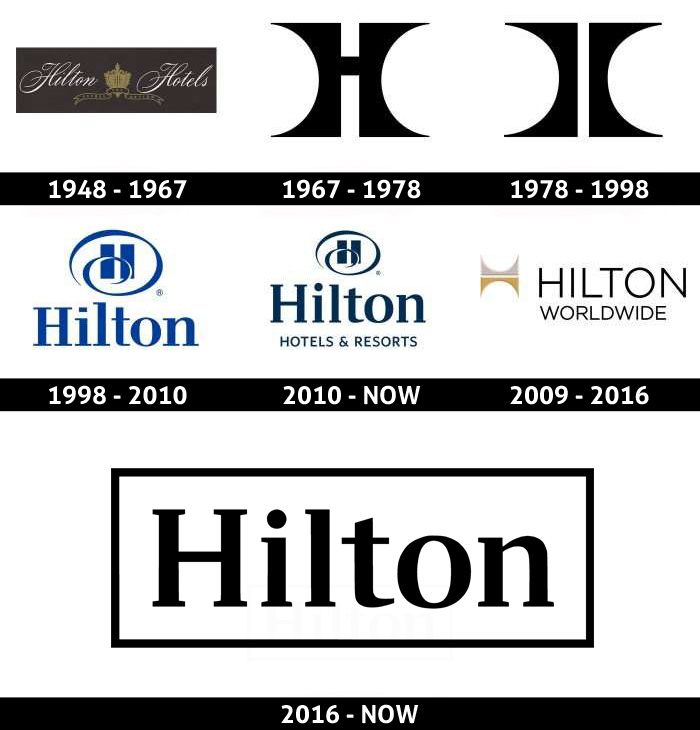
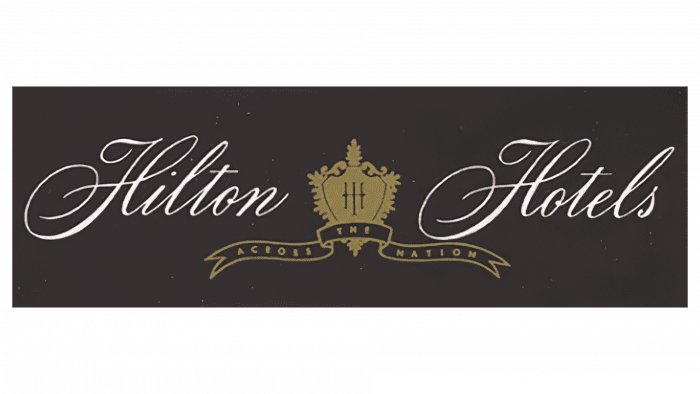
The earliest Hilton Hotels & Resorts logo introduced in the postwar era featured a horizontally oriented black rectangle containing a shield-shaped emblem. The crest-like form incorporated ornamental details, including a ribbon and decorative flourishes, evoking traditional heraldry.
Flanking the emblem were cursive inscriptions reading “Hilton” and “Hotels,” executed in an Old English-style script with thin, elegant strokes. This design reflected early hospitality branding conventions, emphasizing prestige and formality at a time when hotel chains were still rare.
1967–1978: Birth of the Architectural “H” Monogram
In 1967, Hilton introduced one of its most important visual shifts. The ornate crest was replaced by a minimalist symbol centered on a capital “H.” The letter was stylized with thick vertical stems and elongated terminals, resembling two architectural arches connected by a thin crossbar.
This abstraction marked Hilton’s transition into modern corporate branding. The monogram communicated structure, modernity, and confidence, aligning with the brand’s expanding international footprint.

1978–1998: Simplification and Icon Consolidation
By 1978, the central connecting bar was removed, leaving two symmetrical vertical forms that suggested an open gateway. The color, proportions, and general structure remained unchanged, reinforcing brand continuity.
This version strengthened the monogram’s independence, allowing it to function as a standalone symbol across signage and marketing materials.

1998–2010: Brand Differentiation and Serif Authority
Towards the end of the 1990s, Hilton’s corporate structure became more complex. During this period, the Hilton Hotels & Resorts logo combined the iconic “H” symbol with a bold serif wordmark placed beneath it.
The lettering featured elongated proportions and pronounced serifs, reinforcing authority and heritage. A thin spiral element was introduced around the “H,” replacing the central bar and adding a sense of motion and refinement.

2010–Today: Refined Consistency and Brand Clarity
The current Hilton Hotels & Resorts logo retains the core structure introduced in earlier decades. The blue tone was intensified, serifs were softened, and letterforms were slightly rounded to improve digital readability. The descriptor “Hotels & Resorts” was added beneath the main name in uppercase sans-serif lettering, clarifying brand scope.
This version balances heritage and modernity, ensuring relevance across physical properties and digital platforms.
2009–2016: Hilton Worldwide Corporate Identity
Following the formal separation of brand and corporate structures, Hilton Worldwide adopted a distinct logo. The familiar “H” elements were rotated ninety degrees, forming a shape resembling a gate or crown. Rendered in silver and gold tones, the emblem communicated corporate leadership rather than guest experience.
The accompanying “Hilton Worldwide” wordmark appeared in a clean sans-serif typeface, reinforcing the distinction between parent company and hotel brand.
2016–Today: Framed Wordmark and Holding Identity
The modern Hilton Worldwide logo simplified this approach further, presenting the Hilton name enclosed within a rectangular frame. The serif lettering remained consistent with the flagship brand, ensuring visual lineage while signaling a governance-focused identity rather than a consumer-facing one.
Typography and Visual Construction
Typography is central to the Hilton logo meaning. The combination of serif and sans-serif typefaces reflects a balance between heritage and clarity. Wide letter spacing enhances legibility, while strong vertical strokes echo architectural stability.
The emblem and wordmark are designed to function both together and independently, allowing flexible application across thousands of properties worldwide.
Hilton Logo Heritage and Brand Positioning
The Hilton logo heritage is defined by evolution through refinement rather than reinvention. While decorative elements were gradually removed, the underlying architectural concept remained intact. This continuity reinforces trust and recognition, essential for a brand operating at global scale.
Positioned as a full-service hospitality leader, Hilton uses its logo to communicate assurance rather than aspiration. The identity signals that every operational detail is structured, controlled, and dependable.
Hilton Logo History and Global Hospitality Authority
The Hilton logo history illustrates how disciplined design can support a century-long brand legacy. From heraldic beginnings to architectural minimalism, the logo mirrors Hilton’s journey from a single American hotel to a global hospitality system. Within the broader context of hotel logo design, Hilton stands as a model of stability, consistency, and brand authority built through thoughtful evolution.
FAQ: Hilton Logo Meaning and History
What does the Hilton logo represent?
The logo represents stability, structure, and trust, expressed through an architectural “H” monogram.
Why does Hilton use a framed or enclosed emblem?
The framing symbolizes completeness, protection, and assurance for guests worldwide.
When was the modern Hilton logo introduced?
The refined modern version has been in use since 2010, with minor adjustments for digital optimization.
What colors are associated with the Hilton logo?
Blue is the primary color, symbolizing professionalism, reliability, and calm authority.