HBO Logo History: Meaning, Symbolism & Brand Heritage

Few entertainment brands have influenced modern television with the force and longevity of HBO. From a struggling subscription experiment in the early 1970s to one of the world’s most prestigious sources of original programming, HBO’s evolution mirrors the transformation of television itself. Yet through all the company’s dramatic shifts—its expansion into film financing, the rise of cable television, the golden age of original series, and the streaming revolution—its visual identity has remained remarkably consistent.
The simplicity and boldness of the HBO logo reflect the company’s commitment to clarity and premium storytelling. While other networks experimented with color, ornament, and shifting motifs, HBO embraced a minimalist, typographically driven mark that has barely changed since 1980. The result is one of the most recognizable logos in entertainment history, symbolizing authority, cinematic quality, and the promise of exceptional programming.
To understand how the HBO logo achieved such longevity, it is necessary to explore the company’s origins, the challenges it overcame, and the distinct design decisions that shaped its iconic identity.
HBO Meaning and Symbolism
HBO, short for Home Box Office, was conceived as an at-home alternative to the cinema experience. Its name and early branding referenced the traditional box office—the place where moviegoers purchased tickets to theatrical releases. HBO’s mission was simple but ambitious: bring the box office into the living room, offering films, specials, sports events, and eventually groundbreaking original series that viewers could not access anywhere else.
The logo’s simplicity reflects this purpose. Its stark black-and-white palette evokes sophistication and cinematic gravity. The bold uppercase typography communicates confidence and premium quality. Perhaps the most distinctive detail is the circular “O” with a central dot, a shape reminiscent of a camera lens, film reel, spotlight, or aperture. This subtle design gesture visually anchors HBO’s identity in the world of filmmaking and broadcast production. It suggests a company focused on framing stories, capturing performances, and delivering visuals with cinematic intention.
Over time, the symbol came to represent far more than a subscription channel. It embodies HBO’s reputation for boundary-pushing storytelling, editorial fearlessness, and a relentless pursuit of originality.
HBO Logo History & Evolution Timeline
1972–1975: The Cinematic Marquee
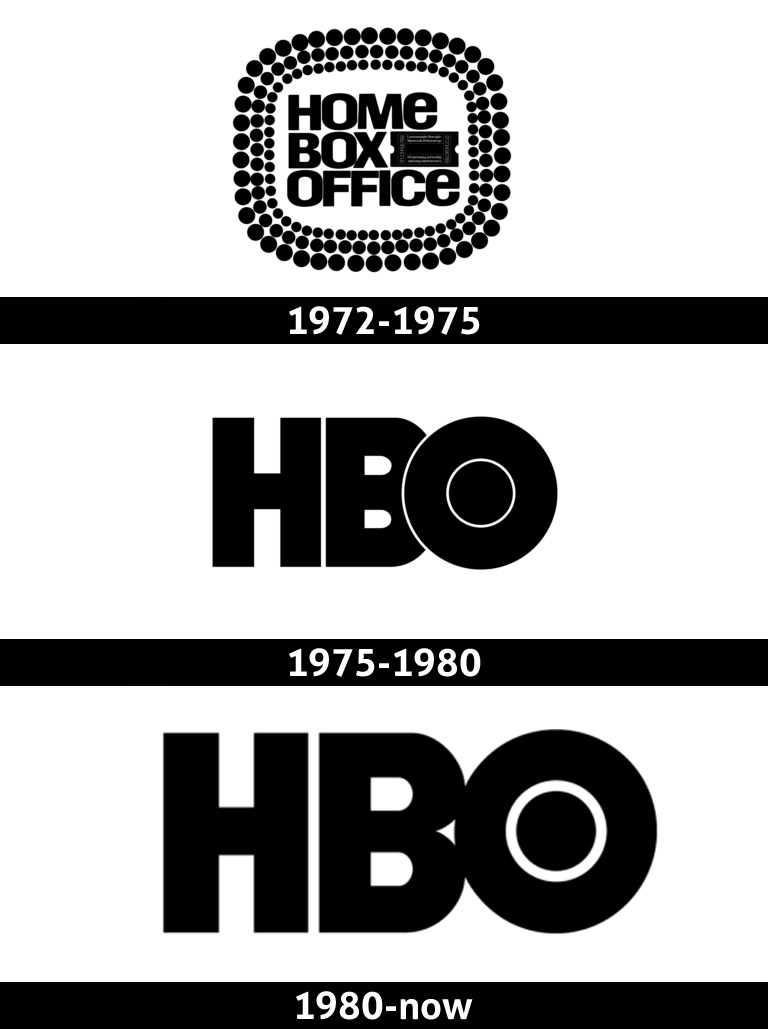
HBO’s first logo reflected the theatrical origins implied by the name Home Box Office. The full words were spelled out in a compact block, positioned beside a stylized ticket stub and surrounded by multiple loops of circular ornaments that resembled marquee lights. The typography, set in Westinghouse Regular, conveyed a retro, entertainment-forward feel. Although visually elaborate, the logo established HBO’s identity as a service rooted in cinematic experience.
However, its complexity worked against it. The dense composition lacked clarity at a distance and proved difficult to reproduce consistently across early cable systems. As HBO began expanding beyond its modest first markets, the company needed a simpler, stronger, and more modern identity.

1975–1980: The Transition to Modern Minimalism
On May 1, 1975, HBO introduced a radically different identity. The lengthy name was replaced with the bold acronym HBO, and the design adopted a modified Avant Garde Gothic Bold typeface. The logo demonstrated newfound confidence. The “H” stood alone, while the “B” overlapped the circular “O,” whose central dot suggested a camera lens or film aperture.
This abstraction created a subtle visual metaphor for moving images and production. More importantly, it was far easier to read, reproduce, and scale. The logo marked HBO’s shift from a small experimental channel into a national broadcast force, coinciding with the network’s historic 1975 satellite transmission of the Ali–Frazier “Thrilla in Manila” fight—a milestone that signaled HBO’s arrival on the national stage.

1980–Present: The Definitive HBO Wordmark
In April 1980, HBO refined the logo into the form that has become globally iconic. The letters were narrowed slightly, the spacing between “H” and “B” widened, and the central dot in the “O” gained more breathing room. These adjustments improved legibility, especially on emerging cable systems and television screens.
The new design was clean, bold, and unmistakable. It eliminated ambiguity in the “B,” ensuring viewers could instantly identify the letters even at a distance or in low resolution. This logo would accompany HBO through its explosive growth in the 1980s and 1990s, through landmark original films and series, and into the prestige era defined by The Sopranos, The Wire, and later Game of Thrones.
The 1980 version remains in use today, a testament to its timelessness and the brand’s dedication to design consistency.
The HBO Max Era
Pre-Launch Concept (2019)
Before the official launch of HBO Max, a preliminary logo appeared on digital platforms. It placed the black HBO mark inside a multicolored rectangle above a large, rounded “max.” The typography and proportions suggested imbalance, with the oversized “max” overshadowing the established strength of the HBO brand. The rectangle created unnecessary visual noise, and the overall composition felt misaligned with HBO’s minimalist legacy.
This concept was ultimately discarded before the platform debuted.
Official Launch (2020): A Balanced Reinterpretation
The finalized HBO Max logo paired the iconic HBO wordmark with a lowercase “max” set in Gilroy, a geometric, semi-rounded typeface. The “max” element featured a gradient blend of purple and ultramarine, invoking energy, vibrancy, and the expansive library that the new service offered.
In contrast to the earlier concept, this design struck the appropriate balance between tradition and innovation. The HBO mark retained its seriousness and legacy, while “max” added color, personality, and the promise of a broader entertainment universe. The pairing reflected a strategic expansion rather than a rebranding, signaling that HBO Max was built on HBO’s identity rather than replacing it.
Design Analysis
The success of the HBO logo stems from its uncompromising simplicity. Its black-and-white palette creates instant contrast and universality, functioning effectively across television, film, digital interfaces, billboards, and streaming platforms. The choice of a modified Avant Garde Gothic Bold typeface contributes to its visual authority—geometric, heavy, and confident.
The lens-like “O” remains the most distinctive component. It subtly communicates filmic origins without resorting to illustration. It creates a focal point and injects personality into an otherwise purely typographic mark. The interaction between the “B” and “O,” where the counter of the O intrudes on the B’s form, maintains dynamic tension while ensuring the letters read cohesively as a single unit.
The logo’s enduring relevance results from its ability to remain modern across decades of design shifts. In an industry full of colorful rebrands, animated marks, and complex visual languages, HBO’s identity has remained anchored in the power of typographic clarity. This makes the brand immediately recognizable, whether projected onto a theater screen or appearing on a smartphone app icon.
The Enduring Power of HBO’s Visual Identity
HBO’s history is a story of reinvention, ambition, and creative risk-taking. Yet amid constant change, its visual identity has remained one of the most stable elements of the brand. From a complicated marquee-style emblem to the sleek acronym recognized worldwide, HBO refined its identity with each iteration until it reached a perfect balance in 1980.
This logo has witnessed the rise of cable television, the explosion of original programming, and the global expansion of streaming media. It has stood beside landmark projects—from early film broadcasts to The Sopranos, from Game of Thrones to contemporary streaming hits—and remains as modern today as the day it debuted.
The HBO logo represents clarity, cinematic authority, and a fearlessness in storytelling. It is a mark that has not only endured but defined an entire era of premium television. Its simplicity is its strength, and its longevity is a tribute to the power of thoughtful, disciplined design.
FAQ: HBO Logo & Brand Identity
What does the HBO logo represent?
The logo represents cinematic quality and premium storytelling. Its bold typography and lens-like “O” evoke filmmaking and broadcast production.
Why has the HBO logo barely changed since 1980?
The design achieved a timeless balance of simplicity, legibility, and visual impact. It remains effective across traditional television and modern digital platforms.
What font is used in the HBO logo?
The logo uses a custom-modified version of Avant Garde Gothic Bold, adapted to create unique spacing and the iconic lens-style “O.”
When did HBO adopt its current logo?
The definitive HBO logo debuted in 1980 and has remained virtually unchanged since.
How is the HBO Max logo related to the original HBO wordmark?
HBO Max retains the original HBO mark and adds a stylized “max” component, creating a balance between heritage and contemporary streaming identity.