
Hampton Inn Logo History: Meaning, Symbolism & Brand Heritage
Hampton Inn represents one of the most successful examples of budget hospitality branding in the United States and beyond. Built on the promise of reliability, cleanliness, and value-driven comfort, the brand has always communicated clarity rather than excess. The Hampton Inn logo history reflects this positioning with remarkable precision, using simple geometry, restrained color, and badge-like construction to signal trust and universality. When viewed alongside other value-oriented hospitality identities such as the Holiday Inn logo history and the streamlined structure explored in the Hilton logo, Hampton Inn occupies a clearly defined space within modern hotel logo history.
The Hampton Inn logo meaning is rooted in balance. It communicates affordability without austerity and familiarity without informality, reinforcing the brand’s promise of dependable stays at accessible prices.
Meaning and History: The Origin of the Hampton Inn Identity
Hampton Inn was founded in 1984 by the Promus Hotel Corporation in Memphis, Tennessee. The brand was conceived as a limited-service hotel concept, designed to deliver essential comfort while eliminating unnecessary extras that typically drive up prices. The first Hampton Inn property was a modest two-story building with 128 rooms, reflecting the brand’s practical philosophy from the very beginning.
As the chain expanded rapidly across the United States, Hampton Inn established itself as one of the largest budget hotel franchises in the country. Over time, the brand evolved into what is now known as Hampton by Hilton, becoming part of the broader Hilton portfolio while preserving its distinct identity.
The logo origin mirrors this evolution. Each stage of the visual identity responded directly to the brand’s operational philosophy, emphasizing clarity, approachability, and standardization rather than visual luxury.
Logo Symbolism: Structure, Universality, and Trust
The Hampton Inn logo symbolism relies heavily on geometric clarity. The emblem’s chevron-like or hexagonal shape conveys structure and order, qualities essential for a brand built on repeatable standards. The resemblance to a badge or nameplate reinforces ideas of identification and assurance, as if each hotel is personally accountable for delivering the promised experience.
The honeycomb-like form introduced in later designs subtly references repetition and modularity, reflecting the standardized room layouts typical of the brand. This symbolism aligns with Hampton Inn’s operational efficiency and franchise-based expansion.
Color symbolism further strengthens this message. Blue communicates trust, calm, and reliability, while red adds warmth and approachability. White functions as a neutral balance, enhancing legibility and reinforcing transparency.
Hampton Inn Logo History Timeline
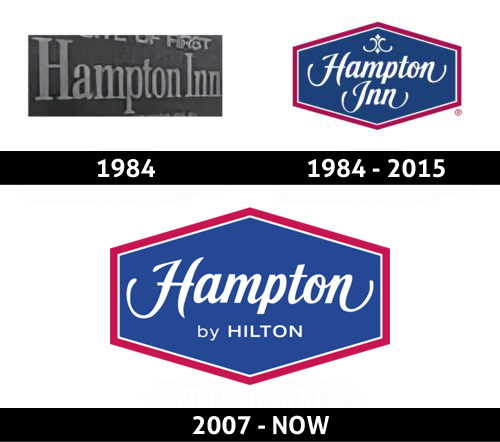
1984: Foundational Wordmark and Practical Identity
The earliest Hampton Inn logo introduced in 1984 was purely typographic. It featured the brand name set in a classic serif typeface reminiscent of Times New Roman. The capitalized initials “H” and “I,” combined with softly rounded lowercase letters, created an understated yet welcoming appearance.
This minimalist wordmark reflected the brand’s early positioning as a practical lodging option. Its simplicity inspired trust and made the name easy to recognize, aligning with Hampton Inn’s focus on clarity and accessibility.

1984–2015: Geometric Badge and Brand Recognition
Later in 1984, Hampton Inn introduced a more distinctive emblem that would define the brand for decades. The logo adopted a horizontal rhombus with truncated ends, effectively forming a flattened hexagon. This shape resembled a honeycomb cell, symbolizing a structured environment composed of many similar, reliable units.
The emblem featured a red outer frame, a white inner border, and a deep blue central field. The brand name appeared in a cursive, handwritten-style script, adding warmth and approachability. Decorative elements at the top, including miniature rhombuses and semicircles, introduced subtle sophistication without compromising the budget-focused message.
This logo became one of the most recognizable symbols in American midscale hospitality, reinforcing Hampton Inn’s reputation for consistency and value.
2007–Today: Hampton by Hilton and Refined Consistency
Following the brand’s integration into the Hilton portfolio, the logo was refined to reflect its new positioning as Hampton by Hilton. The emblem retained its flattened hexagonal shape, ensuring continuity and recognition, but the typography was restructured into a two-line composition.
The upper line features a semi-connected, italicized script with lowercase letters, preserving the brand’s friendly tone. The lower line introduces a clean, printed sans-serif inscription reading “by Hilton,” with restrained spacing and clear hierarchy. This addition strengthened brand association while maintaining Hampton’s independent identity.
The color palette was slightly lightened, and the composition became more balanced for digital and physical applications. This version remains in use today, supporting Hampton’s global expansion across dozens of countries.
Typography and Visual Construction
Typography plays a central role in the Hampton Inn logo meaning. The combination of calligraphic and sans-serif fonts reflects the brand’s dual promise: warmth and professionalism. The script-like upper wordmark adds personality, while the precise lower inscription communicates structure and brand alignment.
Spacing, framing, and symmetry are carefully controlled, allowing the emblem to function as a compact badge across signage, digital platforms, and printed materials.
Hampton Inn Logo Heritage and Brand Positioning
The Hampton Inn logo heritage is built on consistency rather than reinvention. While typography and color have been refined, the core geometric badge has remained intact for decades. This continuity reinforces trust, especially important for budget-conscious travelers seeking predictable quality.
Positioned within the Hilton ecosystem, Hampton Inn serves as a dependable entry point, offering essential comfort without unnecessary complexity. The logo supports this role by communicating honesty, order, and value.
Hampton Inn Logo History and Reliable Hospitality Design
The Hampton Inn logo history demonstrates how restrained design can achieve lasting recognition. Through clear geometry, balanced color, and thoughtful typography, the brand’s visual identity reflects its operational philosophy with precision. Within the broader narrative of hotel logo heritage, Hampton Inn stands as a model of how simplicity and structure can build one of the most trusted names in budget hospitality.
FAQ: Hampton Inn Logo Meaning and History
What does the Hampton Inn logo represent?
The logo represents structure, reliability, and accessible comfort through its geometric badge design.
Why does the Hampton Inn logo resemble a hexagon or chevron?
The shape symbolizes order, modularity, and standardized hospitality.
When did Hampton Inn become Hampton by Hilton?
The brand adopted the Hampton by Hilton name as part of its integration into the Hilton portfolio in the mid-2000s.
What colors are used in the Hampton Inn logo?
The logo primarily uses blue, red, and white to convey trust, warmth, and clarity.