
Hamilton Logo History: Meaning, Symbolism & Brand Heritage
When Hamilton premiered in 2015, it did far more than redefine musical theater. Created by Lin-Manuel Miranda, the production reshaped how historical narratives could be told—using hip-hop, R&B, and contemporary storytelling to revisit the life of Alexander Hamilton. Yet beyond the revolutionary score and choreography, Hamilton also established one of the most striking and recognizable visual identities in modern theater history.
The Hamilton logo is a masterclass in contrast and symbolism. It fuses historical gravitas with modern boldness, using minimal elements to communicate ambition, rebellion, and legacy. Its logo history is short in terms of iterations, but extraordinarily rich in meaning, making it a defining example of logo heritage within performing arts branding.
Meaning and History: The Origin of the Hamilton Logo
From its earliest development stages, Hamilton was conceived as a break from traditional Broadway aesthetics. Although the story unfolds in 18th-century America, the creators deliberately avoided period-accurate visual tropes. Instead, the brand identity was designed to feel contemporary, disruptive, and instantly recognizable.
The logo origin reflects this philosophy. Rather than portraits, crests, or ornamental typography, Hamilton relies on stark symbolism: a single figure, a star, and an uncompromising color palette. This approach positioned the musical not as a nostalgic historical retelling, but as a living, modern cultural statement.
The visual identity played a crucial role in the show’s meteoric rise, becoming as iconic as the music itself and serving as a central pillar of its global recognition.
Hamilton Logo History Timeline
2015: The Early Promotional Identity
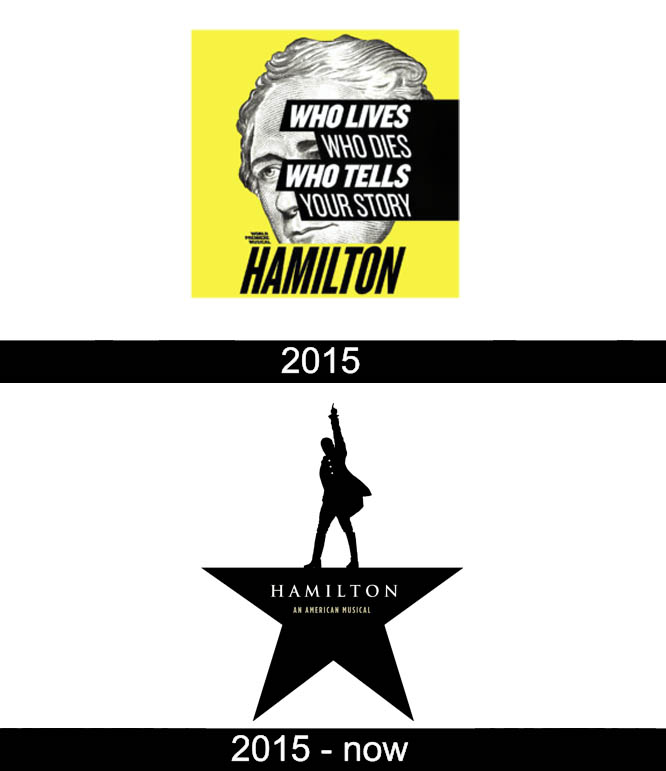
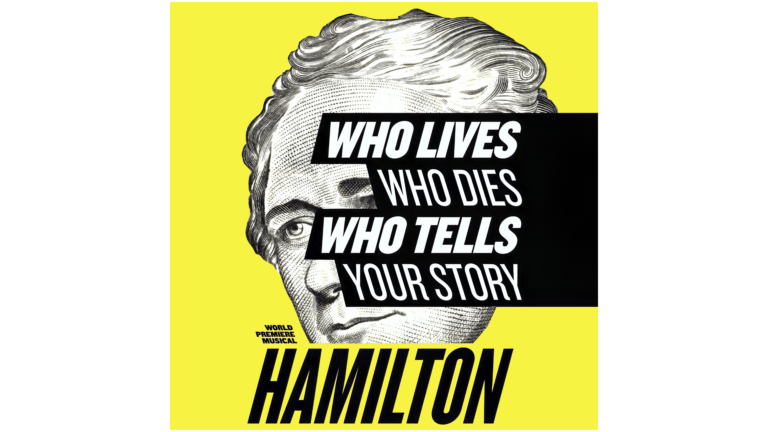
The first official Hamilton emblem appeared in 2015, coinciding with the show’s initial run at The Public Theater in New York. This early design leaned heavily into bold typography and striking contrast. A bright yellow background dominated the composition, immediately setting the musical apart from other Broadway productions.
The graphic featured a partially turned portrait of Alexander Hamilton, overlaid with the tagline “Who Lives, Who Dies, Who Tells Your Story.” The text alternated between bold and italic styles, reinforcing a sense of rhythm and narrative tension. The name “Hamilton” appeared at the bottom in large, italicized black letters, signaling confidence and urgency.
While this version was impactful, it functioned primarily as a transitional identity leading toward the definitive logo.
2015–Today: The Iconic Star Emblem
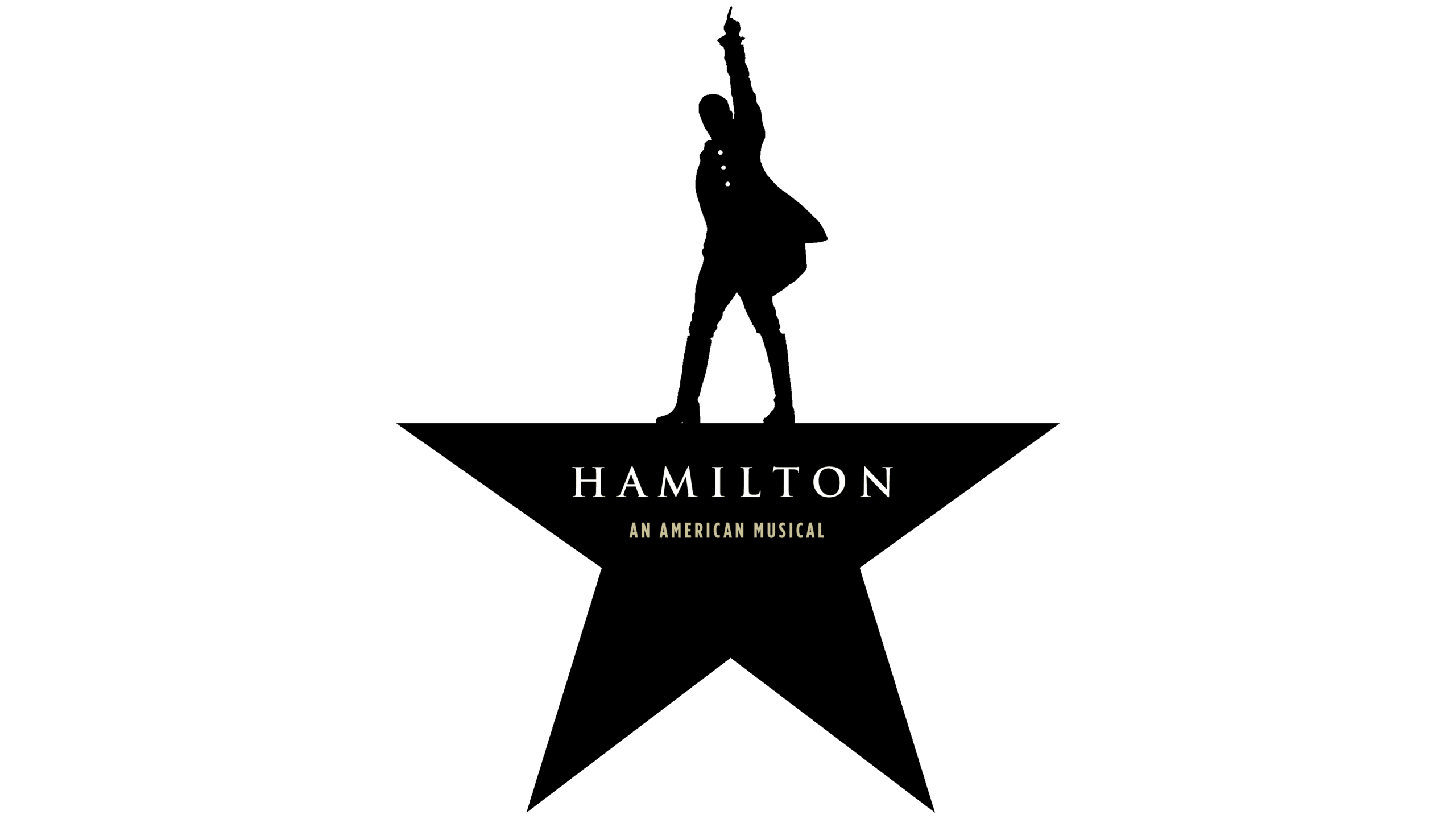
Later in 2015, the now-famous Hamilton logo was introduced—and it has remained unchanged ever since. At its center stands a black silhouette of Alexander Hamilton, posed triumphantly with one arm raised skyward. His stance is confident, defiant, and forward-looking.
The figure stands atop a five-pointed star, with its top point deliberately missing. Hamilton himself occupies that space, effectively becoming the star’s apex. Inside the star, the word “HAMILTON” appears in uppercase white serif letters, with the subtitle “An American Musical” placed beneath in smaller type.
This emblem became instantly iconic, not only on posters but across merchandise, stage branding, and global promotional campaigns.
Logo Symbolism: Ambition, Legacy, and Revolution
The symbolism of the Hamilton logo is dense yet accessible. The star is a longstanding symbol of the United States, representing unity, aspiration, and national identity. By removing the top point and replacing it with Hamilton’s silhouette, the logo visually suggests that individuals shape history.
Hamilton’s raised arm echoes both victory and defiance, reinforcing the themes of ambition and relentless self-determination that define the musical’s narrative. His windswept coat and wide stance add a sense of motion, as if history itself is being rewritten in real time.
The logo meaning extends beyond the character. It symbolizes voices rising, stories being claimed, and the power of those previously excluded from the historical spotlight.
Typography and Color in the Hamilton Logo
Typography plays a crucial supporting role in the Hamilton visual identity. The word “Hamilton” is set in a classical serif typeface, widely associated with Trajan-inspired forms. This choice anchors the logo in historical tradition and authority, aligning with the 18th-century setting of the story.
In contrast, supporting text such as “An American Musical” uses a condensed sans-serif style reminiscent of Gotham. This juxtaposition mirrors the show’s creative tension: old history told through modern voices.
Color is perhaps the most defining element. The black-and-gold palette is bold, theatrical, and unapologetic. Gold evokes value, legacy, and permanence, while black introduces seriousness, rebellion, and strength. White accents provide clarity and balance, ensuring legibility across formats.
Hamilton Logo Heritage and Visual Adaptability
Despite its apparent simplicity, the Hamilton logo has proven remarkably adaptable. It has appeared on countless poster variations, stage backdrops, merchandise lines, and international productions without losing its identity.
Early concept explorations included abstract ink blots, feathers, typographic “H” experiments, and symbolic references to writing and authorship. Ultimately, the final emblem struck the ideal balance between abstraction and narrative clarity, reinforcing the show’s themes without overexplaining them.
This restraint is central to the Hamilton logo heritage. Rather than evolving through redesigns, the logo achieved near-perfect expression at its inception.
A Modern Classic in Logo Heritage
The Hamilton logo stands as one of the most successful examples of modern theatrical branding. Its power lies not in complexity, but in precision. Every element—figure, star, typography, and color—serves a clear symbolic purpose.
By merging historical weight with contemporary design language, the logo reflects the musical’s core achievement: making the past feel urgent, relevant, and alive. In the landscape of cultural branding, Hamilton’s visual identity proves that a logo does not need decades of evolution to achieve lasting heritage—only clarity of vision and fearless execution.
FAQ: Hamilton Logo Meaning, Symbolism, and History
What does the Hamilton logo represent?
It represents ambition, legacy, and the idea that individuals shape history.
Who created the Hamilton musical?
The musical was created by Lin-Manuel Miranda.
Why is Alexander Hamilton standing on a star in the logo?
The star symbolizes America, and Hamilton replacing its top point suggests personal impact on national history.
What colors define the Hamilton logo?
Black and gold, with white accents.
Has the Hamilton logo changed since 2015?
No, the iconic star-and-silhouette logo has remained unchanged.
What font is used in the Hamilton logo?
The main wordmark resembles a Trajan-style serif, paired with a condensed sans-serif for supporting text.