
Greek Alphabet: Meaning, History, Symbolism

Human communication existed for tens of thousands of years before writing emerged. Spoken language was enough for early societies, but once civilizations grew more complex, memory alone could no longer preserve laws, trade, religion, and knowledge. Writing became necessary — and with it, symbols capable of transforming sound into meaning.
The true history of written language begins with the Greek alphabet. More than a system of letters, it represents a turning point in human civilization. It was the first alphabet designed to accurately record spoken sounds, including vowels, and it became the structural foundation for most modern European writing systems. From a cultural and historical perspective, the concepts of alphabet and Greek alphabet are inseparable.
The influence of Greek letters extends far beyond language. They shaped science, mathematics, philosophy, religion, and — centuries later — branding and corporate identity. Today, Greek symbols appear everywhere: in equations, aircraft tails, luxury watches, airline logos, automotive badges, and technology brands. Their endurance is no accident.
Meaning and History of the Greek Alphabet
The Greek alphabet emerged around the 8th century BC, derived primarily from the Phoenician script. While Phoenician writing recorded only consonants, the Greeks introduced a revolutionary concept: explicit vowel representation. This single innovation transformed writing into a precise tool for recording speech.
Early Greek writing existed in two main branches:
Eastern Greek, which later influenced Coptic, Armenian, Slavic, and Cyrillic scripts, and Western Greek, which became the basis for Latin and Germanic alphabets. Without the Greek alphabet, neither modern English nor most European languages would exist in their current form.
Originally, the Greek alphabet contained 27 letters. Over time, some characters disappeared or evolved into ligatures, while others were preserved strictly for numerical use. By the modern era, the system stabilized at 24 letters, a structure that remains unchanged today.
From science to scripture, Greek letters became carriers of meaning. Concepts such as Alpha and Omega — the beginning and the end — entered theology, philosophy, and later visual culture.
The Complete Greek Alphabet Table
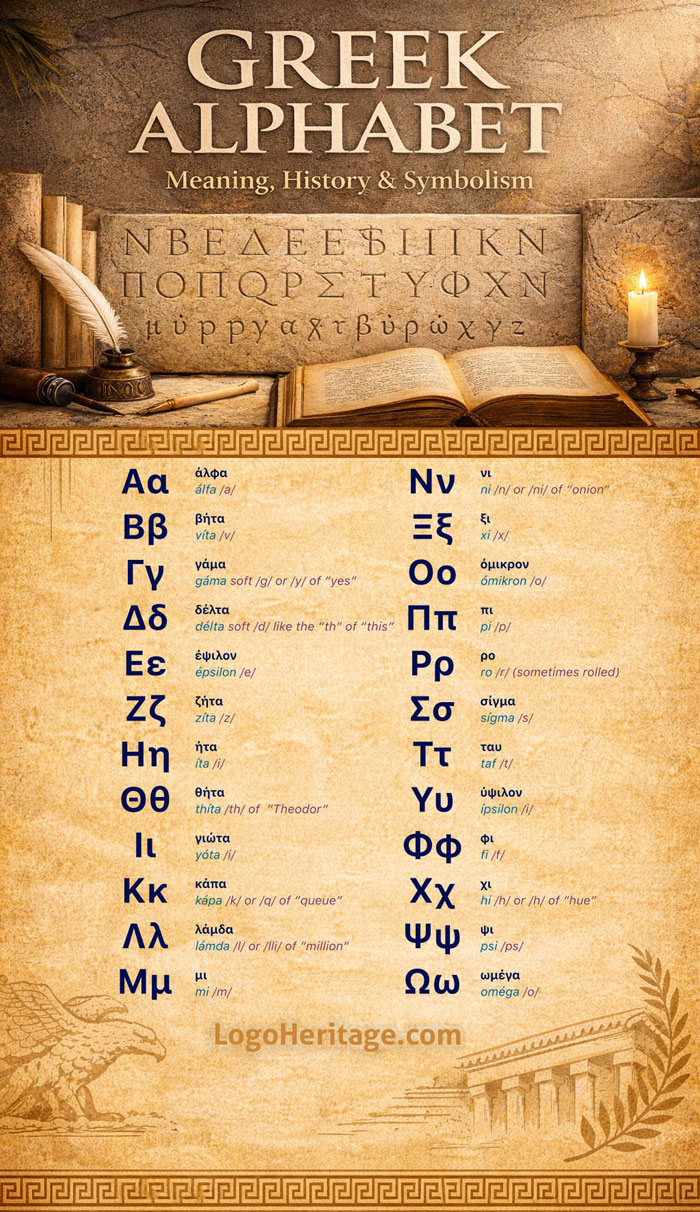
Below is the full Greek alphabet, presented in its standard modern form, including uppercase, lowercase, traditional names, and commonly accepted English equivalents.
Greek Alphabet Reference Table
| Upper Case | Lower Case | Greek Letter Name | English Equivalent |
|---|---|---|---|
| Α | α | Alpha | a |
| Β | β | Beta | b |
| Γ | γ | Gamma | g |
| Δ | δ | Delta | d |
| Ε | ε | Epsilon | e |
| Ζ | ζ | Zeta | z |
| Η | η | Eta | ē / i |
| Θ | θ | Theta | th |
| Ι | ι | Iota | i |
| Κ | κ | Kappa | k |
| Λ | λ | Lambda | l |
| Μ | μ | Mu | m |
| Ν | ν | Nu | n |
| Ξ | ξ | Xi | ks |
| Ο | ο | Omicron | o |
| Π | π | Pi | p |
| Ρ | ρ | Rho | r |
| Σ | σ / ς | Sigma | s |
| Τ | τ | Tau | t |
| Υ | υ | Upsilon | u / y |
| Φ | φ | Phi | ph / f |
| Χ | χ | Chi | ch / kh |
| Ψ | ψ | Psi | ps |
| Ω | ω | Omega | o (long) |
A distinctive feature of the Greek system is Sigma’s dual lowercase form: σ is used within words, while ς appears only at the end. This typographic nuance alone illustrates the sophistication of the system.
Symbolism of Greek Letters
Each Greek letter carries symbolic weight developed over centuries of use.
Alpha represents origin, leadership, primacy.
Beta signifies secondary order, progression, testing.
Delta denotes change, movement, transformation.
Omega symbolizes completion, finality, mastery.
In mathematics, physics, astronomy, and medicine, these meanings became standardized. Over time, the same symbolic logic migrated into branding, where clarity, authority, and recognition are essential.
Greek Letters in Logos, Brands, and Corporate Identity
Greek letters function exceptionally well in logos because they are language-independent symbols with pre-existing meaning. They communicate ideas instantly, without explanation.
Alpha in Branding
Alpha is frequently used to signal leadership, superiority, and origin. The automotive brand Alfa Romeo embeds this meaning directly into its name, reinforcing ideas of performance, heritage, and prestige.
Delta in Corporate Identity
Delta’s triangular geometry naturally suggests motion and direction. This makes it ideal for aviation and logistics. Delta Air Lines uses the letter both visually and conceptually to express progress and global movement.
Omega as a Symbol of Mastery
Omega’s association with time and completion explains its prominence in luxury. The Swiss watchmaker Omega uses the final letter of the alphabet to position itself as the ultimate benchmark of precision and endurance.
Pi, Sigma, and Scientific Authority
Brands tied to engineering, analytics, and systems thinking often reference Pi or Sigma. Piaggio subtly aligns with Pi’s mathematical connotations, reinforcing technical competence and design logic.
Sigma, long associated with summation and systems, has become synonymous with optimization and quality control, especially in industrial and technological branding.
Why Greek Symbols Endure in Modern Design
Greek letters succeed where many graphic symbols fail because they combine visual simplicity with deep cultural memory. They are timeless rather than trendy. Their forms are balanced, their meanings stable, and their associations authoritative.
In branding, this translates into trust. A Greek letter does not need explanation — it carries history with it.
From Ancient Script to Timeless Symbol
The Greek alphabet is not merely a historical artifact. It is a living system of symbols that continues to shape how humanity communicates knowledge, authority, and identity. From the foundations of Western writing to the logos of global corporations, Greek letters remain essential because they are efficient carriers of meaning.
In a visual world saturated with novelty, Greek symbols endure because they are anchored in something deeper than fashion: civilization itself. Alpha still marks beginnings. Omega still signals completion. And between them lies a system that has defined culture for nearly three millennia — and continues to do so today.
Frequently Asked Questions About the Greek Alphabet
Why is the Greek alphabet considered the foundation of Western writing?
The Greek alphabet is considered foundational because it was the first writing system to consistently represent both vowels and consonants. This innovation transformed writing from a symbolic approximation of speech into a precise system capable of preserving philosophy, science, and law. As a result, it directly influenced the development of the Latin and Cyrillic alphabets, which dominate modern Western communication.
How many letters are in the Greek alphabet?
The modern Greek alphabet consists of 24 letters. Earlier versions included additional characters used mainly for numerical purposes, but these were gradually removed as the language standardized.
What makes Greek letters so popular in science and mathematics?
Greek letters are visually distinct, compact, and culturally neutral. Over centuries, they became standardized symbols for constants, variables, and concepts in mathematics, physics, astronomy, engineering, and medicine. Their consistency allows complex ideas to be communicated universally without language barriers.
Why are Greek letters used in logos and brand identities?
Greek letters carry strong symbolic associations such as intelligence, origin, authority, precision, and timelessness. Brands use them to convey heritage, credibility, or leadership while maintaining a minimalist and universal visual language.
What does Alpha and Omega symbolize?
Alpha symbolizes beginnings, origins, and leadership, while Omega represents completion, finality, and mastery. Together, they form one of the most enduring symbolic pairs in Western culture, often used to express totality or absolute authority.
Is the Greek alphabet still used today?
Yes. Modern Greek uses a standardized version of the ancient alphabet, and Greek letters remain deeply embedded in global culture through education, science, religion, and branding.