
GQ Logo History: Meaning, Symbolism & Brand Heritage
Few men’s magazines have managed to remain culturally relevant for nearly a century while continuously redefining masculinity, style, and sophistication. Founded in 1931 in New York, GQ began its life not as a lifestyle magazine but as a professional trade publication focused on menswear. Over the decades, it transformed into a global authority on fashion, culture, entertainment, and modern male identity.
Today, GQ is published monthly and distributed worldwide, shaping conversations around style, power, creativity, and social change. This evolution is mirrored in its visual identity. The GQ logo is a case study in editorial restraint, typographic confidence, and brand clarity. Its logo heritage reflects how a publication can modernize without losing authority, relying on typography alone to communicate prestige and relevance.
GQ Logo Meaning and Editorial Identity
The GQ logo meaning is rooted in confidence, modern masculinity, and cultural awareness. Unlike magazines that rely on illustrative symbols or decorative marks, GQ communicates identity exclusively through typography. This approach aligns perfectly with its editorial voice: sharp, assertive, and unmistakably contemporary.
The two-letter abbreviation carries weight through proportion and contrast. Compact, bold, and visually balanced, the GQ logo feels decisive and self-assured. It does not explain itself, nor does it soften its message. Much like the magazine’s content, the logo assumes an informed, discerning audience.
GQ Logo History Timeline: From Trade Journal to Global Brand
1931–1958: Apparel Arts and the Origins of Editorial Elegance
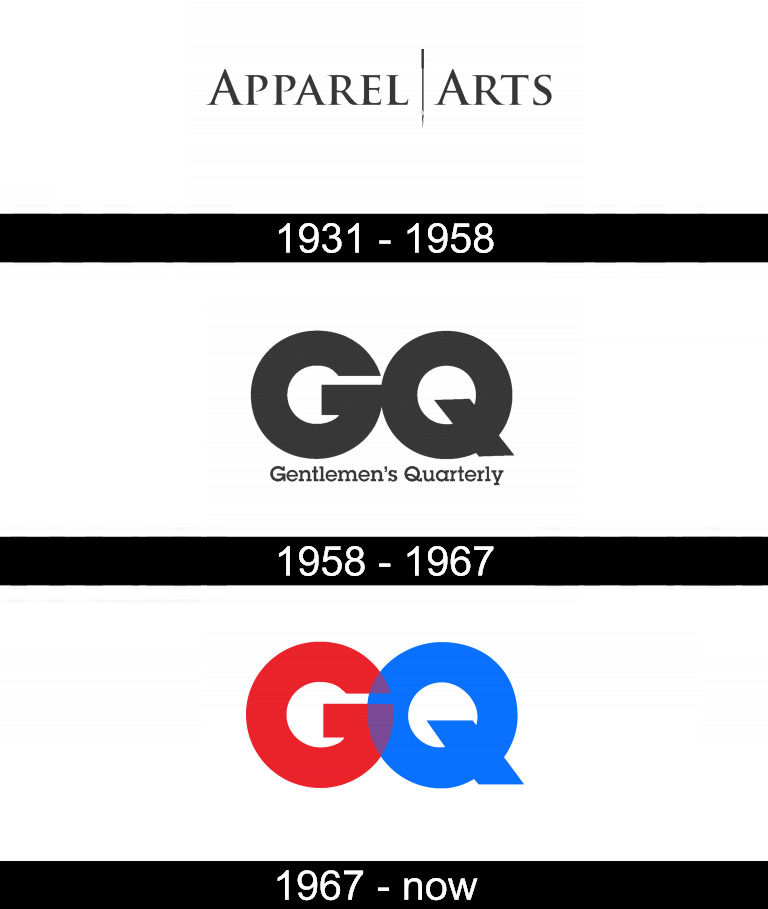
The first logo associated with what would eventually become GQ appeared in 1931, when the magazine was launched under the name Apparel Arts. The wordmark was set in elegant uppercase lettering, with both initial “A” characters slightly enlarged to emphasize symmetry and structure.
A vertical stylized line separated the two words, reinforcing a sense of order and professionalism. Executed in monochrome, the logo reflected the publication’s original role as a trade journal for the menswear industry. It was restrained, refined, and unmistakably editorial.

1958–1967: Gentlemen’s Quarterly and the Birth of “GQ”
In 1958, the magazine was renamed Gentlemen’s Quarterly, marking a shift from industry trade publication to broader lifestyle content. With this change came a new logo that introduced the visual foundation of today’s identity.
For the first time, the enlarged letters “GQ” appeared prominently. Set in bold black and placed closely together, they sat above the full Gentlemen’s Quarterly name rendered in a modern serif typeface. This hierarchical composition signaled confidence and memorability, while still respecting editorial tradition.
This period established the abbreviation as the core visual asset of the brand.
1967–Today: The GQ Abbreviation Becomes the Brand
In 1967, Gentlemen’s Quarterly was officially rebranded as GQ, and the logo followed suit. The abbreviation became the sole identifier, eliminating explanatory text and embracing modern branding principles.
Over time, the typeface was refined to appear more contemporary, confident, and adaptable. Inspired by New York’s cultural energy, the logo evolved into a bold typographic mark capable of sitting comfortably on fashion covers, celebrity portraits, and political commentary alike.
While the core structure remained stable, subtle refinements ensured relevance across decades of design trends.
GQ Logo Symbolism Explained
The symbolism of the GQ logo lies in its minimalism. Two letters, tightly spaced, create a sense of unity and strength. The absence of decorative elements emphasizes clarity and decisiveness, qualities associated with authority and modern masculinity.
The logo’s adaptability is also symbolic. Whether rendered in classic black or the iconic red-and-blue combination, the mark retains its identity. This flexibility reflects GQ’s editorial range, spanning fashion, culture, politics, and personal expression.
GQ Logo Typography and Color Meaning
The GQ logo is based on a bold serif-inspired typeface often associated with RTF Amethyst Light Italic, though the magazine’s lettering has been customized for exclusivity and balance. The thick strokes convey confidence, while subtle curves add refinement.
Traditionally, the logo appears in black, reinforcing authority and editorial seriousness. The alternative color version, featuring a red “G” and blue “Q,” introduces contrast and energy. Red suggests passion, power, and confidence, while blue conveys trust, intelligence, and stability. Together, they reflect the dual nature of GQ as both bold and thoughtful.
Conclusion: GQ Logo Heritage and Timeless Masculine Authority
The GQ logo heritage demonstrates how a publication can evolve culturally while maintaining a stable visual core. From Apparel Arts to Gentlemen’s Quarterly and finally to GQ, the logo adapted to changing audiences without abandoning typographic discipline.
Today, the GQ logo stands as one of the most recognizable editorial wordmarks in the world. Its strength lies not in reinvention, but in clarity, restraint, and confidence—qualities that continue to define the magazine’s voice in modern culture.
GQ Logo FAQ: Common Questions About the Magazine’s Visual Identity
What does the GQ logo stand for?
GQ stands for Gentlemen’s Quarterly, the magazine’s former full name before it was shortened in 1967.
Why is the GQ logo so simple?
The simplicity reflects editorial authority and modern masculinity, allowing content and photography to take center stage.
Has the GQ logo changed much over time?
No. The logo has evolved subtly, refining typography and proportions while maintaining the same core structure.
What colors are used in the GQ logo?
GQ primarily uses black, but also an iconic red-and-blue version that adds contrast and visual energy.