Google Logo History: Heritage, Meaning & Symbolism
Google is one of the most powerful and recognizable brands in modern history — a global technology giant whose products and services shape everyday life. Founded in the United States and owned by the multinational corporation of the same name, Google today encompasses dozens of platforms, tools, and online services. The search engine, however, remains its crown jewel: the gateway millions of people use every second to access information from all over the world.
Created by Stanford PhD students Larry Page and Sergey Brin, Google has always operated with a bold mission: to organize the world’s information and make it universally accessible and useful. This spirit of simplicity, curiosity, and playfulness has also guided its visual identity. Designer Ruth Kedar played a crucial role in developing some of Google’s earliest logo concepts — dozens of ideas that shaped today’s familiar style.
Bright, simple, and instantly recognizable, the Google logo has become a landmark of the digital era.
Meaning and History
Google began in 1995 under the name BackRub, a search engine running on Stanford servers. In 1997, the founders chose a new name — a playful derivative of “Googol”, the mathematical term for the number 10¹⁰⁰. The new word conveyed the idea of infinite search power.
Except for its first two years, Google’s visual identity has remained surprisingly consistent: colorful, friendly, and accessible. This simplicity played a huge role in making the logo iconic.
Google Logo History: Evolution Through the Years
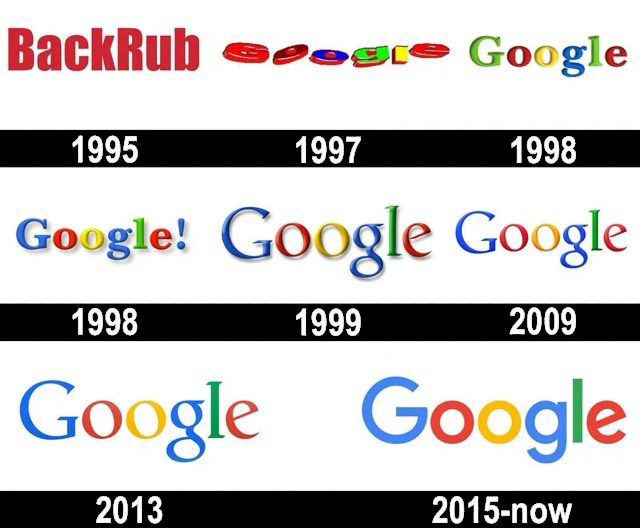
1995–1997: The BackRub Era
The first logo, created for BackRub, featured a bold red wordmark with two uppercase letters. The design was simple, solid, and very “tech startup.” The typeface resembled PF Fusion Sans Pro Black and Impart Family fonts.
It lasted only until Google adopted its new name.
1997–1998: The First Google Beta Logo
The very first Google logo appeared in 1997 for the beta version of the search engine. Each letter was rendered in a different color, with bouncy, somewhat amateurish 3D shapes.
Although rudimentary, this design set the foundation for the color philosophy that became Google’s signature.
1998–1999: The First Official Logo
In 1998, Google introduced its first official wordmark, using the transitional serif typeface Baskerville Bold. Each letter carried one of Google’s now-classic colors: blue, red, yellow, or green.
Later that same year, a blue exclamation point — inspired by Yahoo! — was added, along with a light gray drop shadow.
1999–2013: The Catull Era
In 1999, Google adopted the Catull BQ serif typeface.
Key features included:
-
sharp, elegant serifs
-
consistent color palette
-
a slight left tilt of both “O” letters
This version became the longest-running Google logo, lasting 14 years.
A 3D variant was later added for certain interfaces.
2010–2013: A Cleaner Look
In 2010, Google removed the drop shadow and refreshed its colors for a brighter, more polished appearance.
2013–2015: Flat & Minimalist
Google embraced flat design in 2013. Colors were fine-tuned again, and the serif wordmark gained cleaner, more contemporary lines.
2015–Today: Product Sans & the New Google
On September 1, 2015, Google unveiled a completely redesigned wordmark.
The changes included:
-
a switch to Product Sans, a custom geometric sans-serif
-
perfectly round “O” letters
-
a more modern, friendly, and digital-first look
The iconic four-color palette remained, but tones became brighter and more uniform.
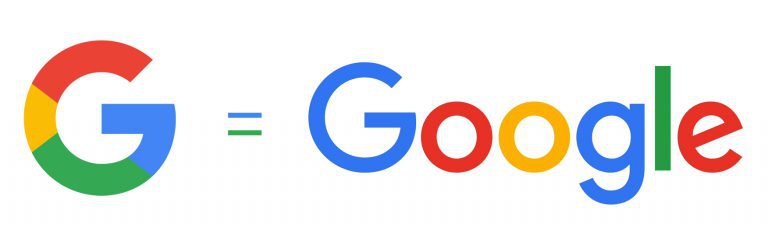
Google also introduced its new icon: a bold “G” divided into four colors, matching the brand’s visual identity across all devices and screen sizes.
The Meaning of the Google Logo
The Google logo is deceptively simple — but filled with symbolism.
The Colors
The four-color palette reflects:
-
diversity
-
playfulness
-
creativity
-
inclusivity
-
global accessibility
The colors follow a tetradic color scheme, giving the logo energy and harmony.
The famous color order signals Google’s identity as a brand that embraces nonconformity: three primary colors, interrupted by a single green letter that breaks the pattern intentionally.
The Bite of Meaning Behind “Google”
The name represents a playful distortion of “Googol”, symbolizing the company’s endless capacity for information processing.
Even the typography shifts have symbolic weight — evolving with each technological milestone.
Google’s “White” Logos
On rare occasions, Google adopts a grayscale version of the logo as a mark of global mourning.
Examples include:
-
the death of Polish President Lech Kaczyński (Google Poland)
-
remembrance of victims of the Qinghai earthquake (Google Hong Kong & Google China)
-
the death of Queen Elizabeth II (Google worldwide, 2022)
This monochrome adaptation underscores Google’s responsiveness to world events.
Symbol & Favicon Evolution
Early Favicons
-
1999: Blue uppercase “G” in a square
-
2008: Blue lowercase “g”
-
2012: Multi-colored “g”
2015–Today: Multicolored “G”
The current favicon — the four-colored “G” — aligns with Google’s shift toward unified branding. Some designers have noted its resemblance to the early-1990s Gymboree logo, though the color palette differs significantly.
Google Service Logos
Google’s brand identity extends far beyond its primary wordmark. Over the years, every major Google service has developed its own iconography — unified through the same four-color palette, geometric simplicity, and digital-first philosophy. These service logos represent an essential part of Google’s heritage, shaping how billions of users interact with the company’s ecosystem every day.
Google Play
Originally known as Android Market, Google Play was reintroduced in 2012 with a new identity and a distinctive triangular emblem symbolizing motion, discovery, and digital entertainment.
Across its updates, the Google Play logo has undergone:
-
refinements of color saturation
-
transitions from 3D gradients to flat design
-
subtle adjustments in geometry for scalability
Today, its triangular arrow — rendered in Google’s signature red, yellow, green, and blue — stands as a universal symbol for apps, media, and entertainment. The icon has become a recognizable piece of Google’s brand heritage, balancing simplicity with a sense of dynamic movement.
Google Drive
The Google Drive logo is one of the most symbolically rich emblems in the Google ecosystem. Introduced in 2012, it features a triangular shape constructed from three interlocking colors:
-
Blue = Docs
-
Green = Sheets
-
Yellow = Slides
The triangle, a closed geometric form, represents security, stability, and protection — all central themes of cloud storage.
The interlocking edges reflect Google’s philosophy of integration and connectivity, an important thread in the company’s visual heritage.
With every update, the Google Drive icon has maintained its conceptual clarity while adopting cleaner, flatter aesthetics aligned with the modern Google symbol system.
Google Maps
Google Maps uses the classic Google wordmark paired with a proportional gray “Maps” label. The favicon incorporates:
-
two roads
-
various colored fields
-
a red location pin
Google Analytics
Analytics features an orange-toned, minimalistic chart icon.
Its wordmark follows Google’s standard format: “Google” in trademark colors + “Analytics” in gray.
Font
The current Google logo uses Product Sans, a custom geometric sans-serif designed for legibility across all resolutions — especially on small mobile screens.
It replaced a long lineage of serif-based designs, signaling Google’s commitment to a modern, digital-first aesthetic.
FAQ
What is the current Google logo?
Introduced in 2015, the current Google logo is a bold sans-serif wordmark using Google’s four signature colors: blue, red, yellow, and green.
Why is the Google logo grey today?
Google switches to a grey logo during global mourning events, such as the passing of Queen Elizabeth II in 2022.
Why does Google use four colors?
The palette reflects creativity, inclusivity, and Google’s playful personality. It also symbolizes the diversity of Google’s many services.
What does the Google logo represent?
The logo represents the company’s mission to process and organize vast amounts of information. Its colorful design conveys simplicity, curiosity, and innovation.
5 Facts About Google You Probably Didn’t Know
1. The First Google Server Was Made of LEGO Bricks
To store the rapidly growing data index, Page and Brin built their first server prototype using colorful LEGO pieces — an unintentionally fitting match for Google’s playful branding.
2. Google Almost Became “Googolplex”
The founders initially considered calling the company “Googolplex.” A misspelling by a colleague led to “Google,” which stuck — fortunately.
3. Ruth Kedar Designed Dozens of Logo Prototypes
Before settling on the famous serif wordmark, designer Ruth Kedar created more than a dozen wildly different concepts, including magnifying glasses, abstract shapes, and completely different color schemes.
4. Google’s First Office Was a Garage
Just like Apple, Google began in a rented garage — owned by Susan Wojcicki, who later became CEO of YouTube.
5. Google Changes Its Logo Over 2,000 Times a Year
Thanks to Google Doodles — temporary, artistic variations celebrating events, anniversaries, and holidays — Google’s homepage sees far more logo changes than any major brand in the world.