Goldman Sachs Logo History: Meaning, Symbolism & Brand Heritage

Few corporate identities in modern history have demonstrated such resilience, consistency, and quiet authority as the Goldman Sachs logo. While financial institutions around the world frequently rebrand to match shifting markets, Goldman Sachs has stood almost unchanged for more than half a century. Its visual identity is built on clarity and restraint—qualities that mirror the precision and discipline of global investment banking. The softly structured square, the gentle blue tone, and the perfectly balanced serif typography together create a corporate emblem that is instantly recognizable and deeply tied to the firm’s heritage.
Founded in 1869 by Marcus Goldman, the company began as a small New York operation focused on promissory notes. Over the next century and a half, Goldman Sachs evolved into one of the most influential financial institutions in the world. While its services expanded—investment banking, securities, asset management, wealth advisory—its logo remained a fixed point of stability, projecting professionalism and trust in an industry where perception is everything.
Meaning & Symbolism: The Philosophy Behind the Blue Square
The Goldman Sachs logo communicates confidence through understatement. Its most defining element, the light-blue square, has long symbolized clarity, openness, and reliability. Blue is a color deeply rooted in corporate culture, associated with intelligence, integrity, and sound judgment. For Goldman Sachs, it reinforces the idea of calm decision-making and long-term stability in a world of fluctuating markets.
The typography, set in white serif letters, introduces an element of refinement that contrasts with the modern minimalism of the square. The serif forms express heritage and intellectual rigour, while the softness of their curves tempers the austerity often associated with financial emblems. Together, the square and the wordmark strike an equilibrium between authority and approachability, a visual metaphor for a firm that serves both global institutions and individual clients.
Goldman Sachs Logo Evolution
A Half-Century of Minimalist Continuity
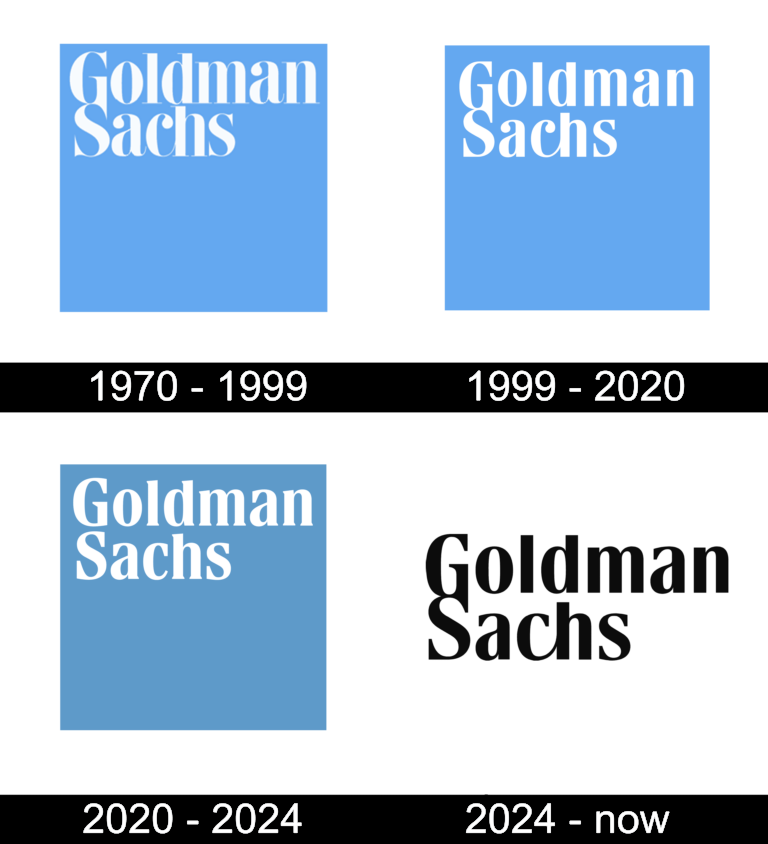
1970–1999: The Original Blue Square
The first official Goldman Sachs logo appeared in 1970. It featured the now-iconic light-blue square containing two lines of white serif lettering placed slightly toward the top-left corner. The design was elegant and modern, capturing the rise of corporate identity systems in late-century America. The merging of the initial “G” and “S” contributed to a distinctive, cohesive structure, while the serif forms added personality to an otherwise minimalist form.
1999–2020: A Refined Classic
Though often mistaken for a redesign, the 1999 version was essentially a continuation of the original logo with subtle adjustments. The square retained its luminous sky-blue tone, and the serif typography remained untouched. The main distinction was its formal adoption across all corporate platforms as Goldman Sachs globalized and entered the digital era. This period cemented the blue square as one of the most recognizable financial marks of the modern world.
2020–2024: A Deeper Shade, A Calmer Voice
The 2020 refinement marked the first visible evolution of the logo’s color and spacing. The blue became slightly deeper, shifting toward a more mature and composed tone. The lettering, still in white serif capitals, gained more breathing room both horizontally and vertically, allowing the two-line structure to appear more balanced. The design felt more confident and sophisticated, ready for a new generation of digital applications without losing its historical DNA.
2024–Today: Pure Typography
In 2024, Goldman Sachs made its boldest visual shift yet, though the change remained faithful to the brand’s heritage. The blue square disappeared, leaving only the two-line serif wordmark, set in solid black against a transparent background. The typography returned to the proportions of the 1999 version, preserving the familiar geometry of the merged “G” and “S.” By removing the square, Goldman Sachs embraced a more universal, timeless, and flexible identity—one capable of adapting across a global digital ecosystem while remaining unmistakably its own.
Font & Typography
Typography has always been the hallmark of the Goldman Sachs identity. The logo uses a distinctive serif typeface whose forms are soft yet authoritative. The letters feature gentle curves, thin serifs, and slightly arched strokes, giving the brand a traditional elegance that contrasts with the rigidity of typical financial typography. The two-level structure ensures readability and adds rhythm to the composition, while the merged shapes of the initial letters provide personality without visual noise. This typographic approach reinforces Goldman Sachs as a heritage institution grounded in expertise, clarity, and trust.
Color Palette
Throughout most of its history, Goldman Sachs has relied on a clean combination of light blue and white. The blue—calm, optimistic, aspirational—communicates stability and intellectual clarity. It is a color widely associated with finance, but Goldman Sachs distinguished itself by selecting a softer, more luminous tone that felt approachable and modern. White reinforced purity, transparency, and the company’s adherence to fairness and lawful conduct, a cornerstone of its public messaging. Even in the 2024 minimalist black wordmark, the spirit of the original palette continues to influence the brand’s visual language.
A Logo That Redefined Corporate Minimalism
The Goldman Sachs logo stands as one of the most successful examples of modern corporate identity. For over fifty years, the blue square and white serif lettering have shaped the brand’s public image, serving as a quiet symbol of consistency in a volatile industry. As the firm enters a new digital era with its latest minimalist version, it continues to honor its heritage—demonstrating that the most enduring logos are those built not on ornament, but on clarity, precision, and unwavering self-assurance.
FAQ — Goldman Sachs Logo
What is the Goldman Sachs symbol?
Goldman Sachs does not use a separate graphical symbol. Its identity is built around a two-line serif wordmark, historically placed in a light-blue square. On the New York Stock Exchange, the company is represented by the ticker symbol “GS.”
Why is the Goldman Sachs logo blue?
The brand uses blue to symbolize reliability, optimism, stability, and clarity—attributes associated with professional financial services. The light-blue tone became one of the firm’s most recognizable visual traits.
Does Goldman Sachs have a motto?
Goldman Sachs’ current motto is “You Can Money,” introduced in 2019. Previously, the company used the slogan “Our Clients’ Interests Always Come First,” reflecting its commitment to client-centered values.
Who founded Goldman Sachs?
The firm was founded in 1869 by Marcus Goldman, a German-born entrepreneur who began by trading promissory notes before expanding into investment banking together with family partners.
Is Goldman Sachs a brand?
Yes. Goldman Sachs is not only a financial institution but a globally recognized brand, known for its leadership in investment banking, wealth management, and financial innovation.