
Frontier Airlines Logo History: Meaning, Symbolism & Brand Heritage

Within the competitive sphere of American low-cost aviation, Frontier Airlines occupies a distinctive visual position shaped by reinvention, affordability, and graphic experimentation. Unlike legacy carriers that emphasize continuity above all else, Frontier’s visual identity reflects a history of interruption and revival, resulting in a logo heritage marked by clear stylistic contrasts rather than gradual refinement.
Much like the disruptive branding paths explored in Southwest Airlines logo history or the merger-driven shifts examined in United Airlines logo heritage, Frontier Airlines presents a compelling case of how airline branding responds to structural change. Its logo evolution mirrors the company’s broader journey through consolidation, bankruptcy, and rebirth, all while maintaining a focus on accessibility and competitive pricing.
Meaning and History: The Origin of the Frontier Airlines Logo
The original Frontier Airlines emerged in the late 1950s following the merger of Arizona Airways, Monarch Airlines, and Challenger Airlines. Operating exclusively within the United States, the airline developed a strong regional presence before ceasing operations in 1986 after merging with Continental Airlines. This first incarnation established the earliest foundations of Frontier’s visual identity.
The modern Frontier Airlines was founded in 1994 as a new entity, deliberately distancing itself from the aesthetic legacy of its predecessor while retaining the name. From the outset, the airline positioned itself as a low-fare competitor, using branding that emphasized approachability rather than prestige. The logo meaning across its various iterations reflects this pragmatic orientation, prioritizing readability and motion over symbolism-heavy design.
Frontier Airlines Logo History Timeline
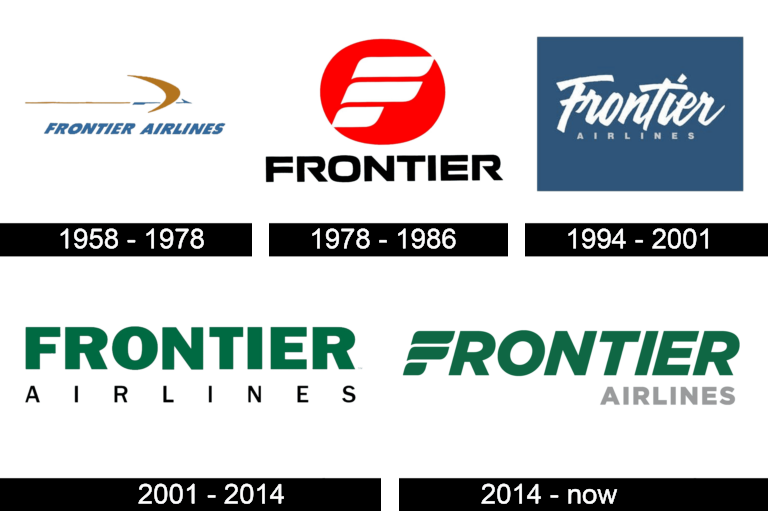
1958–1978: Dynamic Forms and Early Aviation Abstraction
The earliest Frontier Airlines logo introduced in 1958 featured a stylized emblem that could be interpreted as an abstract aircraft, an arrow, or a bow in motion. This ambiguity gave the mark a dynamic quality, reinforced by italicized sans-serif lettering spelling “Frontier Airlines” beneath the symbol.
The color palette combined dark blue and gold, evoking the sky and sun while lending the logo a sense of optimism and movement. This early logo description aligned with mid-century aviation aesthetics, where abstraction suggested speed and progress.
1978–1986: Saul Bass Modernism and Graphic Authority
In 1978, Frontier Airlines adopted a radically different visual identity designed by Saul Bass, one of the most influential graphic designers of the twentieth century. The new logo featured a white stylized “F” composed of three horizontal bars with rounded ends, enclosed within a red circle.
Below the emblem, the word “Frontier” appeared in a black sans-serif typeface with distinctive letterforms, particularly the “R.” The contrast between the geometric symbol and the restrained typography created a bold and authoritative composition. This logo remains one of the most iconic chapters in Frontier Airlines logo history, even though the original airline ceased operations in 1986.

1994–2001: Casual Script and Brand Reintroduction
When the modern Frontier Airlines launched in 1994, its logo bore no resemblance to earlier designs. The new wordmark featured “Frontier” in a relaxed, handwritten-style script, paired with a simple sans-serif “Airlines” below. The lettering appeared in white against a muted dark blue background.
This design emphasized friendliness and informality, aligning with the airline’s positioning as an accessible alternative to major carriers. While visually distinctive, legibility was a recurring concern.
2001–2014: Functional Clarity and Reduced Personality
In 2001, Frontier Airlines shifted toward a more conventional design. The handwritten script was replaced with a bold, highly legible sans-serif typeface. “Airlines” increased in size and appeared in black against a white background, significantly improving contrast and readability.
Although functional, this version lacked the expressive character of earlier designs. The logo symbolism during this period leaned toward neutrality, prioritizing clarity over brand storytelling.
2014–Today: Motion, Heritage Reference, and Visual Softening
The current Frontier Airlines logo was introduced in 2014 and represents a synthesis of past and present. The wordmark is italicized, introducing a sense of forward motion appropriate for an airline. Most notably, the design reincorporates the concept of the “Flying F,” now embedded as the initial letter of the brand name.
The color palette shifted toward softer, dustier tones, creating a lighter and more contemporary appearance. Tighter letter spacing in “Airlines” improved cohesion, while the overall composition regained a degree of distinctiveness absent from the previous iteration.
Logo Symbolism: Movement, Simplicity, and Reinvention
The symbolism of the Frontier Airlines logo centers on motion and adaptability. Italicized letterforms suggest speed and progression, while the revived “Flying F” references historical identity without direct replication. This balance reflects Frontier’s role as a reinvented airline operating in a highly competitive low-cost market.
Rather than relying on overt aviation imagery, the logo communicates its purpose through typographic motion and subtle abstraction. Within logo symbolism analysis, Frontier’s identity demonstrates how selective heritage cues can enhance modern branding without overwhelming it.
Frontier Airlines Logo History and Visual Reinvention
The Frontier Airlines logo history reveals a brand shaped by discontinuity and renewal. From Saul Bass modernism to minimalist wordmarks and contemporary motion-driven typography, each iteration reflects a specific chapter in the airline’s operational life. Rather than pursuing seamless continuity, Frontier embraced reinvention as a defining characteristic of its visual identity.
Today, the Frontier Airlines logo stands as a reflection of flexibility, affordability, and forward movement. Its evolution underscores how airline branding can adapt to structural change while maintaining recognizability within a crowded aviation landscape.
FAQ: Frontier Airlines Logo Meaning and History
What does the Frontier Airlines logo represent?
The logo represents motion, adaptability, and reinvention through italicized typography and abstract forms.
Who designed the classic Frontier Airlines logo from the 1970s?
The 1978 logo was designed by Saul Bass, a legendary American graphic designer.
Why did Frontier Airlines change its logo so often?
Frequent changes reflect mergers, bankruptcy, and the airline’s reinvention as a low-cost carrier.
What is the significance of the “Flying F” in the current logo?
The “Flying F” references earlier Frontier branding while adding motion and continuity.