
Four Seasons Logo History: Meaning, Symbolism & Brand Heritage

Few names in global hospitality are as closely associated with refinement, discretion, and timeless luxury as Four Seasons. Built on an uncompromising approach to service and architectural coherence, the brand has cultivated an identity that avoids trends in favor of enduring symbols. The Four Seasons logo history reflects this philosophy with remarkable consistency, relying on a single emblem refined rather than reinvented. When examined alongside prestige-driven identities such as the Ritz-Carlton logo history and the restrained elegance explored in the Sofitel logo heritage, Four Seasons stands apart within modern luxury hotel logo history for its commitment to symbolic continuity.
The Four Seasons logo meaning is directly tied to the brand name itself. Rather than abstract interpretation, the logo embraces literal symbolism, translating the idea of seasonal transition into a visual system that communicates permanence, balance, and natural rhythm.
Meaning and History: The Origin of the Four Seasons Identity
Four Seasons was founded in 1960 by Isadore Sharp, a Canadian businessman and trained architect. Sharp’s entry into hospitality began almost accidentally when he designed a motel for an acquaintance. After recognizing the commercial potential of thoughtful design paired with attentive service, he decided to create a hotel of his own.
In 1961, the Four Seasons Motor Hotel opened in Toronto, establishing the foundation for a hospitality philosophy centered on consistency, elegance, and guest-focused architecture. As the brand expanded internationally, its identity remained tightly controlled, ensuring that every element, from interiors to visual branding, aligned with a unified vision of luxury.
The logo origin reflects this architectural mindset. Designed not as a marketing flourish but as a structural symbol, the emblem communicates the brand’s core promise without reliance on ornamentation or trend-driven aesthetics.
Logo Symbolism: Nature, Balance, and Timeless Continuity
The Four Seasons logo symbolism is rooted in nature and cyclical balance. The central tree represents the passage of time and the constancy of change, mirroring the concept of four seasons repeating endlessly. Each quadrant of the tree corresponds to a different season, expressed through variations in foliage density and branch form.
Winter appears as bare branches, spring introduces new growth, summer shows full foliage, and autumn suggests transition and decline. This progression communicates renewal without decay, reinforcing the idea of continuity rather than impermanence.
Unlike many luxury brands that rely on crowns, crests, or monograms, Four Seasons uses a natural symbol to convey permanence and understated authority. The monochrome palette further removes distraction, allowing the symbolism itself to carry meaning.
Four Seasons Logo History Timeline
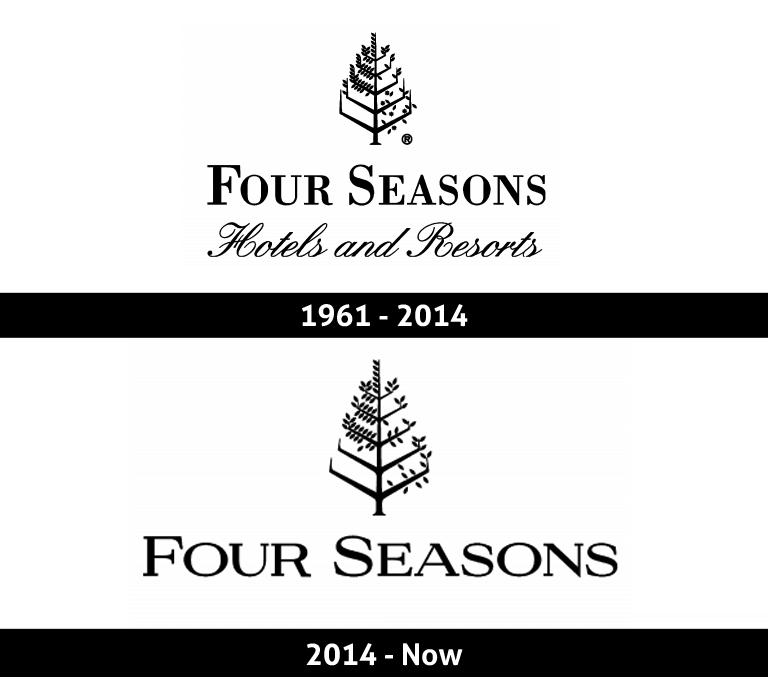
1961–2014: Seasonal Tree Symbol and Architectural Stability
Four Seasons introduced its definitive visual identity in the early 1960s, establishing a logo that would become one of the most enduring symbols in luxury hospitality. The emblem was structured across three conceptual levels, with the upper section dominated by a stylized tree whose vertical silhouette subtly echoed the proportions of a high-rise building. This architectural resemblance reinforced ideas of stability, permanence, and long-term presence, values central to the Four Seasons brand philosophy.
The tree itself was divided into four distinct quadrants, each representing a different season through variations in foliage. One section appeared completely bare, symbolizing winter, while another was densely covered with leaves, representing summer. The remaining two quadrants illustrated spring and autumn through intermediate stages of growth and decline. This visual metaphor directly translated the brand name into symbolism, emphasizing the cyclical nature of time and the concept of continuity.
Beyond seasonal symbolism, the emblem also communicated adaptability. The changing foliage suggested the company’s ability to evolve with markets, cultures, and guest expectations while maintaining a consistent core identity. This message aligned closely with Four Seasons’ strategy of adapting hotel architecture and interiors to local environments, allowing each property to integrate seamlessly into its surroundings while preserving brand standards.
Beneath the tree, the “Four Seasons” wordmark appeared in a refined serif typeface. The varying stroke thickness and pronounced serifs conveyed tradition, prestige, and exclusivity. A secondary cursive inscription referencing hotels and restaurants complemented the emblem, reinforcing the brand’s association with fine hospitality and dining. During this period, the logo became a global marker of understated luxury and reliability.

2014–Today: Refined Minimalism and Brand Expansion
In 2014, Four Seasons introduced a subtle but meaningful refinement to its logo, coinciding with the expansion of its services beyond traditional hotels to include branded vacation residences and extended luxury experiences. The most visible change was the removal of the lower descriptive inscription, which previously referenced hotels and restaurants. This simplification signaled the brand’s broader scope and its evolution into a multifaceted luxury lifestyle company.
The wordmark itself was slightly widened and visually strengthened, adding a sense of solidity and confidence. These adjustments reflected the brand’s accelerated global growth during the 2010s, including high-profile openings in markets such as China, India, Southeast Asia, and Eastern Europe. Despite these refinements, the core emblem remained untouched.
The stylized tree continues to serve as the central symbol, still divided into four seasonal sections. Its meaning remains unchanged: luxury, comfort, and consistency at any time of year and in any location worldwide. The black-and-white color scheme reinforces timelessness and authority, avoiding trend-driven aesthetics in favor of permanence.
By maintaining visual continuity while refining execution, Four Seasons reinforced its reputation for stability, discretion, and trust. The logo today functions not as a marketing device, but as a seal of assurance, instantly communicating the brand’s values to a global, affluent audience.
Typography and Visual Construction
Typography plays a crucial role in the Four Seasons logo meaning. The custom uppercase serif wordmark features delicate stroke transitions paired with sharp terminal serifs, balancing elegance and authority. The letterforms visually harmonize with the angular structure of the tree, creating a cohesive system rather than separate elements.
The restrained use of text reinforces exclusivity and confidence. By avoiding slogans or descriptive additions, the brand allows its name and symbol to stand alone, signaling maturity and self-assurance.
Four Seasons Logo Heritage and Brand Positioning
The Four Seasons logo heritage is defined by restraint, continuity, and symbolic clarity. While many luxury brands periodically refresh their identities to signal relevance, Four Seasons has chosen consistency as its strongest asset. This strategy reinforces trust, particularly among a clientele that values discretion and stability.
Positioned at the pinnacle of global luxury hospitality, Four Seasons uses its logo not to attract attention but to confirm expectations. The emblem functions as a visual promise of experience quality rather than a marketing hook.
Four Seasons Logo History and Timeless Luxury Identity
The Four Seasons logo history demonstrates how a literal symbol, when executed with discipline and restraint, can achieve lasting relevance. From its original seasonal tree to its refined modern form, the logo has remained faithful to its core meaning while adapting quietly to changing contexts. Within the broader framework of luxury hotel logo heritage, Four Seasons stands as a rare example of identity built on continuity rather than reinvention.
FAQ: Four Seasons Logo Meaning and History
What does the Four Seasons logo represent?
The logo represents the cycle of the four seasons through a stylized tree, symbolizing balance, continuity, and renewal.
Why does Four Seasons use a tree as its symbol?
The tree visually translates the brand name and reflects permanence, growth, and the passage of time.
Has the Four Seasons logo changed significantly over time?
No, the logo has evolved through subtle refinements rather than major redesigns.
What colors are used in the Four Seasons logo?
The primary palette is black and white, with occasional gold or dark green variations depending on placement.