
Formula 1 Logo History: Meaning, Evolution & Brand Heritage
Few sports blend cutting-edge technology, global prestige, and pure adrenaline the way Formula 1 does. More than just racing, F1 represents engineering excellence, fierce rivalries, and the pursuit of perfection at over 200 miles per hour. And alongside its dramatic history on the track stands a logo heritage that has evolved as boldly as the sport itself.
From the earliest identity marks of the mid-1980s to the sleek, forward-leaning emblem of today, the Formula 1 logo tells a story of speed, innovation, and modernity. This is one of the most recognizable logos in global sports—and its evolution mirrors the transformation of F1 from a high-stakes competition to a worldwide entertainment powerhouse.
The Global Identity of Formula 1
Formula 1 began in 1950 under the governance of the FIA, marking the birth of modern motorsport. What followed was a spectacle unlike anything else on Earth—national pride, legendary teams, record-breaking champions, and extreme technological advancement. What started as a European racing championship became a global phenomenon watched by hundreds of millions.
As the sport grew, so did its visual identity. The F1 logo has become a universal symbol of velocity and high-performance engineering, capturing the essence of the fastest sport in the world. Its logo history reflects continuous reinvention: sharper lines, bolder silhouettes, and dynamic forms that express motion, precision, and the future of automotive innovation.
Meaning of the Formula 1 Logo
The F1 logo has always served one purpose—to visually express the feeling of speed. Its geometric angles, abrupt cuts, and forward-leaning shapes represent acceleration. Its modern red palette symbolizes energy, passion, and the intensity of the championship.
Each redesign has been influenced by the evolution of motorsport itself. As Formula 1 entered new eras—commercial expansion, faster cars, digital broadcasts—the logo subtly shifted to match the moment. Today’s version leans toward minimalism, letting pure form and negative space communicate motion, innovation, and a global entertainment identity.
This is logo heritage at its finest: an emblem continuously modernized without losing its spirit.
Formula 1 Logo Evolution
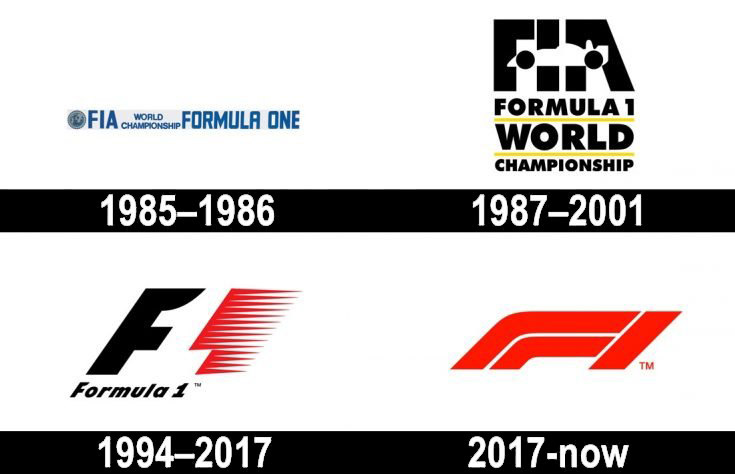
1985–1987: The First Modern Identity
Formula One’s first recognizable logo appeared in 1985. It featured a horizontal rectangle with a rounded emblem on the left and a blue wordmark on a light gray background. The style felt corporate and conservative—an early attempt to formalize the sport’s growing brand presence.
1987–1993: A Stronger, More Confident Look
In 1987, F1 introduced a more assertive design. A bold black wordmark appeared in three stacked lines, underlined in yellow, accompanied by an FIA badge above it. The racing-car silhouette integrated into the FIA lettering reinforced the connection between governance and the sport itself.
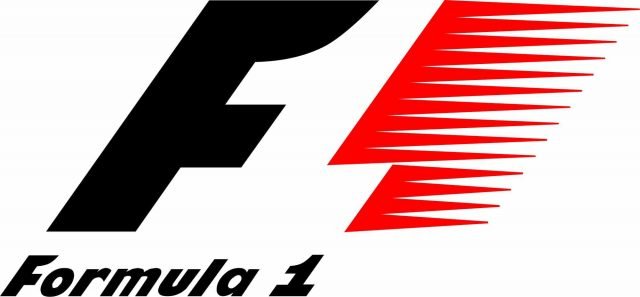
1993–2018: The Iconic Negative-Space ‘1’
The 1993 redesign by Carter Wong became one of the most famous sports logos ever created. The slanted “F” and dynamic speed lines cleverly formed the number “1” in the negative space—a masterstroke that symbolized velocity and engineering precision.
Black represented power and control; red conveyed energy, aggression, and passion.
This logo appeared on cars, race suits, circuits, broadcasts, and merchandise for nearly 25 years, becoming inseparable from F1 culture.
2018–Today: A New Era Under Liberty Media
After Liberty Media acquired Formula 1, the sport entered a new commercial and digital age. To reflect this shift, Wieden+Kennedy London redesigned the logo for the 2018 season.
The new emblem features:
-
a bold, forward-leaning red “F”
-
a diagonal “1” shape completing the mark
-
softened corners for a modern, fluid silhouette
Minimalist but powerful, the design captures acceleration and the future of racing. It works perfectly across digital platforms, streaming content, social media, and global merchandising—an essential step in F1’s transformation into a lifestyle and entertainment brand.
Design, Typography & Color
Typography
The current F1 logo uses a custom futuristic typeface built from heavy bars, sharp cuts, and compressed forms. The elongated upper stroke of the “F” gives the logo its distinctive motion. This typeface is proprietary—no commercial equivalent matches its geometry or proportions.
Color
Formula 1’s visual identity revolves around red and white, occasionally accented with black.
Red embodies passion, danger, speed, and excitement—the emotional core of racing.
White provides clarity and balance, while black adds strength and contrast when needed for digital or on-track visibility.
The palette is timeless and immediately associated with the sport’s high-intensity environment.
Conclusion
The Formula 1 logo is more than a design—it’s a declaration of speed, innovation, and ambition. From the clever negative-space masterpiece of the 1990s to the sleek modern emblem of today, each version mirrors a chapter of F1’s evolution.
In the world of sports branding, few emblems demonstrate stronger logo heritage than F1’s. Its bold forms, relentless motion, and unmistakable energy echo everything the sport stands for: engineering excellence, global competition, and the pursuit of the extraordinary.
Whether displayed on a car nosecone or a digital leaderboard, the F1 logo continues to symbolize the pinnacle of motorsports.
FAQ – Formula 1 Logo
Why was the F1 logo redesigned in 2018?
To modernize the brand for digital media, streaming platforms, and global merchandising, aligning with the sport’s new era under Liberty Media.
What does the red color in the F1 logo represent?
Red conveys power, intensity, speed, and the high-adrenaline nature of competitive racing.
Why is the 1993 F1 logo so iconic?
It cleverly forms the number “1” using negative space between the “F” and the red speed lines—one of the most ingenious logo concepts in sports history.
Who created the new F1 logo?
The 2018 redesign was developed by Wieden+Kennedy London, a world-renowned creative agency.
Does the F1 logo have different versions?
The primary logo is the red-and-white wordmark, but variations in black or monochrome appear on digital graphics, merchandise, and circuit branding.
Is the F1 logo trademarked?
Yes, it is fully trademarked to protect the identity of the sport and its global commercial rights.