FIFA Logo History: Evolution, Meaning & Global Symbolism
Few symbols in global sports carry as much cultural weight as the FIFA logo. Representing the world’s most beloved game, this emblem is more than a mark—it is a visual expression of unity, global reach, and the emotional power of football. From its early monochrome badges to today’s bold modern wordmark, FIFA’s logo history mirrors the evolution of the sport itself, becoming one of the most recognizable symbols on Earth.
Introduction: A Symbol That Unites the World
FIFA—the Fédération Internationale de Football Association—was founded in 1904 with a mission that transcended borders: to govern, grow, and promote the global game of football. Over more than a century, the organization has expanded into every corner of the globe, overseeing competitions in men’s and women’s football, beach soccer, and futsal.
Alongside this growth, its logo has become a cornerstone of sports branding, representing not only governance but passion, teamwork, and global connection. Few emblems demonstrate logo heritage better than FIFA’s, a mark that has evolved while maintaining its universal message of unity through sport.
Meaning and Symbolism Behind the FIFA Logo
The FIFA logo has long incorporated two recurring ideas:
global presence and the spirit of football.
The two overlapping hemispheres—present in most historical versions—symbolize every continent, emphasizing FIFA’s international authority. The pentagonal football pattern embedded into the globes expresses movement, competition, and excitement, while the blue and gold color palette evokes trust, excellence, optimism, and prestige.
The current iteration, a bold blue wordmark, may appear minimalist, but it remains instantly associated with the world’s most watched sport. Its simplicity places full emphasis on the power of the four letters that represent football at its highest level.
FIFA Logo History and Evolution
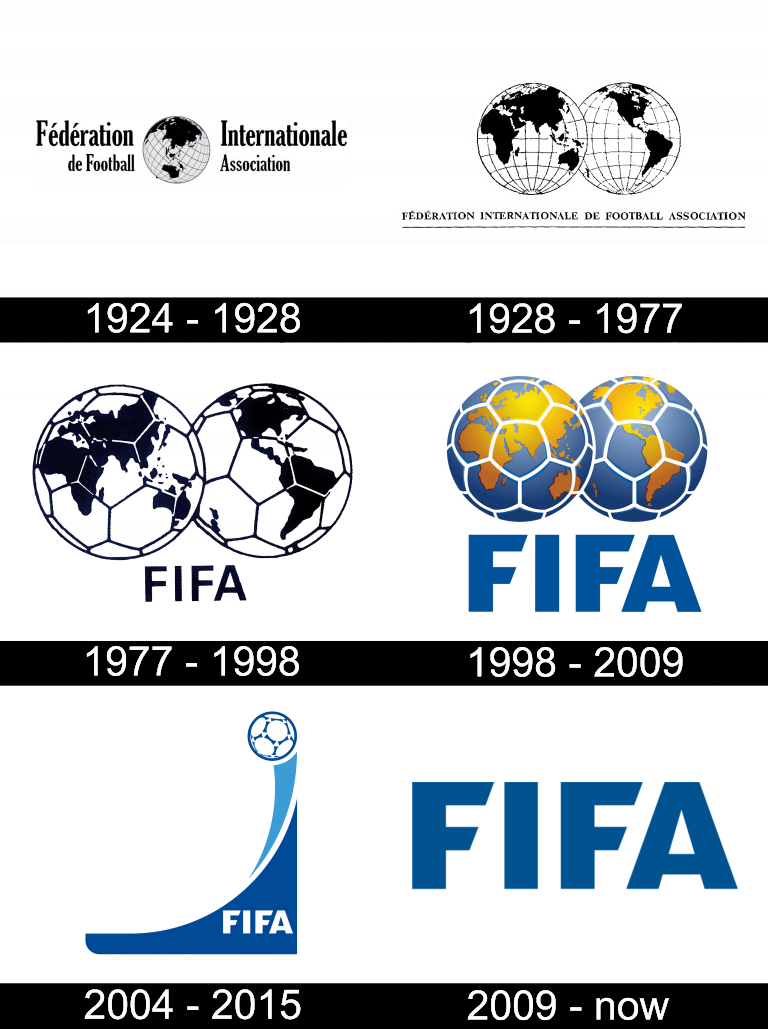
1924 – The First Visual Identity
FIFA’s earliest emblem appeared twenty years after its founding: a monochrome globe paired with French lettering. Simple and understated, it emphasized international expansion and hinted at the federation’s growing legitimacy in world sport.
1928 – A More Defined Emblem
In 1928, FIFA introduced a stronger, more refined design: two overlapping globes above a bold, underlined serif wordmark. This dual-globe motif instantly communicated global unity and remained a foundational part of FIFA’s logo heritage for nearly 50 years.
1977 – The Football Pattern Appears
FIFA modernized its design in 1977 by integrating a soccer-ball pattern into the hemispheres. This was the moment when the logo finally connected visually with the sport itself. The wordmark, shortened to “FIFA,” was rewritten in a clean geometric sans-serif, used in black, white, or yellow depending on the background.
1998 – A Colorful, Contemporary Look
The late 1990s brought a major update: vibrant blue oceans, golden continents, and soft gradients that made the globes appear more dynamic and three-dimensional. The wordmark was redesigned in a custom bold typeface with diagonal cuts on the letters “F,” symbolizing forward motion and technological progress.
2004 – Centennial Edition
To mark its 100th anniversary, FIFA temporarily introduced a special commemorative version. A blue-and-white football sat atop a sweeping abstract wave, paired with a bold white wordmark. This celebratory design represented progress, unity, and the organization’s expansive impact on global sport.
2009 – Present: The Iconic Wordmark
In 2009, FIFA officially adopted the type-only version of the logo first seen in 1998. Stripped of globes and imagery, the modern wordmark demonstrates confidence through simplicity. Its solid geometric shapes and upward-slanted cuts reinforce ideals of stability, leadership, and continuous development.
Today, this clean mark appears at every major competition—from the FIFA World Cup to youth development programs—embodying the federation’s global presence.
Design, Typography & Colors
Typography
The FIFA logotype uses a custom sans-serif typeface defined by its bold weight, strong geometry, and diagonal upper cuts. These slanted accents add motion and subtle dynamism, echoing the speed and energy of the sport. The style resembles Outlast Regular or Tanseek Sans Pro Extra Bold but remains proprietary.
Color Palette
FIFA’s signature deep blue symbolizes reliability, professionalism, and trust—qualities essential to an organization ruling the world’s most popular game. Paired with white, the contrast is clean, confident, and instantly recognizable.
Earlier versions incorporated a complementary palette of:
-
Gold yellow: excellence, championship spirit, ambition
-
Bright blue: global unity, optimism, the “planetary” identity
Together, these tones reinforce the idea of football as a universal language.
Why the FIFA Logo Matters in Global Culture
A FIFA tournament reaches billions of households. For millions of fans, players, and nations, the logo means more than governance—it represents belonging to a global community fueled by emotion, rivalry, and passion.
Its logo heritage reflects decades of evolution in both design and the sport’s cultural impact. Whether displayed on a pitch banner or a TV broadcast, the FIFA wordmark signals one thing: the world is watching.
FAQ – FIFA Logo
Why does the FIFA logo often feature two globes?
The two overlapping hemispheres symbolize FIFA’s global reach and unity across continents.
Why was the current wordmark introduced?
To modernize the identity and create a clean, adaptable logo for digital platforms, HDTV broadcasts, and global merchandising.
What does the blue color represent?
Blue conveys trust, reliability, and authority—core values for a global governing body.
What font does FIFA use?
A custom geometric sans-serif with angled cuts on the “F” letters, designed exclusively for FIFA.
Did FIFA remove the globes permanently?
For branding consistency, yes. The current official logo is the standalone wordmark, though globes remain in secondary or commemorative applications.
Which FIFA logo is the most iconic?
The 1998–2009 design featuring two blue-and-gold globes above the bold wordmark remains the most globally recognized.