ExxonMobil Logo History: Meaning, Symbolism & Brand Heritage
Few corporate emblems in the global energy sector carry as much historical weight as the ExxonMobil logo. Born from the merger of two of the oldest American petroleum giants—Exxon and Mobil—the current wordmark represents more than a simple fusion of names. It encapsulates more than a century of visual evolution, industrial power, and design influence, combining Standard Oil’s legacy with two iconic symbols: the interlocking “XX” created by Raymond Loewy and Mobil’s legendary Pegasus.
The modern ExxonMobil logo, introduced in 1999, is deceptively simple at first glance: a minimalistic red wordmark, clean and unadorned, with the instantly recognizable double-X at its core. Yet behind this clarity lies a deep visual heritage stretching back to the late 19th century—one that shaped the global petroleum brand we know today.
Origins of ExxonMobil: A Brand Built From the Standard Oil Legacy
The roots of ExxonMobil travel back to 1870, when John D. Rockefeller founded Standard Oil—a company that would dominate the U.S. petroleum landscape for decades. As antitrust laws eventually split Standard Oil into separate entities, two of its successors—Exxon (formerly Esso / Standard Oil of New Jersey) and Mobil (formerly Standard Oil of New York)—developed their own identities, symbols, and corporate mythology.
What makes the ExxonMobil logo fascinating is that it retains design DNA from both of its ancestors. Mobil contributed the refined typographic philosophy and its once-famous Pegasus, while Exxon brought its forward-leaning, ultra-modern “XX,” arguably one of the most influential letterform treatments in 20th-century corporate branding.
The merger in 1999 required a unified visual voice, and the resulting emblem has remained untouched for more than two decades—a sign of its effectiveness and enduring clarity.
Logo Evolution Timeline
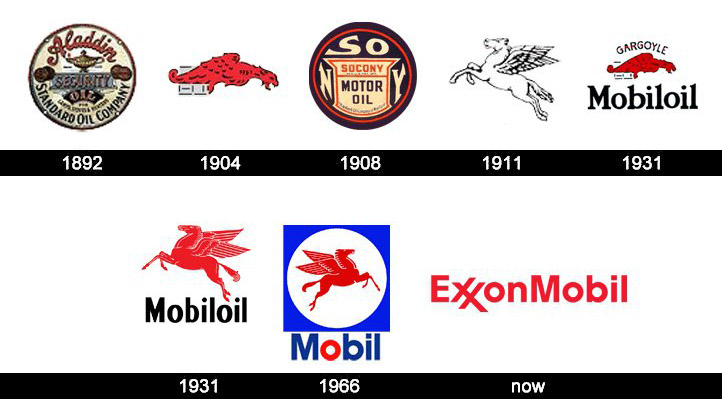
1892–1904: The Decorative Circular Emblem of Standard Oil
The earliest known symbol connected to the ExxonMobil lineage appeared in the early 1890s under Standard Oil. It was an ornate circular badge built around traditional shading and an Arabic-inspired “Metal P” symbol, designed for the brand’s pioneering product “Security Oil.” The mark reflected the Victorian aesthetic of the industrial age—ornamental, intricate, and symmetrical.
1904–1908: The Red Gargoyle
In 1904, Standard Oil adopted a striking, mythical mascot: a red gargoyle drawn in profile. Strong, bold, and instantly memorable, the gargoyle appeared without any additional typography. This aggressive, almost industrial creature projected power, durability, and energy—qualities essential to a rapidly expanding petroleum empire.
1908–1911: A Cleaner Circular Badge
A new emblem arrived in 1908, modernizing the circular format with geometric lines and a sophisticated color palette of sea-blue, red, and pale yellow. This refinement suggested the company’s technological evolution and growing international stature.
1911–1931: The Birth of Pegasus
In 1911, one of the most iconic symbols in petroleum history emerged: the winged horse Pegasus. Drawn in delicate monochrome lines, Pegasus symbolized speed, freedom, and mobility. It became the defining emblem of Mobil and a lasting symbol of 20th-century motion.
1931–1966: The Red Pegasus Returns
During the 1930s and onward, both Pegasus and the red gargoyle were used for different product lines. The detailed red Pegasus, facing right, often accompanied the “Mobiloil” name in bold black lettering. The pairing established Mobil’s commitment to innovation and progress, turning Pegasus into a global icon.
1966–1999: Mobil’s Modernist Masterpiece
Mobil’s identity was modernized in 1966 with one of the most elegant logos in corporate history. Pegasus appeared as a clean red silhouette inside a white circle, framed by a bright blue square. Below it, the minimalist “Mobil” wordmark featured its famous red “O,” symbolizing energy and forward vision. This design became globally recognizable and served Mobil until the merger.
1999–Today: The ExxonMobil Wordmark
When Exxon and Mobil merged in 1999, Lippincott & Margulies created a unified visual mark. The new logo kept Mobil’s typographic sensitivity and Exxon’s dynamic, interlocking “XX”—originally designed by the legendary industrial designer Raymond Loewy in 1966.
The emblem features the name ExxonMobil in bold red, with a distinctive double-X structure that communicates precision, engineering, and forward motion. Pegasus was retired from the corporate logo but remains part of Mobil’s brand heritage.
Meaning & Symbolism
The ExxonMobil logo may appear understated, but it carries profound symbolic weight.
The interlocking XX is the visual core of ExxonMobil’s identity. Designed by Raymond Loewy, the “father of industrial design,” the diagonal, interwoven strokes communicate modernity, momentum, and structural strength. The design reflects engineering discipline and the interconnectedness of ExxonMobil’s global operations.
The red color symbolizes energy, action, innovation, and industrial capability—qualities essential for a global petroleum leader. Red also stands out vividly in signage, refining facilities, and fuel distribution environments.
The absence of imagery (such as Pegasus) in the modern logo reflects a strategic shift toward minimalism, corporate stability, and a focus on precise visual communication. The mark is corporate rather than sentimental—an expression of scale, authority, and reliability.
Font & Typography
The typography used in the ExxonMobil logo is deliberately clean and modern. While the wordmark may appear generic at first glance, the typeface is subtly customized—particularly around the double-X treatment.
The characters are bold, geometric, and balanced, embodying structural stability. Their proportions were refined to ensure clarity on fuel stations, refinery signage, tanker ships, and digital environments.
The centerpiece remains the interlaced X’s, a typographic achievement that merges aesthetics and engineering. The letterforms create a sense of movement without compromising legibility.
Color Palette
The ExxonMobil palette is anchored in a confident and timeless shade of industrial red, paired with pure white. Earlier identities used blue as well—especially in Mobil’s era—but the merged corporation opted for the clarity of a two-color system.
Red represents energy, determination, and industrial heritage.
White reinforces clarity, transparency, and precision—the qualities a global financial and energy powerhouse must communicate.
On product applications, signage may extend into silver, black, or blue, but the official corporate mark remains strictly red and white.
The Enduring Legacy of the ExxonMobil Logo
The ExxonMobil logo is a masterclass in corporate minimalism: a mark that appears simple yet carries one of the richest design heritages in American industry. From the early Victorian emblems of Standard Oil to the red Pegasus of Mobil and the interlocking X’s of Exxon, each historical layer survives within the sleek 1999 wordmark.
More than a brand symbol, it represents a centuries-old industrial lineage—one built on engineering innovation, global expansion, and some of the most recognizable corporate design elements in history. Fidelity to this heritage explains why the ExxonMobil logo has remained unchanged for decades: it is already timeless.
FAQ: ExxonMobil Logo Heritage & Meaning
What does the ExxonMobil logo represent?
It represents the merger of Exxon and Mobil, symbolized through the interlocking “XX” and the modern red wordmark, reflecting innovation and industrial strength.
Who designed the Exxon double-X?
The double-X was created by renowned industrial designer Raymond Loewy in 1966.
Why doesn’t the Pegasus appear in the ExxonMobil logo?
While Pegasus was iconic for Mobil, the merged company chose a unified corporate identity focusing on typography rather than imagery.
When was the current ExxonMobil logo introduced?
The logo debuted in 1999, the year Exxon and Mobil officially merged.
What colors define the ExxonMobil logo?
A strict palette of red and white, chosen for visibility, energy, and clarity.