
Emerson Logo History: Meaning, Symbolism & Brand Heritage

The story of Emerson Radio Corporation is one of the longest continuous branding legacies in American consumer electronics. Few companies in the United States can claim uninterrupted trademark use for more than a century, yet Emerson has carried its visual identity from the phonograph age into the modern era of audio, home appliances, and personal electronics. The evolution of the Emerson logo reflects not only the technological shifts that shaped the industry, but also the company’s commitment to preserving its brand heritage while adapting to new markets and new generations of consumers.
Founded in 1912 and incorporated in 1915 as Emerson Phonograph Co., the company quickly became one of the earliest and most influential makers of home audio equipment. Its early catalog of phonographs and radios helped define consumer entertainment long before the rise of television. As the decades progressed, Emerson expanded beyond sound reproduction into broader electronics and household products, yet the musical symbolism embedded in its identity remained a central thread.
The modern Emerson logo, with its musical note emblem and distinctive lettering, is more than a decorative mark. It is a link to the origins of audio technology in America, a reminder that the company’s story begins with recorded music and the machines that played it. The design language shaped over the last seventy years reflects both continuity and modernization—a delicate balance few brands have maintained as successfully.
This article explores the meaning, heritage, and full logo evolution of Emerson Radio, revealing how a century-old identity survived while remaining relevant in a rapidly changing consumer electronics landscape.
Meaning and Symbolism Behind the Emerson Logo
From its earliest forms, the Emerson logo has carried a strong musical association. Whether expressed through stylized serif lettering or the musical note enclosed within geometric forms, sound has always been its core symbolic theme. The note references the company’s founding product category—phonographs—and later radios, amplifying Emerson’s heritage as one of America’s original home-audio manufacturers.
The circular forms embedded within the note have also evolved in symbolic meaning. Originally reminiscent of tuning dials or radio speaker grilles, they now evoke the grooves of a vinyl record or the precision components found in modern audio devices. Throughout its history, the logo has balanced technical modernity with musical warmth, communicating both innovation and tradition.
The most essential element across versions is the emphasis on motion. Whether created through italicized lettering, a slanted note, or flowing calligraphic strokes, the Emerson identity has consistently projected forward momentum—mirroring the company’s continuous adaptation to new eras in consumer electronics.
Emerson Brand Heritage and Identity Philosophy
As one of the oldest names in American electronics, Emerson’s brand heritage is rooted in accessibility, reliability, and entertainment. Throughout the 20th century, millions of households first encountered recorded music, radio broadcasts, and television through Emerson-branded products. It became a fixture in ordinary homes, making technology approachable.
The logo serves as a visual summary of that history. Its emphasis on music and motion positions Emerson not merely as a manufacturer of hardware but as a company woven into the cultural experience of listening, watching, and enjoying sound. In a sector where many brands have disappeared, merged, or drastically rebranded, Emerson’s ability to preserve the essence of its symbol reinforces its longstanding reputation and cultural footprint.
Emerson Logo History & Evolution Timeline
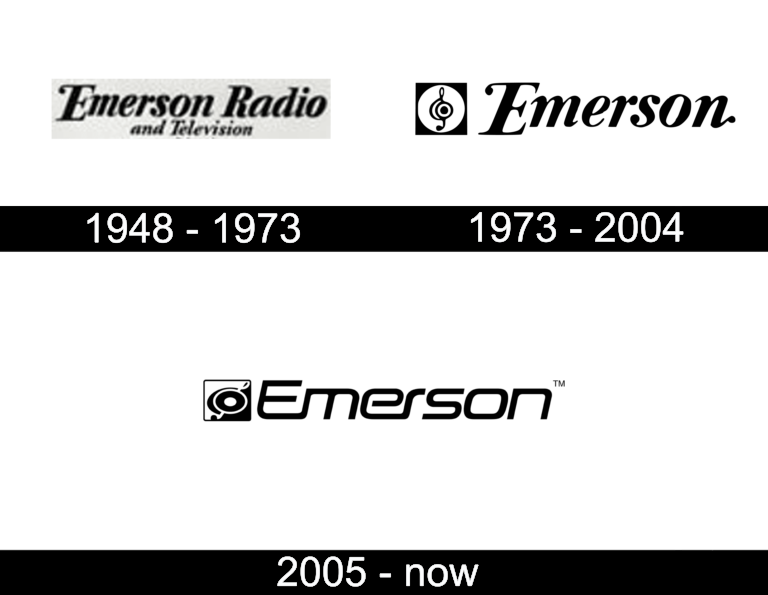
1948–1973: The Foundational Identity
The first major Emerson logo introduced in 1948 established the classic typographic style that defined the early brand. Set in an italic serif typeface, the wordmark featured long, elegant strokes, most notably in the extended and curved crossbar of the letter “E.” Its visual personality echoed craftsmanship and refinement, qualities associated with high-quality home audio equipment of the mid-20th century. Beneath the primary nameplate, the phrase “and Television” acknowledged Emerson’s expansion into a rapidly growing medium.
The logo’s monochrome design was simple, confident, and utilitarian—typical of industrial-era electronics branding—but the distinctive “E” immediately set it apart.

1973–2004: The Introduction of the Musical Note
A defining transformation occurred in 1973, when Emerson introduced its iconic musical note emblem. Positioned within a white circle placed inside a black square, the note served as both symbol and storytelling device. A small circular arrangement at its center resembled vintage radio components, reinforcing the company’s original domain.
The accompanying script-style wordmark brought a sense of elegance and fluidity, contrasting with the geometric note. Decorative dots at the ends of certain letters, variations in stroke thickness, and a handwritten feel created a more expressive identity aligned with the brand’s musical heritage.
This version endured for more than thirty years, becoming one of Emerson’s most recognizable marks.

2005–Today: Modernization and Streamlining
The latest redesign ushered in a modern era for the Emerson brand. The musical note was retained but tilted forward, giving the emblem a new sense of kinetic energy. Its inner circular motif now evoked the grooves of a vinyl record, offering a subtle nod to nostalgia while remaining technically modern.
The wordmark was fully redrawn in a custom sans-serif style with italic influence. Rounded contours and consistent stroke widths replaced the decorative script flourishes of the past. Select letters connect while others stand apart, a deliberate design choice that preserves individuality without sacrificing visual cohesion.
The overall result is a sleeker, more contemporary logo that maintains continuity with Emerson’s musical and technological foundations.

Typography and Color
Emerson’s current typeface is a smooth and modern italicized sans-serif with rounded forms and clean geometry. It conveys efficiency and forward motion while retaining a friendly visual tone. Although custom, its closest relatives include Conthrax Italic, Korataki Book Italic, and Shary I Semi-Bold, each requiring modifications to match Emerson’s precise sculpting.
The color palette remains the timeless black-and-white combination. This restrained approach allows the logo to function on packaging, digital interfaces, and physical products without distraction. Black represents reliability and authority, while white creates contrast and clarity—together projecting a classic identity that withstands shifting design trends.
The Heritage of a Century-Old Identity
The history of the Emerson logo is a rare example of brand continuity across more than seventy years of dramatic technological transformation. From early phonographs to modern electronics, the company has preserved the symbolic connection to its musical origins while consistently refining its visual identity for new generations. The musical note remains the anchor of the Emerson brand—an emblem of sound, innovation, and cultural relevance.
In an industry defined by rapid change, the Emerson logo endures as a testament to longevity, heritage, and the power of a thoughtfully preserved design tradition.
FAQ: The History, Meaning and Identity of the Emerson Logo
When was the Emerson logo first introduced?
The earliest major Emerson logo appeared in 1948, introducing the company’s distinctive italic serif wordmark.
Why does the Emerson logo include a musical note?
The musical note symbolizes the brand’s origins in phonographs and radios, preserving Emerson’s deep heritage in audio technology.
What does the circular detail in the note represent?
It recalls radio dials, gramophone records, and early sound equipment, serving as a connection to Emerson’s long history in home audio.
Has the Emerson logo changed much over time?
While typography and styling evolved, the core musical symbolism has remained consistent since the 1970s.
Why did Emerson modernize its logo in 2005?
The update aligned the brand with contemporary electronics design while retaining its signature elements and historical symbolism.