Eicher Motors Logo History: Meaning, Symbolism & Brand Heritage
Founded in 1948, Eicher stands among the oldest and most respected names in the Indian automotive industry. From its earliest years, the brand focused on engineering vehicles designed for durability, load-bearing strength, and long-term commercial use. What began as an ambition to manufacture motorcycles and utility vehicles gradually evolved into a broader industrial vision, later reinforced through a strategic collaboration with Volvo for the production of trucks and heavy-duty commercial vehicles.
The Eicher logo history is notable not for frequent redesigns, but for its unwavering consistency. Unlike many automotive brands that repeatedly modernized their visual identities to follow design trends, Eicher adopted a logo early on that aligned perfectly with its engineering philosophy. The logo meaning, symbolism, and overall logo heritage reflect stability, discipline, and mechanical strength rather than emotional or lifestyle-driven branding.
In an industry where logos often evolve to appear lighter, faster, or more consumer-oriented, Eicher represents a different school of thought. Its visual identity was conceived as a statement of reliability and seriousness, qualities deeply rooted in the brand’s origin and sustained through decades of industrial use.
Meaning and History: The Origin of the Eicher Logo
Eicher was established in post-independence India at a time when industrial self-reliance and infrastructure development were national priorities. From the outset, the brand adopted a production philosophy inspired by European engineering principles, particularly those associated with Northern European manufacturing culture. This influence became more explicit later, when Eicher entered into collaboration with Volvo, reinforcing its positioning around safety, precision, and durability.
The logo origin dates back to 1948, the same year the company was founded. Rather than experimenting with multiple visual directions, Eicher introduced a single emblem that encapsulated its values from the very beginning. This early commitment to a strong visual symbol eliminated the need for future redesigns and allowed the logo to mature alongside the brand itself.
In contrast to automotive brands that evolved from consumer markets and later entered commercial segments, Eicher was built around professional use cases. This focus is clearly reflected in its logo meaning, which emphasizes strength, motion, and controlled power rather than speed for its own sake.
Eicher Logo History Timeline
1948–Present: The Eicher Horse Emblem and Visual Continuity
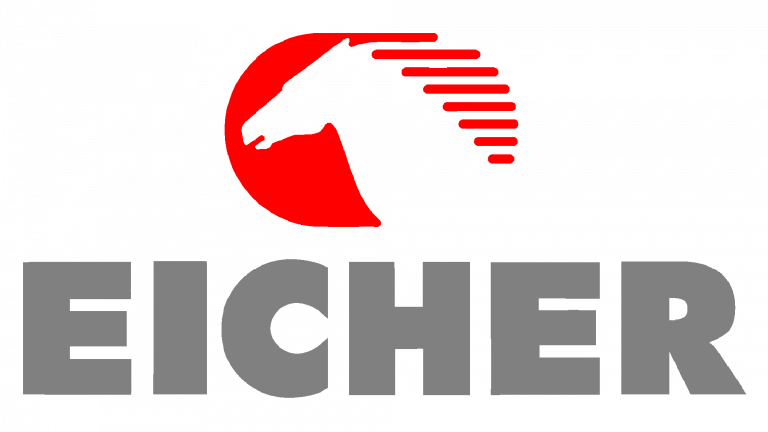
The Eicher logo was introduced in 1948 and has remained fundamentally unchanged ever since. At its core is a horizontally oriented oval emblem in red and white, containing the profile of a horse facing left. The horse is rendered in white, set against a red background, immediately communicating strength, endurance, and disciplined motion.
The oval is visually divided into two distinct sections. The left side is solid red, providing visual weight and balance, while the right side features horizontal red-and-white stripes. This striped pattern introduces a sense of forward motion and speed, suggesting progress without chaos. The contrast between solidity and movement reflects the brand’s engineering philosophy, where controlled power is valued more than aggressive acceleration.
Over time, only minor refinements were made to proportions and reproduction quality to adapt the logo to different media. The emblem itself, however, has never been redesigned, making it one of the most stable automotive logos still in use today.
Logo Symbolism: Strength, Motion, and Discipline
The symbolism of the Eicher logo is rooted in classical imagery rather than abstract forms. The horse has long been associated with power, endurance, and reliability, qualities directly aligned with commercial and industrial vehicles. Unlike racing-inspired automotive logos that emphasize speed and aggression, the Eicher horse represents sustained performance and controlled energy.
The horizontal orientation of the emblem reinforces stability, while the striped section adds a dynamic element without undermining balance. This approach to logo symbolism mirrors strategies seen in other engineering-driven automotive brands, where visual identity prioritizes trust and longevity over visual experimentation.
The color symbolism further strengthens this message. Red conveys power, determination, and mechanical strength, while white introduces clarity, precision, and discipline. Together, they form a logo that communicates confidence without excess.

Typography and Color in the Eicher Logo
The Eicher logotype is set in an all-uppercase ExtraBold sans-serif typeface with clean, straight lines and sharply defined edges. This typographic choice reinforces the brand’s industrial character and avoids decorative elements that could undermine its professional image. The lettering appears in two primary variants, a straight version rendered in light gray and an italicized version executed in the same red used in the emblem.
The italicized logotype introduces subtle motion, complementing the striped portion of the oval emblem, while the gray version emphasizes neutrality and balance. Both variations rely on the same typographic structure, ensuring consistency across applications.
The red-and-white color palette is central to the Eicher logo heritage. Red signals passion, power, and resilience, while white provides contrast and legibility. When paired with the gray wordmark, the overall composition conveys stability, responsibility, and technical reliability, qualities essential for a brand operating in the commercial vehicle sector.
Eicher Logo Heritage and Brand Identity
Eicher’s logo heritage is defined by restraint and confidence. In more than seven decades, the brand has never felt the need to reinvent its visual identity. This continuity reflects a belief that strong engineering values do not require constant visual updates to remain relevant.
The logo is not designed to appeal emotionally to a mass consumer audience. Instead, it functions as a professional seal of reliability, particularly important in commercial transportation, where trust and safety outweigh aesthetics. This philosophy aligns Eicher with other legacy automotive manufacturers whose identities are built around engineering credibility rather than lifestyle branding.
A Logo Built to Last
The Eicher logo history demonstrates how a well-conceived visual identity can remain relevant without constant redesign. From its 1948 origin to the present day, the horse emblem has symbolized strength, motion, and disciplined power, perfectly reflecting the brand’s engineering-focused mission.
By preserving its original logo structure and refining only what was necessary, Eicher created a logo heritage rooted in consistency and trust. In an industry where visual change is often mistaken for progress, Eicher stands as a reminder that true brand strength is built through continuity, not reinvention.
FAQ: Eicher Logo Meaning, Symbolism, and History
What does the Eicher logo represent?
The Eicher logo represents strength, endurance, motion, and reliability, symbolized by a horse within a balanced oval emblem.
When was the Eicher logo created?
The Eicher logo was introduced in 1948 and has remained largely unchanged since then.
Why does the Eicher logo feature a horse?
The horse symbolizes power, controlled movement, endurance, and mechanical strength, qualities associated with commercial vehicles.
Has the Eicher logo ever been redesigned?
No major redesigns have occurred; only minor refinements were made to adapt the logo to modern reproduction standards.
What do the red and white colors mean in the Eicher logo?
Red represents power and determination, while white conveys clarity, precision, and reliability.
What font style is used in the Eicher logo?
The logo uses an ExtraBold sans-serif typeface, emphasizing strength, stability, and industrial professionalism.