
EgyptAir Logo History: Meaning, Symbolism & Brand Heritage

As one of the world’s oldest continuously operating airlines, EgyptAir carries a visual identity shaped by civilization, mythology, and national symbolism rather than transient design trends. Established during the early expansion of commercial aviation, the airline developed a logo that functions as more than corporate branding. The EgyptAir logo history reflects a deliberate fusion of ancient heritage and modern aviation authority. When examined alongside other culturally rooted flag carriers such as the Ethiopian Airlines logo history and the monarchic symbolism explored in the Royal Air Maroc logo, EgyptAir emerges as one of the strongest examples of mythological symbolism within global airline logo history.
The EgyptAir logo meaning is inseparable from Egypt’s historical narrative. Instead of abstract corporate forms, the airline chose to anchor its visual identity in ancient mythology, using a symbol instantly recognizable across cultures. This decision established EgyptAir as both a modern airline and a visual ambassador of one of the world’s oldest civilizations.
Meaning and History: The Origin of the EgyptAir Identity
EgyptAir was founded in 1932, making it one of the earliest airlines in the Middle East and Africa. As Egypt’s flag carrier, the airline has long served as a strategic bridge between Africa, the Middle East, Europe, Asia, and the Americas. Headquartered in Cairo and owned by the Egyptian government, EgyptAir has played a central role in supporting tourism, commerce, and international connectivity.
From its early years, the airline’s visual identity was designed to reflect national pride and historical continuity. The logo origin was not rooted in aviation mechanics or modernist abstraction, but in ancient Egyptian symbolism. This approach distinguished EgyptAir from many contemporaries and established a timeless narrative that would endure through multiple redesigns.
The logo meaning evolved alongside the airline’s modernization, but its symbolic foundation remained constant. By adopting an emblem tied to mythology rather than technology, EgyptAir positioned itself as an institution connected to history, protection, and endurance.
Logo Symbolism: Horus, Protection, and Vision
The EgyptAir logo symbolism is centered on the figure of Horus, the falcon-headed deity of the sky in ancient Egyptian mythology. Horus represents protection, power, and divine oversight, attributes directly aligned with the values of aviation safety, reliability, and vigilance. The falcon’s sharp profile and commanding gaze convey strength and control, reinforcing trust in the airline’s operational authority.
Color symbolism further strengthens this narrative. Blue represents the Nile, the sky, and continuity, while gold and warm tones historically referenced the sun and desert landscapes of Egypt. In later iterations, the palette was refined to emphasize deep blue, reinforcing professionalism, stability, and international credibility.
Unlike abstract airline symbols, the EgyptAir emblem communicates meaning instantly. Its mythological reference transcends language, allowing the logo to remain culturally specific yet globally legible.
EgyptAir Logo History Timeline
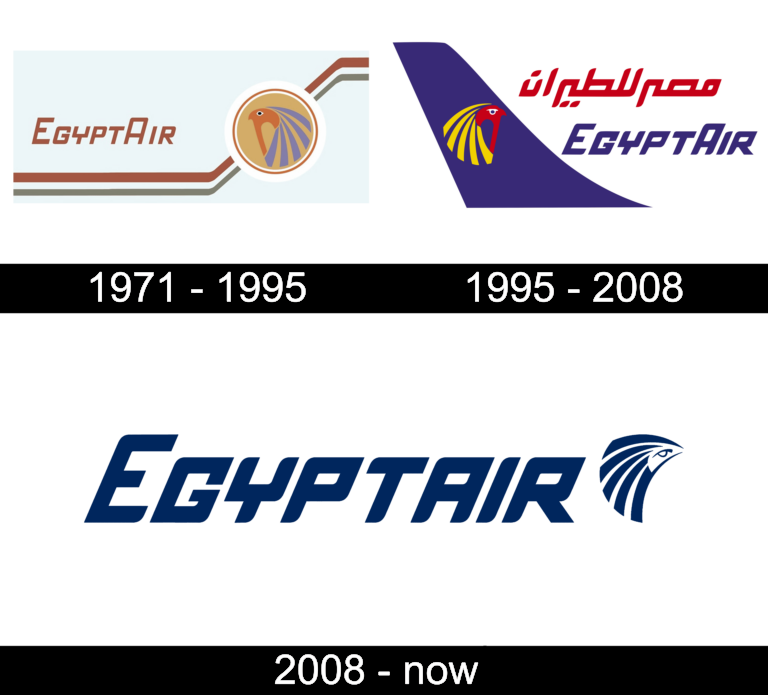
1971–1995: Mythological Emblem and Cultural Authority
The 1971 EgyptAir logo introduced a refined and authoritative depiction of Horus, marking the airline’s most symbolically rich visual identity. The falcon-headed deity was rendered in profile, emphasizing sharp lines, extended wings, and a commanding posture. This version highlighted Egypt’s ancient heritage while projecting strength and vigilance.
The accompanying wordmark featured bold, geometric letterforms that balanced modern aviation aesthetics with the emblem’s historical depth. The color palette included gold, blue, and warm tones, visually linking the airline to Egypt’s natural and cultural landscape. This logo established EgyptAir as a carrier deeply rooted in national identity.
1995–2008: Expanded Color Palette and Bilingual Identity
The 1995 redesign retained Horus as the central symbol while introducing a more colorful and complex composition. The emblem was placed on a stylized blue wing, reinforcing the connection between mythology and aviation. The palette expanded to include blue, red, and yellow, creating a vibrant and expressive visual presence.
Typography evolved to incorporate both English and Arabic lettering, reinforcing EgyptAir’s role as a bridge between cultures. This version remained in use for over a decade, becoming one of the most widely recognized iterations of the airline’s logo.
2008–Present: Minimalist Refinement and Global Modernization
The 2008 redesign marked a strategic shift toward simplification while preserving symbolic continuity. The color palette was reduced to a deep, authoritative blue set against a white background. Horus was retained but rendered as a clean, unframed icon, emphasizing clarity and adaptability across digital and physical platforms.
The wordmark adopted bold uppercase lettering in a stylized, slightly slanted sans-serif typeface. Softened edges introduced modernity without sacrificing authority. This version reflects EgyptAir’s transition into a contemporary global airline while maintaining its mythological core.
Typography and Visual Construction
Typography in the EgyptAir logo is designed to convey strength, reliability, and modernity. The uppercase wordmark projects confidence and institutional authority, while the subtle slant introduces a sense of motion and progress.
The balance between emblem and lettering is carefully controlled, ensuring the Horus symbol remains dominant without overwhelming the wordmark. This proportional discipline allows the logo to perform effectively across aircraft liveries, airport signage, and digital applications.
EgyptAir Logo Heritage and Brand Positioning
The EgyptAir logo heritage is defined by symbolic consistency rather than visual experimentation. While execution and color have evolved, the core emblem has remained intact for decades. This continuity reinforces trust and positions EgyptAir as a stable national institution rather than a trend-driven commercial brand.
By anchoring its identity in mythology, EgyptAir differentiates itself from airlines that rely on abstract or generic symbols. The logo functions as both branding and cultural representation, strengthening the airline’s role as a national ambassador.
EgyptAir Logo History and Timeless Symbolism
The EgyptAir logo history demonstrates how ancient symbolism can coexist with modern aviation branding. From richly detailed mythological depictions to refined minimalist execution, the logo’s evolution reflects the airline’s growth without abandoning its origin. Within the broader context of airline logo heritage, EgyptAir stands as a compelling example of how cultural depth and visual restraint can produce a timeless and globally respected identity.
FAQ: EgyptAir Logo Meaning and History
What does the EgyptAir logo represent?
The logo represents protection, vision, and authority through the ancient Egyptian deity Horus.
Why does EgyptAir use Horus in its logo?
Horus symbolizes protection and the sky, aligning with aviation values and Egypt’s cultural heritage.
Has the EgyptAir logo changed significantly over time?
While refined in style and color, the core Horus symbol has remained consistent across decades.
What does the blue color in the EgyptAir logo symbolize?
Blue represents the sky, the Nile, stability, and trust, reinforcing the airline’s reliability.