Duke Energy Logo History, Meaning, and Symbolism
Duke Energy Corporation stands among the most established and influential energy providers in the United States, with roots that stretch back to the dawn of the modern electrical age. Headquartered in Charlotte, North Carolina, the company has grown from a regional power supplier into a diversified energy holding group serving millions of customers across the US and parts of Canada. Like many legacy infrastructure brands, Duke Energy’s long-term success has depended not only on engineering and scale, but also on a visual identity capable of evolving alongside changing technologies, environmental priorities, and public expectations.
The Duke Energy logo history reflects this gradual transformation. Rather than chasing short-term design trends, the company has refined its identity through carefully timed updates that mirror shifts in corporate strategy, regulatory landscapes, and cultural attitudes toward energy production. Similar evolution patterns can be observed in the Exxon logo history and the Chevron logo history, where visual continuity reinforces trust and institutional stability. Within the broader energy brand logo history, Duke Energy occupies a distinctive position as a utility brand that successfully transitioned from industrial power symbolism to a modern, sustainability-oriented visual language.
Meaning and History: The Origin of Duke Energy
The origins of Duke Energy trace back to 1900, when the Catawba Power Company was established to harness hydroelectric resources in the Carolinas. In 1924, the business was reorganized and renamed Duke Power, a title that would become synonymous with electricity generation throughout the southeastern United States for much of the 20th century. As the company expanded its operations, infrastructure, and service territory, its identity increasingly reflected the scale and authority of a major utility provider.
The transition to the Duke Energy name occurred in the late 1990s following a series of mergers and strategic realignments, most notably with PanEnergy Corporation. This shift marked more than a corporate rebranding exercise. It represented a broadening of scope beyond traditional electricity generation to include natural gas, transmission infrastructure, and integrated energy services. The logo meaning evolved accordingly, moving from a purely industrial aesthetic toward a more dynamic and adaptable visual identity capable of representing a modern energy corporation.
Logo Symbolism: Power, Motion, and Transformation
Throughout its various redesigns, Duke Energy’s logo symbolism has centered on movement, continuity, and controlled power. Earlier versions emphasized solidity and authority, appropriate for a utility operating critical infrastructure. Over time, curved lines, flowing shapes, and lighter color palettes were introduced to suggest energy in motion rather than static force.
The most recognizable symbolic element in Duke Energy’s identity is the stylized “D” motif, often intersected by a sweeping line. This form functions as both a literal initial and an abstract representation of energy flow, transmission, and balance. As sustainability and environmental responsibility became more central to the company’s messaging, the logo symbolism shifted further toward natural associations, reinforcing a narrative of cleaner, more adaptive energy solutions.
Duke Energy Logo History Timeline
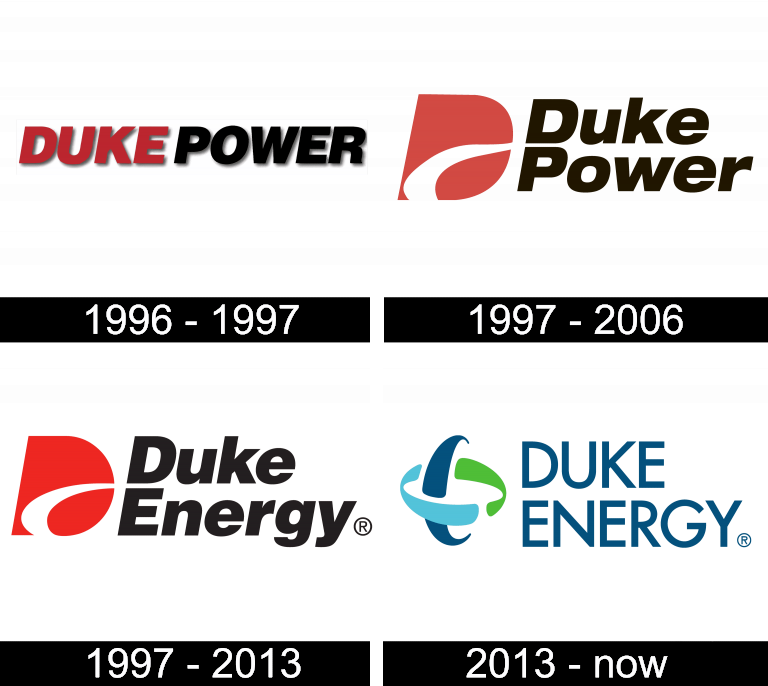
1996–1997: Transitional Duke Power Wordmark
The first major visual shift occurred during the announced merger with PanEnergy Corporation in 1996. A transitional logo was introduced featuring the “Duke Power” name rendered in a bold, italicized sans-serif typeface. The all-capital lettering conveyed strength and momentum, while subtle gray shading added depth. Color differentiation between the two words created visual separation without introducing a separate emblem, signaling an organization in transition rather than reinvention.
1997–2006: Introduction of the Duke Energy Emblem
Following the completion of the merger, the Duke Energy name was formally adopted, accompanied by a new emblem. This version introduced a large red “D” intersected by a white swoosh integrated into the letterform. The swoosh added motion and directed attention toward the wordmark, which appeared in a bold, italicized sans-serif typeface with lowercase letters. This logo marked the first clear step toward a unified corporate identity distinct from the historic Duke Power branding.
1997–2013: Refined Red “D” Identity
Later in 1997, the logo underwent refinement rather than reinvention. The structure remained intact, but the red color was intensified into a brighter scarlet, enhancing visibility and impact. The white swoosh within the “D” was subtly adjusted, becoming more streamlined and controlled. This version dominated Duke Energy’s branding for more than a decade, reinforcing recognition during a period of expansion and operational consolidation.
2013–Today: Modern Eco-Oriented Redesign
A comprehensive redesign was introduced in 2013, following the merger with Progress Energy Inc. The new identity departed from the heavy red-and-black palette of earlier versions in favor of blue and green tones associated with water, sky, and vegetation. The emblem adopted softer curves and thinner strokes, creating a lighter and more fluid appearance.
This redesign aligned the logo heritage with evolving public expectations around environmental responsibility and renewable energy. The abstract form retained a sense of motion while deliberately avoiding aggressive or industrial symbolism, positioning Duke Energy as a forward-looking utility focused on sustainability and innovation.
Typography and Color Palette
The Duke Energy wordmark is set in a clean, modern sans-serif typeface characterized by confident strokes and open letterforms. Its geometry prioritizes clarity and legibility across digital and physical applications, from infrastructure signage to mobile interfaces. The typography avoids decorative excess, reinforcing the brand’s emphasis on reliability and professionalism.
Color plays a central role in the logo meaning. Green symbolizes life, growth, and renewable energy sources, while blue conveys trust, stability, and technical expertise. Against a white background, the palette communicates transparency and openness, reinforcing Duke Energy’s commitment to responsible energy production.
Duke Energy Logo as a Symbol of Adaptation
The Duke Energy logo history illustrates how a legacy utility brand can evolve without sacrificing credibility or recognition. By carefully balancing continuity with adaptation, Duke Energy has transformed its visual identity to reflect changes in technology, regulation, and societal values. Its logo heritage stands as a case study in long-term brand stewardship, demonstrating that effective logo symbolism does not rely on constant reinvention but on meaningful, well-timed evolution.
FAQ: Duke Energy Logo Meaning and History
What does the Duke Energy logo represent?
The logo represents energy flow, reliability, and environmental responsibility, using motion-driven shapes and natural color symbolism.
When did Duke Energy change its name from Duke Power?
The transition to Duke Energy occurred in the late 1990s following mergers that expanded the company’s scope beyond electricity generation.
Why are blue and green used in the current Duke Energy logo?
Blue represents trust and stability, while green reflects sustainability, growth, and renewable energy initiatives.
Has the Duke Energy logo changed significantly over time?
Yes, the logo has evolved through several redesigns, with the most significant change occurring in 2013 to emphasize a modern, eco-friendly identity.