
Dove Logo History: Meaning, Symbolism & Brand Heritage
In the crowded world of personal care branding, few names have achieved the level of emotional recognition and long-term consistency associated with Dove. Introduced in the United States during the mid-1950s, Dove entered the market with a fundamentally different promise: gentleness, care, and trust. This positioning shaped not only its product formulations but also its visual identity. The Dove logo history is a clear example of how a brand can evolve subtly while protecting its core meaning across decades.
Unlike cosmetic brands that rely on constant reinvention, Dove built its logo heritage around continuity and emotional reassurance. Its identity matured quietly, maintaining elegance and softness while adapting to new cultural contexts. Comparable long-term consistency can be observed in Nivea logo history and the restrained refinement seen in Johnson & Johnson logo heritage, while Dove itself sits naturally within the broader context of beauty and personal care logo history.
Meaning and History: The Origin of the Dove Identity
Dove was launched in 1955 as a soap brand positioned around dermatological care rather than beauty ideals. From its inception, the brand emphasized mildness, purity, and everyday accessibility. These values directly influenced the logo meaning. Rather than sharp geometry or bold symbols, Dove adopted flowing typography and a universally positive emblem: the dove bird.
The dove as a symbol has long been associated with peace, purity, and care. For Dove, this imagery aligned perfectly with its promise of gentle cleansing and skin protection. As the brand expanded internationally and later became part of Unilever, its visual identity remained remarkably stable. This consistency helped reinforce trust, especially in a category where consumers form strong emotional bonds with familiar brands.
Dove Logo History Timeline
1955–1969: The Foundational Gentle Identity.
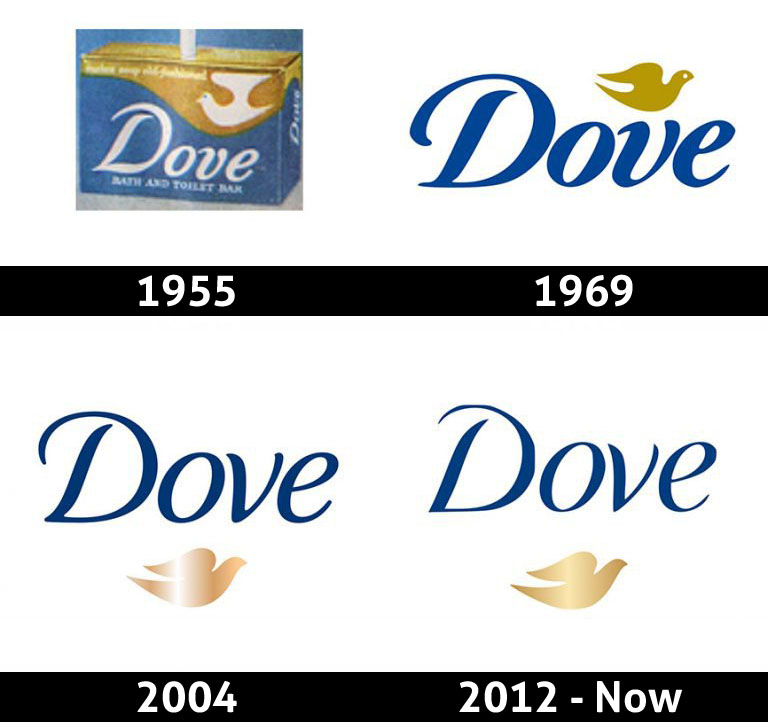
The first Dove logo introduced in 1955 featured a calm blue background with white cursive lettering and a delicate tagline. A stylized white dove appeared in the upper portion of the badge, its wings raised softly and facing left. Gold accents framed the composition, introducing a sense of quiet elegance. This design established all the core elements of Dove logo symbolism: softness, purity, and reassurance.
1969–2004: Simplification and Global Confidence.
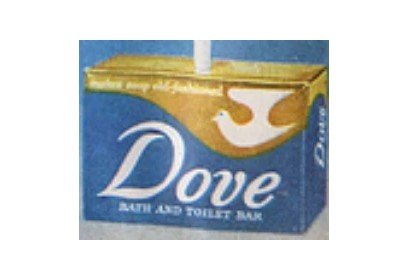
In 1969, Dove refined its logo while preserving its essential character. The background was simplified to white, allowing the blue wordmark and golden dove to stand independently. The dove was redrawn with more refined contours and repositioned to face right, subtly suggesting progress and growth. The cursive lettering remained largely unchanged, but its blue color added clarity and confidence. This version became the longest-running logo in Dove’s history, accompanying the brand through decades of global expansion.
2004–2012: Dimensional Refinement and Modern Balance.
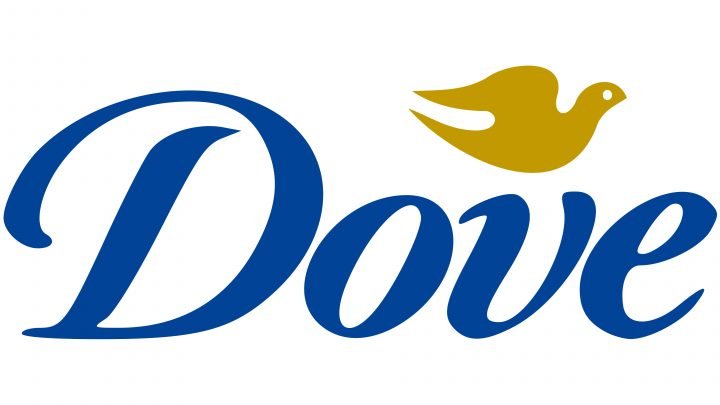
The 2004 redesign introduced depth and subtle dimensionality. The golden dove gained gradient shading, incorporating lighter highlights to create volume and movement. The emblem was repositioned beneath the wordmark, visually grounding the logo. Typography was refined with smoother curves and cleaner lines, particularly noticeable in the redesigned letter “V,” which adopted a more contemporary and luxurious form.
2012–Today: Polished Minimalism and Emotional Continuity.
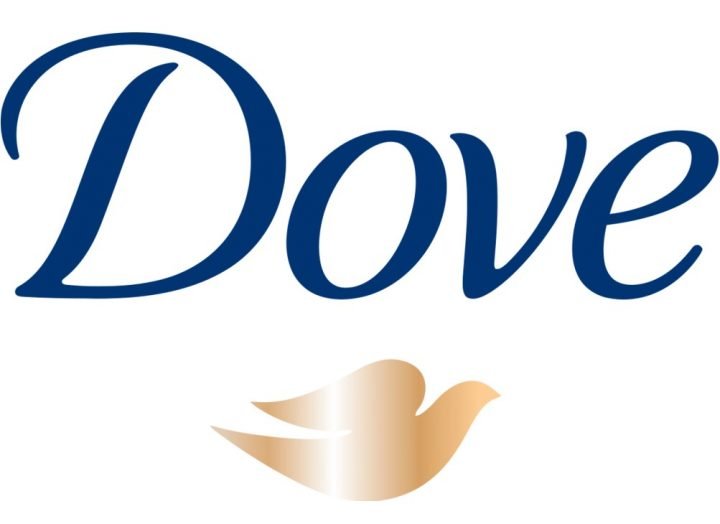
The current Dove logo, introduced in 2012, builds directly on its predecessor. The dove emblem became richer in gold tone, while the wordmark was adjusted with subtle typographic refinements. The “D” was shortened slightly for a stronger opening shape, and the final “E” became thinner and more elegant. These changes enhanced legibility and modern appeal without disrupting brand recognition, reinforcing Dove logo heritage through restraint rather than reinvention.
Logo Symbolism: Purity, Care, and Emotional Trust
Dove logo symbolism operates on a universal emotional level. The dove bird communicates peace, safety, and gentleness without cultural barriers. Its gold coloration adds warmth and a sense of quiet premium quality, distinguishing Dove from purely clinical or mass-market competitors.
The cursive wordmark reinforces approachability and human connection. Its flowing strokes suggest softness and care, aligning with Dove’s emphasis on skin health and self-acceptance. Unlike aggressive or high-fashion cosmetic logos, Dove’s visual language is intentionally calm, reinforcing emotional trust rather than aspiration alone.
Typography and Color as Brand Signals
The Dove logo uses a custom cursive typeface designed to feel smooth, refined, and feminine without appearing fragile. Its closest stylistic relatives can be found in elegant script fonts, but the Dove lettering remains unique through its balanced proportions and restrained ornamentation.
Color plays a central role in the logo description. Blue conveys cleanliness, reliability, and professionalism, while gold introduces warmth, care, and understated luxury. Together, these colors express Dove’s dual promise: scientifically gentle products delivered with emotional sensitivity.
Dove Logo History and Enduring Recognition
The Dove logo history demonstrates how consistency can become a strategic advantage. Rather than chasing trends, Dove refined its identity carefully, ensuring that each update strengthened clarity while preserving emotional meaning. This approach allowed the logo to remain recognizable across generations, cultures, and product categories.
Within the larger landscape of personal care brand logo history, Dove stands as a model of emotional branding built on trust rather than spectacle. Its logo heritage proves that in categories rooted in daily routines and personal connection, subtlety and continuity often outperform radical change. Readers exploring similar branding philosophies may also find value in Nivea logo heritage and Palmolive logo history, where long-term visual stability supports enduring consumer loyalty.
FAQ: Dove Logo Meaning and History
What does the Dove logo represent?
The Dove logo represents gentleness, purity, and care, symbolized through a peaceful dove bird and soft cursive typography.
Why does the Dove logo feature a dove bird?
The dove symbolizes peace, trust, and tenderness, aligning with the brand’s promise of gentle and caring personal care products.
Has the Dove logo changed much over time?
The logo has evolved subtly, preserving its core elements while refining typography, color, and balance for modern use.
Who owns the Dove brand today?
Dove is owned by Unilever and is sold globally as part of its personal care portfolio.