Diesel Logo History: Meaning, Symbolism & Brand Heritage
Few fashion brands have managed to turn provocation, rebellion, and raw individuality into a coherent global identity quite like Diesel. Born in Italy in the late 1970s, Diesel never positioned itself as just another denim label. From its earliest days, the brand stood for disruption, cultural friction, and the refusal to blend in. That philosophy has been reflected not only in its collections and controversial advertising campaigns, but also in its visual identity, which has evolved carefully while remaining unmistakably bold.
The Diesel logo is not decorative, nostalgic, or ornamental. It is direct, confrontational, and unapologetically confident. Over time, it has shifted from expressive symbolism to stripped-down typographic authority, mirroring the brand’s transformation from rebellious denim outsider to global fashion powerhouse. Diesel’s logo heritage tells a story of attitude over elegance, message over embellishment, and meaning over trend.
Meaning and Brand Philosophy Behind the Diesel Name
The Diesel brand was founded in 1978 by Renzo Rosso, together with Adriano Goldschmied, at a moment when Europe was facing an oil crisis. Diesel fuel, considered more economical and efficient, became a metaphor for a new way of thinking. The word “Diesel” was chosen deliberately for its universality. It is pronounced almost identically across languages, sounds industrial and raw, and carries a sense of power and resistance.
From the beginning, Diesel was conceived as a philosophy rather than a product line. Rosso envisioned a brand built on individuality, freedom of expression, and cultural defiance. This mindset would later crystallize in Diesel’s legendary advertising slogan, “For Successful Living,” a phrase that redefined success not as wealth or status, but as authenticity and personal freedom.
That ideological foundation strongly influenced the brand’s visual identity. Diesel’s logos were never meant to look refined or fashionable in the traditional sense. Instead, they were designed to feel bold, masculine, and emotionally charged, acting as visual statements rather than decorative marks.
Diesel Logo History and Evolution Timeline
1978 – 2015: The Foundational Wordmark Era
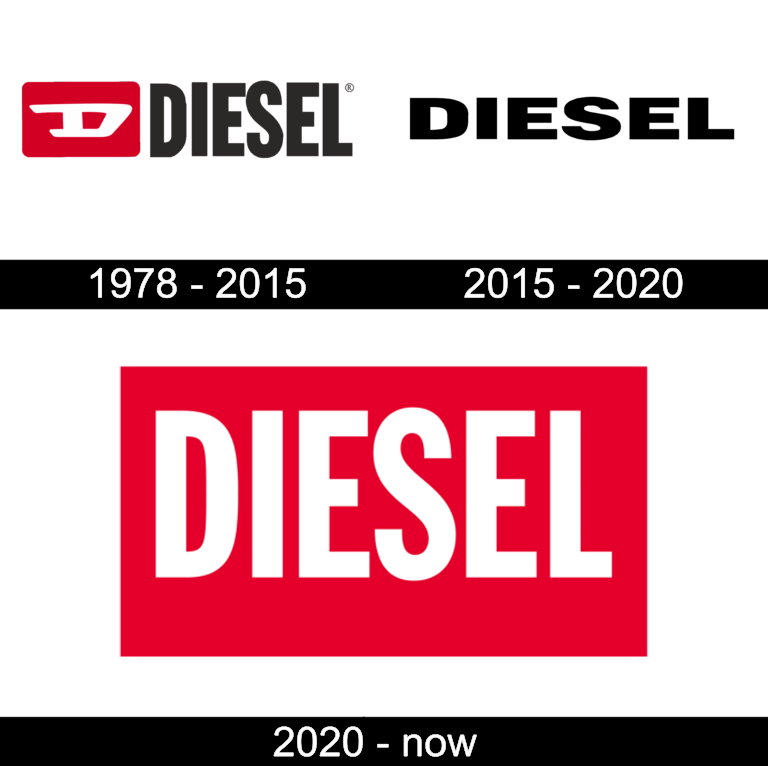
The original Diesel logo introduced in 1978 established the visual core that would define the brand for decades. The wordmark was executed in a heavy, condensed sans-serif typeface, set entirely in uppercase letters. The proportions were tall and narrow, creating a sense of vertical strength and assertiveness.
In some early applications, the wordmark was accompanied by a red “D” symbol. This stylized letter carried references to the brand’s iconic Mohican head emblem, a graphic symbol that represented rebellion, tribal identity, and resistance to conformity. The Mohican logo, often paired with the phrase “Only The Brave,” became deeply associated with Diesel’s countercultural positioning during the brand’s rise in the 1980s and 1990s.
This long-lasting logo era coincided with Diesel’s explosive global expansion and its reputation for provocative advertising. The visual identity remained stable, reinforcing brand recognition while allowing campaigns and collections to carry the expressive weight.
2015 – 2020: Subtle Refinement and Modern Tension
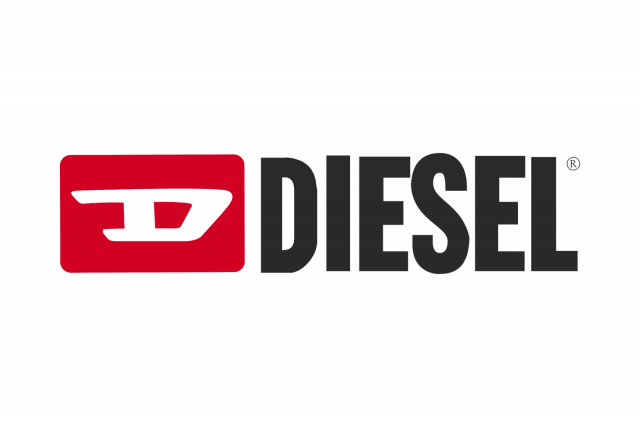
In 2015, Diesel introduced a refined version of its wordmark. While the core structure remained intact, subtle typographic adjustments were made. The letters became more balanced and controlled, and the iconic “S” received a slightly altered curvature that introduced a hint of playfulness without compromising strength.
The color palette remained primarily black and white, reinforcing Diesel’s authoritative and uncompromising character. This period reflected the brand’s attempt to modernize without abandoning its rebellious DNA, aligning its logo more closely with high-fashion sensibilities while retaining street credibility.

2020 – Today: Minimalism and Absolute Confidence
The current Diesel logo represents the most minimal and disciplined expression in the brand’s visual history. The wordmark is enclosed within a rectangular frame, reinforcing a sense of structure, confidence, and permanence. The logo is typically presented in black on white, or in white on a bold red background.
This redesign stripped away all symbolic elements, including the Mohican figure, leaving only the brand name itself. The decision was intentional. Diesel no longer needs visual metaphors or icons to express its identity. The name alone carries enough cultural weight, heritage, and authority.
Red, when used, injects urgency, passion, and aggression into the composition, while white conveys clarity and confidence. The rectangular frame adds a sense of control, suggesting that Diesel has moved from rebellion to mastery, without losing its edge.
The Diesel Logo Symbolism and Visual Meaning
Unlike many fashion brands, Diesel’s logo meaning is rooted almost entirely in typography rather than symbols. The power of the logo comes from its scale, weight, and presence. The all-caps structure communicates dominance and certainty. The condensed proportions convey intensity and focus. There is no softness, no ornamentation, and no unnecessary detail.
The absence of imagery in the modern logo reflects Diesel’s belief in self-expression without explanation. It is a logo that does not ask for approval and does not attempt to be liked. It exists to be recognized and remembered.
Font and Typography in the Diesel Logo
The Diesel wordmark is closely associated with Franklin Gothic Extra Condensed, a typeface designed by Morris Fuller Benton. This font choice is significant. Franklin Gothic carries a strong industrial heritage and is often associated with authority, headlines, and impact-driven communication.
The extended, heavy strokes of the letters give the logo a masculine, mechanical feel, aligning perfectly with Diesel’s raw, urban, and confrontational aesthetic. The typography alone is strong enough to function as an icon, allowing individual letters to stand independently while remaining unmistakably Diesel.
Color Palette and Visual Identity
Diesel’s primary color palette is monochrome, relying on black and white to convey confidence, clarity, and timelessness. When red is introduced, it acts as an emotional amplifier rather than a decorative element. Red represents rebellion, passion, danger, and vitality, all central themes in Diesel’s brand identity.
This restrained color approach ensures that the logo remains powerful across environments, from storefronts and runways to digital platforms and packaging.
Diesel as a Logo Heritage Icon
The Diesel logo history is a case study in restraint, confidence, and long-term brand vision. Rather than chasing trends, Diesel has refined its visual identity through subtraction, allowing typography and meaning to carry the brand forward. Its logo heritage reflects a brand that understands the power of consistency, cultural relevance, and emotional impact.
In an industry often driven by constant reinvention, Diesel proves that true strength lies in knowing when not to change.
FAQ – Diesel Logo History
What does the Diesel logo mean?
The Diesel logo represents strength, individuality, and rebellion. Its bold uppercase typography reflects confidence and self-expression, aligning with the brand’s anti-conformist philosophy.
Has the Diesel logo changed over time?
Yes. While the core wordmark has remained consistent since 1978, Diesel refined its logo in 2015 and introduced a more minimal, framed version in 2020.
What font is used in the Diesel logo?
The Diesel logo is based on Franklin Gothic Extra Condensed, a heavy sans-serif typeface known for its industrial strength and visual authority.
Why does Diesel use red in its logo?
Red symbolizes passion, energy, rebellion, and intensity. When used, it amplifies Diesel’s bold and provocative brand personality.
Who founded Diesel?
Diesel was founded by Renzo Rosso in 1978 in Italy.