Czech Airlines Logo History: Meaning, Symbolism & Brand Heritage
The visual identity of Czech Airlines, widely known as ČSA, represents nearly a century of European aviation history. As one of the world’s oldest airlines, Czech Airlines developed a logo heritage shaped by modernist design, political change, and international integration. Its logo history reflects not only brand evolution but also the broader transformation of Central European aviation from the early 20th century to the globalized airline industry.
Within airline logo history, Czech Airlines stands alongside historic carriers such as Lufthansa logo history and Air France logo heritage, where early modernist principles laid the foundation for long-term visual continuity. As part of broader European airline logo heritage, ČSA demonstrates how national identity, abstraction, and corporate alliances influenced airline branding over decades.
Meaning and History: The Origin of the Czech Airlines Identity
Czech Airlines was founded in 1923, making it one of the oldest continuously operating airlines in the world. From its inception, the airline was conceived as a national symbol of technological progress and international connectivity for Czechoslovakia. This ambition directly shaped the logo meaning, which emphasized modernity, clarity, and authority rather than decorative symbolism.
The airline’s early identity relied on typography as its primary visual tool, a forward-thinking approach for the 1920s. Over time, as political systems changed and the airline transitioned from state-controlled operations to a modern commercial carrier, its visual identity evolved accordingly. Each redesign reflected shifting priorities, from national representation to international competitiveness and alliance alignment.
Logo Symbolism: Geometry, National Colors, and Modernism
The symbolism of the Czech Airlines logo has consistently relied on abstraction rather than figurative imagery. Instead of birds or aircraft, the brand used geometry, typography, and color to communicate reliability and national origin.
The red, white, and blue palette directly references the Czech national colors, but it is applied in a restrained, modernist manner. Triangles, sharp angles, and later softened geometric forms convey stability, precision, and progress. The recurring use of the CSA abbreviation reinforces authority and recognizability, particularly in international contexts where brevity is essential.
Typography plays a central symbolic role. From early custom letterforms to later sans-serif refinements, the lettering communicates discipline and professionalism, aligning with the airline’s long-standing reputation.
Czech Airlines Logo History Timeline
1923–1993: Modernist Typographic Foundation
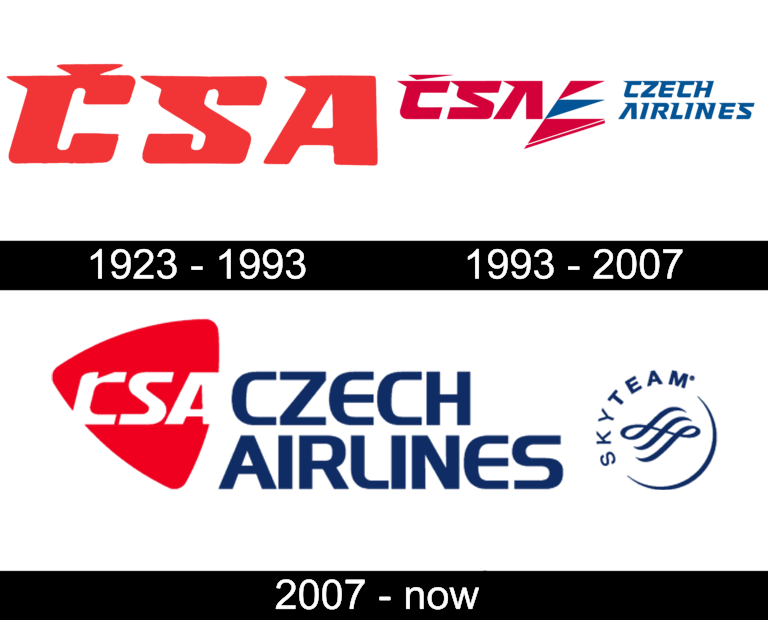
The original Czech Airlines logo introduced in 1923 was remarkably modern for its era. It consisted solely of a bold, stylized “CSA” abbreviation in red on a white background. The custom typeface featured elongated strokes and sharp angles, with a distinctive triangular accent above the letter “C.”
This minimalist approach allowed the logo to remain relevant for decades, surviving political changes and technological advances with minimal modification. Its longevity established one of the strongest foundations in airline logo history.
1993–2007: Geometric Expansion and Post-Transition Identity
Following the political and economic changes of the early 1990s, Czech Airlines introduced a more complex visual system in 1993. The CSA abbreviation was refined, with the crossbar of the “A” removed for a more distinctive silhouette. The red tone deepened, adding seriousness and authority.
A new geometric emblem composed of three diagonally arranged triangles in red and blue was added, symbolizing movement and transformation. The full airline name appeared in blue uppercase letters, reinforcing international readability and corporate structure.
2007–Present: Contemporary National Carrier Identity
In 2007, Czech Airlines unveiled a fully reimagined logo system. The core element became a solid red triangle with softened edges, inside which the white “CSA” abbreviation was set in a clean sans-serif typeface. This marked a shift toward softer geometry while retaining the triangular motif rooted in earlier designs.
The emblem was paired with a two-level blue wordmark spelling out the airline’s full name. The inclusion of the SkyTeam roundel signaled the airline’s alliance membership and global integration. This identity balances national symbolism, modern design, and alliance consistency.
Czech Airlines Logo Heritage in the European Context
Czech Airlines’ logo heritage is notable for its early adoption of modernist principles and its commitment to abstraction. While many airlines relied on illustrative emblems, ČSA trusted typography and geometry to carry meaning.
When compared with identities explored in KLM logo history or LOT Polish Airlines logo symbolism, Czech Airlines stands out for the exceptional longevity of its core visual ideas. Even as forms softened and compositions evolved, the emphasis on clarity and national color discipline remained constant.
Czech Airlines Logo as a Century-Spanning Identity
The Czech Airlines logo history illustrates how disciplined design can transcend generations. From a groundbreaking typographic mark in 1923 to a contemporary geometric emblem aligned with global alliances, ČSA’s visual identity reflects continuity, national pride, and modern adaptation. Within airline logo history and broader logo heritage analysis, Czech Airlines remains a benchmark for long-term brand evolution rooted in modernist design.
FAQ: Czech Airlines Logo Meaning and History
What does the Czech Airlines logo represent?
The logo represents national identity, precision, and modern aviation through geometry and typography.
When was the first Czech Airlines logo introduced?
The original logo was introduced in 1923.
Why does Czech Airlines use a triangle in its logo?
The triangle symbolizes stability, movement, and modern design continuity.
Is Czech Airlines part of an airline alliance?
Yes, Czech Airlines is a member of the SkyTeam alliance.