Comcast Logo History: Meaning, Symbolism & Brand Heritage
Few American corporations illustrate the transformation of media and telecommunications as clearly as Comcast. What began as a small cable operator in the early 1960s evolved into one of the world’s most powerful media and technology groups, shaping how millions consume television, internet, and digital content. Comcast’s growth mirrors the broader shift from analog cable systems to a fully integrated media ecosystem.
As the company expanded its reach, its visual identity evolved in parallel. Much like the structural discipline behind the AT&T logo history and the broadcast symbolism embedded in the NBC logo heritage, Comcast’s logos reflect strategic repositioning rather than cosmetic change. The Comcast logo heritage tells a story of consolidation, technological ambition, and alignment with major media institutions.
Meaning and History: The Origin of the Comcast Identity
Comcast was founded in 1963 as American Cable Systems by Ralph J. Roberts, later joined by Julian A. Brodsky and Dan Aaron. Initially focused on regional cable television services, the company quickly recognized the importance of scalable infrastructure and brand clarity.
In 1968, the company adopted the name Comcast, a portmanteau of “communication” and “broadcast.” The new name directly expressed the company’s purpose and future direction. This clarity of intent became a defining feature of the Comcast logo meaning, which consistently emphasized functionality, professionalism, and technological authority rather than emotional or lifestyle messaging.
As Comcast expanded into content production, broadband internet, and later global media ownership, its visual identity adapted to reflect its changing role within the communications landscape.
Comcast Logo History Timeline
1969 – 2000: Corporate Authority and Stability
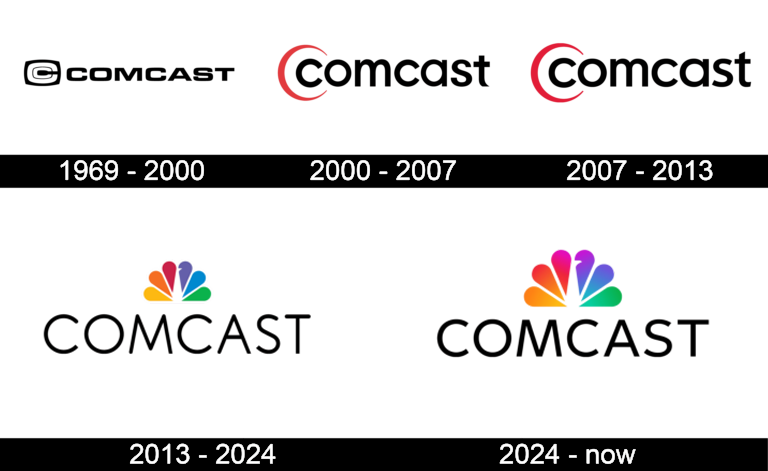
The first official Comcast logo, introduced in 1969, featured a bold uppercase wordmark paired with a geometric emblem. The lettering was set in a strong sans-serif typeface reminiscent of Microgramma, projecting confidence and engineering precision.
The emblem consisted of two interlocking “C” letters placed within a solid black square. This symbol reinforced corporate unity and control, visually aligning Comcast with the era’s industrial and infrastructural aesthetics. The logo remained in use for more than three decades, establishing long-term recognition and trust.

2000 – 2007: Modernization and Accessibility
In 2000, Comcast introduced a dramatically different logo. The wordmark transitioned to lowercase letters, signaling accessibility and a more consumer-facing identity. The typeface shifted toward a modified Futura-style sans serif, softening the brand’s visual tone.
The emblem was simplified into a red stylized “C” encircling the first letter of the wordmark. The red-and-black color palette added energy and urgency, reflecting Comcast’s growing focus on customer services such as cable television and internet connectivity.

2007 – 2012: Refinement Without Reinvention
The 2007 redesign refined the typography, making the letters bolder and more assertive while preserving the lowercase structure. The emblem and color palette remained unchanged, reinforcing continuity.
This period emphasized reliability and scale, positioning Comcast as a mature, nationwide provider rather than a disruptive newcomer.

2013 – 2024: Alignment with NBCUniversal
A major shift occurred following Comcast’s acquisition of a controlling stake in NBCUniversal. In 2013, Comcast adopted the iconic NBC peacock as part of its corporate logo, placing it above an uppercase wordmark.
The colorful peacock symbolized diversity in programming and creative output, while the refined sans-serif typography conveyed professionalism and modernity. This redesign visually linked Comcast to one of the most recognizable broadcast brands in the world, signaling its transformation into a global media conglomerate.

2024 – Today: Consolidation and Clarity
The most recent logo iteration maintains the NBC peacock emblem while simplifying the overall composition. The peacock remains vibrant and multicolored, positioned above a clean, black “COMCAST” wordmark.
This version balances heritage and clarity. The emblem represents content richness and broadcast legacy, while the restrained typography underscores Comcast’s role as a modern, technology-driven corporation.
Logo Symbolism: From Infrastructure to Content
The symbolism of the Comcast logo evolved alongside the company’s business model. Early logos emphasized structure and control, appropriate for a cable infrastructure provider. Later iterations introduced color and softer typography, reflecting customer engagement and service diversity.
The incorporation of the NBC peacock marked a decisive symbolic shift. The logo moved beyond distribution to represent content, creativity, and storytelling. This transition encapsulates the broader transformation of Comcast itself.
Typography and Color Palette
Typography has played a crucial role in shaping the Comcast visual identity. From rigid uppercase sans-serif lettering to approachable lowercase forms and back to authoritative capitals, each shift aligned with strategic repositioning.
Color usage evolved from monochrome black to bold red accents and eventually to the full-spectrum NBC palette. Today’s combination of multicolored symbolism and black typography ensures both expressiveness and legibility across platforms.
Comcast Logo Heritage and Media Legacy
The Comcast logo heritage reflects a company in constant transformation, yet grounded in strategic consistency. Rather than abandoning its past, Comcast integrated new symbols to signal growth and alignment with global media powerhouses.
This approach mirrors broader trends across media conglomerate logo history, where the strongest identities evolve through acquisition and integration rather than disruption. Comcast’s current logo stands as a visual summary of six decades of expansion, consolidation, and adaptation.
For readers interested in how corporate media identities evolve at scale, further insight can be found across the broadcast network logo heritage archive and the wider collection of telecommunications brand logo history case studies.
FAQ: Comcast Logo Meaning and History
What does the Comcast logo represent?
The logo represents communication, broadcast, and content diversity, reflecting Comcast’s role as a global media and technology company.
Why does Comcast use the NBC peacock?
The peacock symbolizes Comcast’s ownership of NBCUniversal and its focus on creative programming and broadcast media.
Has the Comcast logo changed often?
No. While it has evolved at key moments, each redesign reflected strategic business shifts rather than frequent rebranding.
When was the first Comcast logo introduced?
The first official Comcast logo was introduced in 1969, shortly after the company adopted its current name.