Cincinnati Bengals Logo History: Meaning, Symbolism & Brand Heritage

Few NFL franchises rely on visual identity as heavily as the Cincinnati Bengals. While on-field success has arrived in waves rather than dynasties, the Bengals have built one of the most immediately recognizable brands in American sports. From bright orange helmets to tiger-stripe motifs, the franchise has consistently understood the power of symbolism and contrast. The Cincinnati Bengals logo history is a study in how a strong thematic core can survive multiple redesigns without losing its essence.
This visual journey shares conceptual ground with the disciplined abstraction seen in the Chicago Bears logo history and the animal-driven aggression embedded in the Cleveland Browns logo heritage. Within the broader context of NFL logo history, Cincinnati stands out not for minimalism, but for commitment to a bold, high-risk aesthetic rooted in animal symbolism and regional identity.
Meaning and History: The Origin of the Bengals Identity
The Cincinnati Bengals were established in 1967 and began play in 1968, deliberately reviving a historic team name previously used by a Cincinnati-based football club in the late 1930s. That earlier team had drawn inspiration from the white Bengal tiger housed at the Cincinnati Zoo, a connection that the modern franchise preserved to emphasize continuity and respect for local heritage.
From the beginning, the Bengals’ logo meaning was inseparable from the tiger motif. The animal symbolized speed, power, and intimidation, qualities the franchise sought to project regardless of competitive results. Unlike teams that oscillated between symbols and lettermarks, Cincinnati consistently returned to the tiger theme, whether through full illustrations, helmet patterns, or abstract letterforms.
The logo origin story reflects a franchise that understood visibility as a competitive advantage. Even during prolonged periods of limited success, the Bengals remained visually unforgettable, proving that strong brand identity can outlive fluctuating performance.
Cincinnati Bengals Logo History Timeline
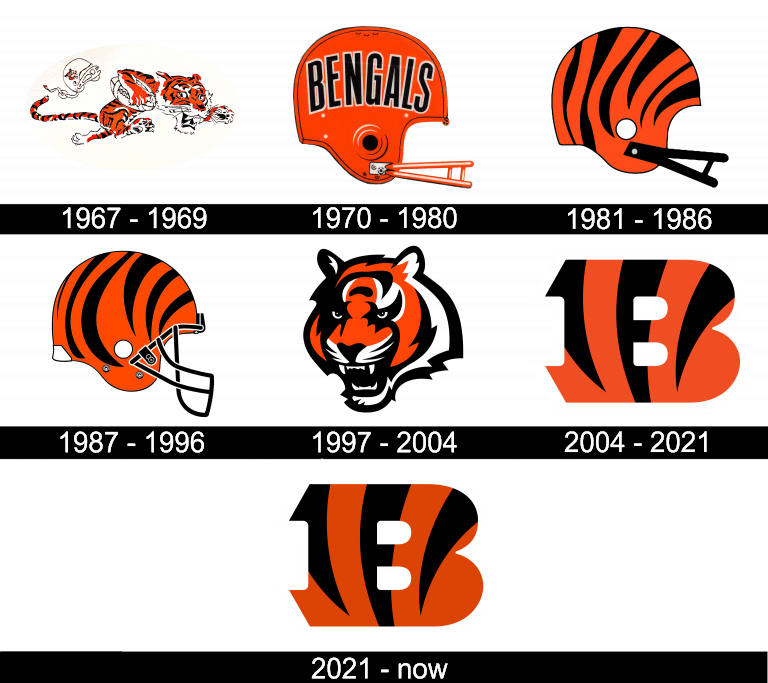
1967–1969: The Original Tiger Mascot Emblem.
The first Cincinnati Bengals logo debuted in 1967 and featured a cartoon-style tiger running while clutching a football. Rendered in bright orange, black, and white, the illustration conveyed speed and enthusiasm rather than menace. The tiger’s fallen helmet and exaggerated motion gave the logo a playful tone, aligning with the optimistic launch of a new franchise.

1970–1980: The Helmet-Based Identity.
In 1970, the Bengals abandoned character illustration in favor of a simplified helmet logo. The emblem showed an orange football helmet bearing the word “BENGALS” in bold black letters outlined in white. While the tiger itself disappeared from the logo, the orange-and-black palette preserved the animal association implicitly, signaling a move toward cleaner, more modern branding.
1981–1986: Introduction of Tiger Stripes.
The 1981 redesign transformed the helmet into a symbolic tiger reference. Black stripes were added across the orange surface, directly mimicking a tiger’s coat. This marked a crucial moment in Cincinnati Bengals logo heritage, as the franchise embraced pattern-based symbolism rather than literal imagery. The result was one of the most distinctive helmets in professional football.

1987–1997: Refined Striped Helmet Mark.
In 1987, the striped helmet was refined with cleaner contours and more balanced spacing between the black stripes. Minor adjustments to proportions and detailing made the emblem more aggressive and professional, aligning with broader NFL branding trends of the late 1980s and early 1990s.

1997–2003: The Tiger Head Emblem.
A major shift occurred in 1997 with the introduction of a standalone tiger head logo. The snarling animal, drawn in thick black, orange, and white lines, projected intimidation and focus. This emblem marked the Bengals’ most literal and aggressive interpretation of their mascot and remains in use today as a secondary identity element.

2004–2021: The Striped “B” Lettermark.
In 2004, Cincinnati introduced its current primary logo: a bold capital “B” filled with black tiger stripes on an orange field. The heavy serif letterform combined abstraction with symbolism, transforming the tiger motif into typography. This design emphasized strength, stability, and brand maturity, becoming the franchise’s most enduring modern mark.

2021–Today: Refined Modern “B” Identity.
The 2021 update retained the striped “B” concept while deepening the orange tone and sharpening contrast. No structural changes were made, reinforcing continuity and confidence. The refinement coincided with the team’s return to championship contention, further cementing the logo’s association with a new competitive era.
Logo Symbolism: Power Through Pattern
The Cincinnati Bengals logo symbolism is built around implication rather than depiction. Whether through stripes, color, or typography, the tiger is always present, even when unseen. The striped “B” functions as both a lettermark and an abstract animal reference, blending identity and symbolism seamlessly.
Orange conveys energy and visibility, black represents strength and intimidation, and white provides balance and clarity. Together, they form one of the NFL’s most aggressive and unmistakable color palettes. The logo description reveals a brand that values boldness over subtlety, embracing contrast as a defining feature.
A Brand That Never Hides
The Cincinnati Bengals logo history demonstrates how consistency of theme can overcome inconsistency of results. By anchoring every redesign to the tiger motif, the franchise maintained a strong visual identity across decades of change.
Within the wider discussion of NFL logo symbolism and long-term logo heritage, the Bengals stand as proof that fearless design choices, when rooted in authentic origin stories, can create lasting recognition. Their logo evolution shows that sometimes, the loudest brands are the hardest to forget.
FAQ: Cincinnati Bengals Logo Meaning and History
What does the Cincinnati Bengals logo represent?
The logo represents strength, speed, and intimidation, symbolized through tiger-inspired colors, stripes, and forms.
Why do the Bengals use tiger stripes instead of a full tiger image?
Stripes allow the team to imply the tiger’s presence while maintaining flexibility and modern design clarity.
When was the current Bengals logo introduced?
The striped “B” logo was introduced in 2004 and refined in 2021.
Is the tiger head logo still used?
Yes, the tiger head remains an important secondary symbol across merchandise and branding.