CBS Logo History: Meaning, Symbolism & Brand Heritage
Among the great symbols in American media, few are as enduring, as culturally embedded, and as visually influential as the CBS eye. Since the company’s early years as a radio network in 1927, CBS has continuously shaped the landscape of news, entertainment, journalism, and live broadcasting. Its identity—today inseparable from the simple but powerful Eyemark introduced in 1951—reflects a unique trajectory in the history of corporate design. While most American broadcasters experimented with bright colors, shifting motifs, or animated symbols, CBS embraced minimalism, clarity, and geometric purity long before such values became industry norms.
What began as a traditional, text-heavy radio seal evolved through experimentation in the 1930s and 1940s. By mid-century, CBS recognized the need for a visual symbol that could transcend radio and define the emerging age of television. William Golden, the visionary art director behind the brand’s transformation, delivered not merely a logo but an icon—an abstract eye that would become one of the most recognizable symbols in global visual culture.
Across decades of technological change and corporate reinvention, the Eyemark has retained an astonishing consistency. Its simplicity makes it infinitely scalable; its symbolism gives it emotional resonance; its timeless geometry ensures it never feels outdated. CBS’s identity remains a masterclass in visual economy, built on a single idea executed to perfection.
CBS Eyemark Meaning and Symbolism
The CBS Eyemark derives its meaning from a blend of cultural reference, artistic inspiration, and visual metaphor. William Golden’s 1951 creation was influenced by two primary sources: the Pennsylvania Dutch hex signs painted on barns, and René Magritte’s surrealist painting The False Mirror, which depicts a human eye as a floating, cosmic sphere.
The resulting symbol is neither literal nor abstract—it sits precisely in between. The eye suggests vision in the broadest sense: seeing, broadcasting, surveillance, awareness, and perspective. For a television network at the dawn of the medium’s golden age, the metaphor was both poetic and practical. CBS no longer merely transmitted sound; it now shaped what Americans saw. The Eyemark symbolized the shift from listening to viewing, from radio memory to television immediacy.
Its monochrome palette reinforces its conceptual purity. Black and white denote authority, seriousness, and editorial clarity. Unlike competitors who adopted vibrant colors, CBS maintained a strictly minimalist palette that communicated trust and professionalism—an aesthetic that served both entertainment and hard news programming with equal strength.
The eye’s shape—an outer circle, an inner almond-shaped aperture, and a central pupil—creates a visual rhythm that is instantly identifiable even at the smallest scale. The symbol suggests presence and steadiness, positioning CBS as a watcher, an observer, and a guardian of public information.
CBS Logo History & Evolution Timeline
1927–1931: The Radio-Era Emblem
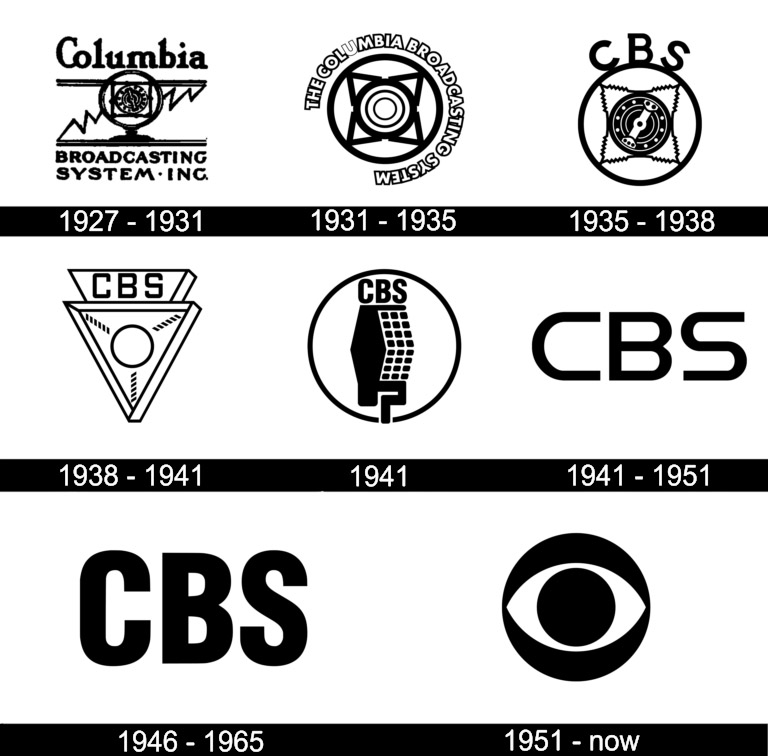
The earliest CBS identity captured the imagery of early broadcast technology. A hand-drawn circular radio receiver bisected by a zig-zag lightning bolt symbolized the transmission of sound across distance. Framed by double horizontal rules and accompanied by serif lettering spelling “American Broadcasting System,” the logo resembled a formal seal more than a corporate mark.

1931–1935: The Geometric Roundel
In 1931, CBS modernized its image with a structured emblem. A circular medallion containing four triangular shapes arranged around smaller inner circles suggested mechanical precision and broadcast engineering. Surrounding this motif, a ring of uppercase lettering presented the company name. Thick outlines and geometric symmetry gave the logo a sharp contemporary character.

1935–1938: The Three-Letter Monogram
By 1935, CBS simplified its identity to a monogram. The letters CBS appeared prominently above a redesigned roundel filled with additional internal elements, creating a dense, compact badge. This era marked the network’s shift toward typography-driven branding.

1938–1941: The Triangular Crest
In 1938, the circular form gave way to a downward-pointing geometric crest. The CBS name appeared above the triangle in a trapezoidal enclosure, while the interior featured radiating lines arranged in a pattern of technical abstraction. The imagery suggested innovation and direction.

1941: The Experimental Black Emblem
For a brief period, CBS introduced a stark black composition featuring block-like abstract forms beneath the company’s name placed inside a circular frame. This short-lived iteration reflected the network’s ongoing search for a symbol suitable for the emerging television era.

1941–1951: The Modern Wordmark
Entering the 1940s, CBS adopted a sleek, typographic wordmark set in a smooth sans-serif with slightly extended geometry. The sharp terminals and clean lines created a forward-looking identity that aligned with the growing importance of national broadcasting and the increasing sophistication of design language in corporate America.

1946–1965: The Television Spotlight
As television gained prominence, CBS introduced a logo consisting of three-dimensional gray lettering set within an oval light spot against a black background. This effect simulated the glow of a television screen and emphasized the transition from radio to visual broadcasting.

1951–Today: The Eyemark
In 1951, William Golden unveiled the CBS Eye—a symbol elegant in its simplicity and profound in its metaphor. A solid black circle holds a white almond-shaped aperture, inside of which sits a smaller black pupil. Though visually minimal, its influence has been monumental. The Eyemark has remained essentially unchanged for more than seventy years, occasionally accompanied by the CBS wordmark but always retaining its authority and clarity.
Design Analysis
The CBS Eyemark is often cited as one of the most successful corporate marks in the history of American design. Its geometric precision, visual symbolism, and conceptual clarity place it alongside the most enduring trademarks of the 20th century.
The outer circle creates a perfect container that stabilizes the form. The inner aperture, slightly elongated horizontally, mirrors the organic proportions of a human eye without resorting to realism. The pupil, a pure circle, provides a center of gravity. Together, the three shapes form a composition that is mathematically balanced and instantly legible.
Typography around the Eyemark—whether in CBS News, CBS Sports, or CBS Radio—has historically employed strong sans-serif letterforms. Their neutrality ensures that the eye remains the primary symbol. Sub-brands such as CBS News pair the Eyemark with a dignified serif wordmark to evoke editorial seriousness, while CBS Sports uses geometric typography to express energy and athleticism.

The color palette is equally intentional. Black and white project authority, reliability, and timelessness. The logo functions flawlessly across analog and digital environments, across news broadcasts and entertainment programming, across decades and technological changes.
Few symbols have achieved this level of universality. The Eyemark communicates trust. It communicates vision. And above all, it communicates presence—the unmistakable sense that CBS is watching, reporting, and informing.
The Enduring Authority of the CBS Eyemark
The CBS Eye stands not only as a logo but as a cultural monument. Over nearly a century of broadcasting, CBS evolved through formats, technologies, and eras of communication, yet its identity found lasting clarity in a single graphic solution. William Golden’s Eyemark distilled the essence of television—seeing—into a symbol so refined that it transcended time, media, and design trends.
While competitors embraced shifting palettes and rapidly changing marks, CBS remained anchored in a visual identity that embodied stability, seriousness, and sophistication. The logo endures because it was crafted with intention, balance, and a deep understanding of symbolism. The Eye both observes and invites observation, positioning CBS as a network defined by perspective and integrity.
In the history of American broadcast design, the CBS Eyemark remains one of the purest examples of what great logo heritage can achieve: simplicity that becomes iconic, and an image that becomes inseparable from the story of the medium itself.
FAQ: CBS Logo & Brand Identity
What is the CBS logo meant to represent?
The CBS Eyemark symbolizes vision, clarity, and the shift from radio to television. Its eye motif represents observation, awareness, and the visual nature of broadcast media.
Who designed the CBS Eye?
The Eyemark was designed in 1951 by William Golden, CBS’s creative director, who was inspired by Pennsylvania Dutch hex signs and René Magritte’s painting The False Mirror.
Why has the CBS logo barely changed since 1951?
Because the design achieves perfect simplicity, legibility, and symbolism. It remains effective in every medium and era, making redesign unnecessary.
What does CBS stand for?
CBS stands for Columbia Broadcasting System, the name adopted in 1928 after the acquisition of United Independent Broadcasters.
What divisions use the CBS Eyemark?
CBS News, CBS Sports, CBS Radio, and other CBS sub-brands use the Eyemark paired with customized typography appropriate to their content and tone.