
Cash App Logo History: Meaning, Symbolism & Brand Heritage

When examining the Cash App logo, its connection to the financial system is immediately clear. Unlike traditional banking identities built on heritage and institutional authority, Cash App represents a new generation of fintech brands focused on speed, accessibility, and simplicity. Its logo history reflects this shift, favoring instant recognition over complexity and symbolic clarity over decorative detail.
Much like the streamlined approach seen in PayPal logo history or the minimalist digital-first philosophy behind Stripe logo history, Cash App’s visual identity was designed for mobile screens first. Its logo heritage is rooted in functionality, where every element serves a practical and psychological role in encouraging trust, ease of use, and frequent interaction.
Meaning and History: The Origin of the Cash App Identity
Cash App was founded in 2013 as Square Cash, a peer-to-peer payment service developed by Square, Inc., later renamed Block, Inc. The platform was created to simplify money transfers, removing the friction associated with traditional banking systems. From the beginning, the brand positioned itself as a tool rather than an institution, and this philosophy directly influenced its logo meaning.
The dollar sign became the centerpiece of the identity, not as a decorative symbol, but as a universal shorthand for money itself. Unlike abstract financial emblems, Cash App embraced the most direct monetary symbol available. The logo description communicates immediacy: press a button, move money, stay in control.
Green was chosen deliberately, reinforcing associations with cash, growth, and financial gain. Combined with the simplicity of the icon, the visual language made the app approachable even for users with little experience in digital finance.
Logo Symbolism: Currency as Interface
Cash App logo symbolism is unusually literal for a financial brand. The dollar sign is not merely a logo; it also functions as an interface element, an app icon, and a conceptual anchor for the entire service. This dual role blurs the line between branding and usability, strengthening recognition through repetition.
The tilted dollar sign suggests motion and progress, subtly reinforcing the idea of money flowing rather than sitting idle. The broken vertical strokes replace the traditional solid line, giving the symbol a contemporary, digital feel. This modification transforms a centuries-old currency mark into a modern fintech emblem.
The rounded square background adds softness and accessibility, counterbalancing the authority traditionally associated with financial symbols. Together, these elements create a logo meaning centered on empowerment rather than control.
Cash App Logo History Timeline
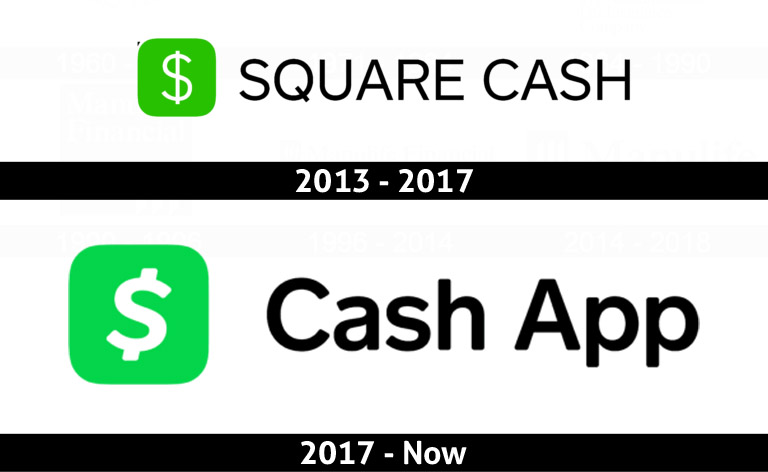
2013–2017: Square Cash and Functional Minimalism
The original Square Cash logo combined a clean wordmark with a green rounded square icon. The typography was thin, uppercase, and sans-serif, emphasizing neutrality and clarity. To the left of the wordmark sat the now-familiar green square containing a white dollar sign.
At this stage, the logo focused on functionality. The dollar sign followed a conventional structure, clearly legible and universally understood. The restrained execution aligned with the app’s early positioning as a straightforward money transfer tool rather than a full financial ecosystem.

2017–Present: Cash App and Digital Confidence
Following the rebrand from Square Cash to Cash App, the logo underwent a subtle yet meaningful transformation. The wordmark became bolder and more compact, with only the initial letters capitalized. Rounded letterforms improved readability across mobile interfaces and conveyed a friendlier tone.
The icon evolved as well. The green background became brighter and more saturated, increasing visibility on app stores and home screens. The dollar sign tilted forward and adopted broken vertical strokes, adding motion and a distinct visual signature. This refinement marked Cash App’s transition from a utility to a recognizable fintech brand.
Typography and Color: Designed for Screens
Cash App’s logo description is defined by its absence of excess. The standalone icon can function independently of text, a critical requirement in mobile-first environments. The dollar sign is custom-drawn, avoiding reliance on standard typefaces and ensuring uniqueness.
The green color, commonly referred to internally as Square Cash green, dominates both the logo and the user interface. This chromatic consistency strengthens brand recall and reinforces the app’s association with money management. White is used sparingly, maintaining contrast and clarity across various digital contexts.
Cash App Logo Heritage in Fintech Culture
The Cash App logo history illustrates how modern financial brands redefine visual identity through usability and symbolism combined. By centering its identity on a universally understood monetary symbol, Cash App eliminated abstraction in favor of immediacy. Its logo meaning is not aspirational or institutional; it is practical, direct, and user-centric.
Within the broader landscape of fintech logo heritage, Cash App stands as an example of how simplicity, repetition, and interface-driven symbolism can build trust at scale. The logo’s endurance lies in its refusal to over-explain, allowing function itself to become the brand.
FAQ: Cash App Logo Meaning and History
What does the Cash App logo represent?
The logo represents fast, simple, and accessible money movement, using the dollar sign as a universal financial symbol.
Why is the Cash App logo green?
Green is associated with cash, growth, and financial gain, reinforcing the app’s core purpose.
Why is the dollar sign tilted in the Cash App logo?
The tilt suggests motion and progress, symbolizing active money flow rather than static storage.
Has the Cash App logo changed over time?
Yes, but only subtly. The core symbol remained consistent while colors, typography, and proportions were refined in 2017.