
Canva Logo History: Meaning, Symbolism & Brand Heritage

Since its launch in Australia in 2012, Canva has transformed how people approach graphic design. What began as a simplified online tool for non-designers quickly evolved into a global platform used by individuals, small businesses, educators, and professional creatives alike. Central to this success is a visual identity that mirrors the product’s mission: clarity, accessibility, and creative confidence.
The Canva logo history fits naturally alongside the design-focused narratives explored in the Adobe logo history and the user-centered simplicity found in the Figma logo meaning. Within the broader conversation around modern software logo heritage, Canva stands out for proving that approachability can coexist with professionalism. Its logo meaning and symbolism are not about technical mastery, but about lowering barriers and inviting participation.
Meaning and History: The Origin of the Canva Identity
Canva was founded with a clear objective: to democratize design. Rather than positioning itself as a replacement for professional software, the platform aimed to make visual creation intuitive for everyone. This philosophy deeply influenced the brand’s visual identity from the start.
The name “Canva” is derived from the word “canvas,” a foundational concept in art and design. The logo origin reflects this idea directly. Instead of complex symbols or abstract metaphors, Canva adopted a friendly wordmark and soft geometry, reinforcing the idea of design as something open, flexible, and welcoming.
From the beginning, the logo meaning centered on balance. Canva needed to feel creative without being chaotic, professional without appearing intimidating. The result was a mark that relied on color, typography, and shape rather than visual complexity, allowing it to scale seamlessly across digital environments.
Canva Logo History Timeline
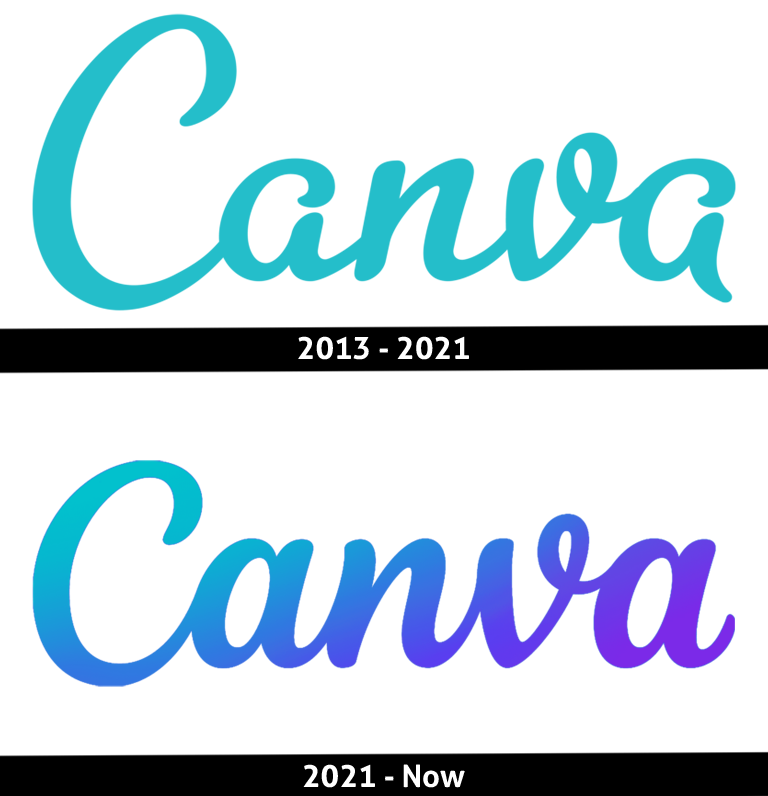
2013–2021: The Turquoise Script Circle.
The first widely recognized Canva logo appeared in 2013 and remained in use for nearly a decade. It featured a solid turquoise circle containing a white script wordmark. The flowing lettering introduced a human, almost handwritten quality, reinforcing creativity and ease of use.
The circular shape carried symbolic weight. Circles traditionally represent wholeness, continuity, and inclusivity, aligning closely with Canva’s mission to provide a complete design environment for users of all skill levels. The turquoise color palette communicated calmness, creativity, and trust, making the brand feel friendly rather than technical.
This logo period coincided with Canva’s rapid global expansion. Its visual consistency helped establish strong brand recognition at a time when the platform was becoming synonymous with accessible design.

2021–Today: The Gradient Wordmark Evolution.
In 2021, Canva introduced a refined logo that marked a subtle but important shift. The circular background was removed, leaving the script wordmark to stand on its own. At the same time, the color treatment evolved into a blue gradient, adding depth and modernity.
While the typography remained largely consistent, the updated execution reflected Canva’s growth from a beginner-friendly tool into a full-scale design ecosystem. The removal of the circle gave the logo greater flexibility across interfaces and signaled confidence in the wordmark itself.
This evolution did not abandon Canva’s original identity. Instead, it streamlined it, reinforcing the platform’s maturity while preserving its approachable character.
Logo Symbolism: Simplicity as a Creative Statement
The Canva logo symbolism is rooted in restraint. The script lettering conveys creativity and personality, while its smooth curves and balanced proportions ensure clarity and legibility. There is no iconography competing for attention, allowing the name itself to become the symbol.
Color plays a defining role in the logo description. Turquoise and blue gradients are associated with calm focus, clarity, and imagination. White space is used intentionally to reinforce openness and simplicity. Together, these elements communicate a brand that empowers users rather than overwhelms them.
Canva’s identity avoids aggressive branding or technical cues. Instead, it positions creativity as something natural and achievable, reinforcing the platform’s educational and supportive role within the design space.
A Logo Built for Accessibility and Scale
The Canva logo history demonstrates how visual identity can evolve without losing its core values. By maintaining consistent typography and refining color and structure over time, Canva built a logo heritage that mirrors its product philosophy: intuitive, flexible, and inclusive.
Within the broader landscape of design software logo symbolism and modern digital branding, Canva’s logo stands as proof that simplicity is not a limitation, but a strategic advantage. Its origin, meaning, and execution align seamlessly with the brand’s mission to make design accessible to everyone.
FAQ: Canva Logo Meaning and History
What does the Canva logo represent?
The logo represents creativity, accessibility, and balance, expressed through soft script typography and calm color palettes.
When was the Canva logo first introduced?
The first widely used Canva logo appeared in 2013 and remained in use until its refinement in 2021.
Why did Canva remove the circle from its logo?
Removing the circle increased flexibility and reflected the platform’s growth and confidence as a global design ecosystem.
What do the colors in the Canva logo symbolize?
Turquoise and blue tones symbolize creativity, clarity, trust, and calmness.