
Burger King Logo History: Meaning, Symbolism & Brand Heritage
Burger King is one of the most influential and recognizable fast-food brands in the world. Founded in the United States in 1953, the chain built its global reputation around a simple promise: flame-grilled burgers served fast, consistently, and at scale. Today, Burger King operates nearly 18,000 locations worldwide and stands as a defining force in modern fast-food culture.
The Burger King logo history mirrors the company’s long journey toward visual clarity and brand confidence. While early years were marked by experimentation, the brand eventually discovered a visual formula so effective that it has remained fundamentally unchanged for decades. Burger King’s logo heritage is a rare example of how a direct, literal design can become timeless through refinement rather than reinvention.
Meaning and History of the Burger King Logo
From its earliest days, Burger King understood that food itself needed to be the hero of its visual identity. Unlike abstract corporate logos, the Burger King logo meaning has always been straightforward: it visually represents a burger. This clarity made the brand instantly understandable, even without text.
The company went through several logo iterations in its first 16 years, searching for a visual identity that could scale globally. Once the iconic bun-based logo was introduced in 1969, Burger King found its signature style. Every redesign since then has respected that foundation, reinforcing a logo heritage rooted in appetite appeal, warmth, and recognizability.
Burger King Logo Evolution Timeline
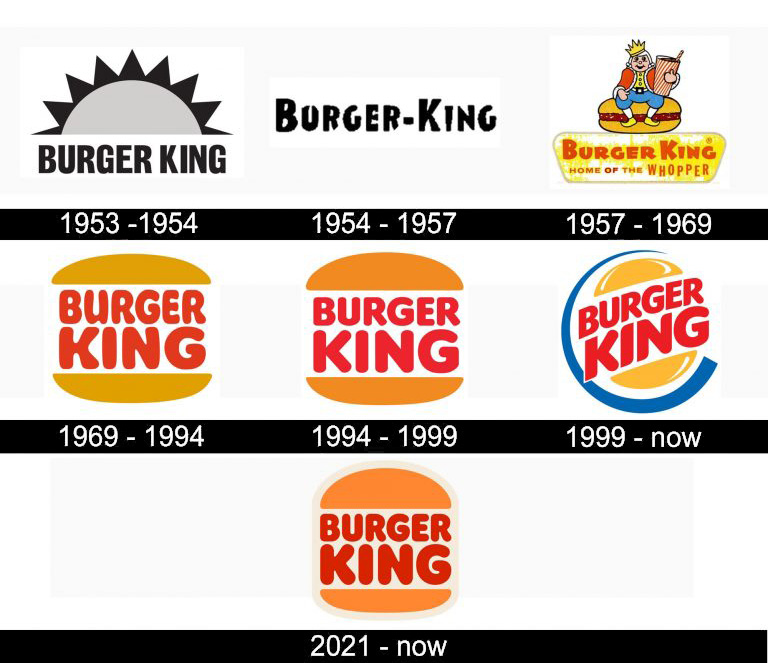
1953 – 1954: Insta-Burger King and the Rising Sun
The very first Burger King logo was created in 1953, when the company operated under the name Insta-Burger King. The emblem featured a bold uppercase wordmark accompanied by a stylized half-sun rising above it.
This logo conveyed optimism and energy but lacked a strong connection to food. It remained in use for only one year, marking the beginning of a period of rapid visual experimentation.

1954 – 1957: A Playful Wordmark Takes Over
In 1954, the brand shortened its name to Burger King and introduced a much simpler logo. The emblem consisted solely of black lettering on a transparent background, executed in a custom sans-serif typeface with playful geometric terminals.
This version felt energetic and modern for its time, but it still did not visually communicate the brand’s core product.

1957 – 1969: Color, Taglines, and Early Identity Building
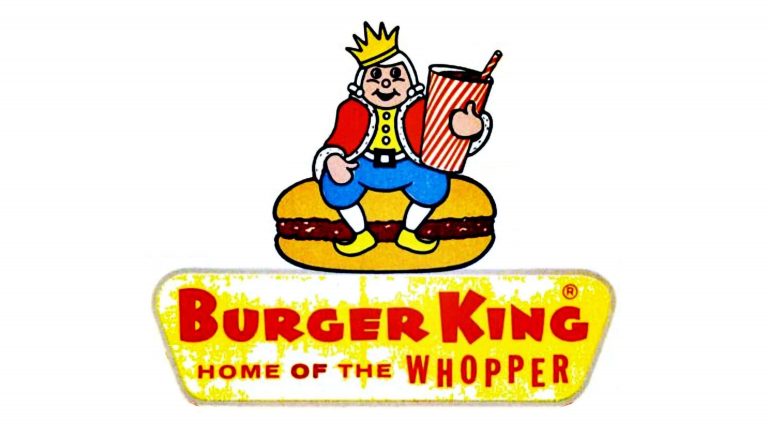
In 1957, Burger King introduced red lettering placed on a light ochre background. The typeface became bolder and more structured, resembling modern sans-serif fonts like TILT.
This logo also introduced the tagline “Home of the Whopper,” anchoring the brand more firmly to its flagship product. While still transitional, this version laid the groundwork for Burger King’s future visual language.
1969 – 1994: The Birth of the Iconic Bun Logo
The defining moment in Burger King logo history arrived in 1969. For the first time, the wordmark was placed between two stylized bun halves, forming a literal burger shape.
The red lettering was arranged on two levels between ochre-colored buns, executed in a rounded sans-serif typeface with smooth, friendly curves. The word “King” was enlarged to balance the composition visually.
This logo instantly communicated what Burger King stood for and became one of the most recognizable food logos in the world.
1994 – 1999: Stronger Colors and Greater Confidence
In 1994, the logo was refined rather than reinvented. The bun color shifted from ochre to a brighter orange, increasing visual energy and appetite appeal.
The typography became more solid and traditional, closely resembling VAG Rounded ExtraBold, with customized letterforms to enhance strength and stability. This version remains in use in some markets today, a testament to its lasting recognition.
1999 – 2021: Motion and the Blue Orbit Era
In 1999, Burger King introduced a more dynamic version of its logo, designed by Sterling Brands. The bun emblem was tilted diagonally, and a blue swoosh encircled the composition, adding motion and modernity.
The typography was subtly adjusted, blending rounded and straight elements to feel more contemporary. This version reflected Burger King’s ambition during a period of global expansion and competitive branding.
2021 – Today: A Return to Heritage and Simplicity
In 2021, Burger King unveiled a new visual identity designed by Jones Knowles Ritchie. The logo returned to a flat, bun-based design, removing the blue entirely.
The red wordmark sits between two orange buns on a warm cream background. This redesign embraces retro inspiration while aligning with modern design trends, reinforcing Burger King’s logo heritage through authenticity and warmth.
Burger KingLogo Symbolism
The symbolism of the Burger King logo is deliberately literal. The two buns represent a hamburger, while the red wordmark replaces the filling. This direct visual metaphor eliminates ambiguity and strengthens instant recognition.
Unlike logos built on abstract symbolism, Burger King’s identity is rooted in product clarity. The logo meaning is universal and intuitive, making it effective across languages and cultures. This simplicity is the cornerstone of Burger King’s enduring logo heritage.
Typography and Color
Typography has always been bold, rounded, and approachable. The current wordmark uses a heavy uppercase sans-serif typeface similar to Corkboard JNL or Frankfurter Std Normal, customized for solidity and friendliness.
Color plays an equally vital role. Red symbolizes appetite, passion, and energy. Orange reinforces warmth and food associations. The cream background softens the composition, making the logo feel inviting rather than aggressive. Together, these elements create a visually appetizing and emotionally engaging identity.
Burger King and the Power of Honest Logo Heritage
The Burger King logo history demonstrates that strong branding does not require complexity. By embracing a literal, food-centered design and refining it carefully over time, Burger King built one of the most durable visual identities in fast-food history.
Its logo heritage proves that clarity, warmth, and consistency can outlast trends. In an industry driven by speed and competition, Burger King’s logo remains a reassuring constant, instantly recognizable and deeply rooted in what the brand does best.
Burger King Logo FAQ
What does the Burger King logo represent?
The Burger King logo represents a burger, with the wordmark replacing the filling between two buns.
Why did Burger King change its logo in 2021?
The brand returned to a simpler, heritage-driven design to emphasize authenticity and modern minimalism.
What colors are used in the Burger King logo?
The logo uses red, orange, and cream, symbolizing appetite, warmth, and comfort.
Who designed the Burger King logo?
The most iconic versions were created by Sterling Brands, while the current identity was designed by Jones Knowles Ritchie.
What type of logo is Burger King’s?
Burger King’s logo is a combination mark, blending a wordmark with a symbolic graphic element.