
Bugatti Logo History: Meaning, Symbolism & Brand Heritage

From the moment its name first appeared on the radiator grilles of early twentieth-century racing machines, Bugatti established itself as something far beyond an automobile manufacturer. Founded in 1909 by Ettore Bugatti, the marque became a rare intersection of mechanical genius, artistic refinement, and uncompromising luxury. While many automotive brands have repeatedly reinvented their visual identity to follow trends, Bugatti stands almost alone in its resistance to change. Its logo history is not a story of constant redesigns, but one of continuity, craftsmanship, and heritage preserved with almost obsessive care.
In the world of logo history, Bugatti represents a unique case. The brand’s emblem, conceived at the very beginning of its existence, survived wars, bankruptcies, ownership changes, and even the transition into the Volkswagen Group era without losing its core structure or symbolism. The Bugatti logo does not simply identify a company; it reflects a philosophy rooted in art, precision, and exclusivity.
Meaning and History of the Bugatti Brand
Bugatti was founded in Molsheim, then part of the German Empire and later France, by Ettore Bugatti, an Italian-born engineer raised in an artistic household. Ettore believed that engineering should never exist without beauty, and that belief shaped not only his cars but also the brand’s visual identity. From the earliest days, Bugatti vehicles were conceived as mechanical sculptures, and the logo was designed to mirror that same approach.
Unlike many industrial logos created by agencies or marketing departments, the Bugatti emblem was a deeply personal creation. It was designed by Carlo Bugatti, Ettore’s father, a renowned artist, furniture designer, and jeweler. This artistic lineage explains why the Bugatti logo has always resembled a piece of fine jewelry rather than an industrial badge. In logo history terms, it is one of the rare automotive emblems born directly from the world of applied arts rather than corporate branding.
Bugatti Logo History and Evolution Timeline
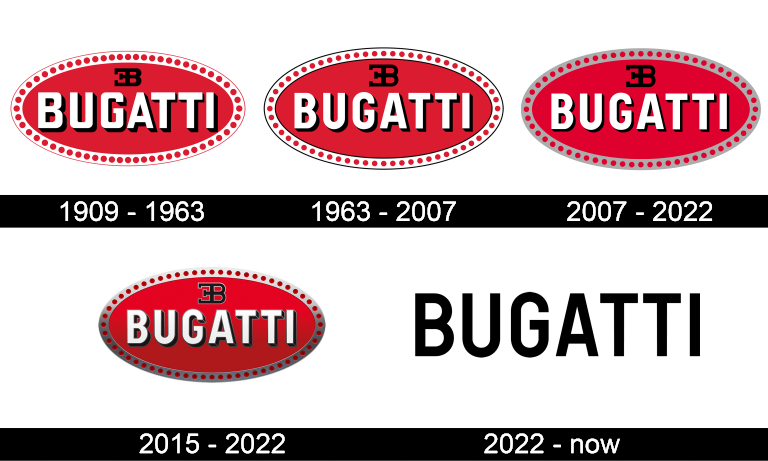
1909 – 1963: The Original Jewel of the Automotive World
The original Bugatti logo introduced in 1909 established a visual identity so complete that it required virtually no alteration for more than half a century. The badge took the form of a horizontally stretched red oval, surrounded by a contrasting light border punctuated by sixty small red dots. At its center sat a bold white uppercase wordmark, rendered in a distinctive geometric sans-serif style, accompanied by the black “EB” monogram honoring Ettore Bugatti himself.

This early logo already contained all the elements that would define Bugatti logo heritage: symmetry, luxury, mechanical precision, and artistic detail. The dots around the perimeter added rhythm and balance, while the deep red background conveyed passion, performance, and exclusivity. Unlike many early automotive logos that appeared ornamental or heraldic, Bugatti’s emblem felt deliberate, modern, and unmistakably confident.
1963 – 2007: Refinement Without Reinvention
In 1963, the Bugatti logo underwent its first notable refinement. Rather than altering the structure, designers focused on subtle improvements to legibility and elegance. The typography became more rounded and refined, moving away from rigid geometric forms toward softer contours that enhanced readability without compromising strength.
The oval grew slightly in scale, while the decorative dots became more evenly spaced, improving balance and clarity. This period reinforced Bugatti’s philosophy that evolution should never erase identity. The logo remained instantly recognizable, proving that true brand power does not depend on frequent reinvention.

2007 – 2015: Modern Luxury and Visual Precision
As Bugatti entered the modern hypercar era under Volkswagen Group ownership, the logo received another careful update in 2007. The gray frame surrounding the oval darkened, black outlines were removed, and spacing between the letters increased, giving the emblem a cleaner and more contemporary feel.
The red background brightened slightly, enhancing contrast and visual impact. These changes aligned the logo with modern automotive design standards while preserving its heritage. Importantly, the EB monogram remained intact, reaffirming the founder’s enduring presence in the brand’s identity.

2015 – 2022: Three-Dimensional Prestige
In 2015, Bugatti introduced a three-dimensional interpretation of its classic badge. Gradients were added to both the red field and the silver-gray border, creating a jewel-like depth that echoed the sculptural quality of modern Bugatti vehicles. The lettering gained subtle volume through refined shadowing, reinforcing the logo’s premium, handcrafted appearance.
This version represented the peak of Bugatti’s traditional emblem, merging heritage symbolism with contemporary visual sophistication.

2022 – Today: Radical Minimalism, Preserved Identity
In 2022, Bugatti surprised the design world by unveiling its most radical logo update in over a century. The iconic red oval, decorative dots, and EB monogram were removed from the primary mark. In their place stood a stark, black uppercase wordmark set against a white background.
Despite its minimalism, the new logo retained the proportions and typographic DNA of earlier versions. Rather than rejecting history, it distilled Bugatti’s visual identity to its purest form. In logo history terms, this shift reflects a broader luxury branding trend: confidence expressed through restraint.
Bugatti Logo Meaning and Symbolism
The Bugatti emblem has always been rich in symbolism. The oval shape suggests continuity, unity, and timeless motion. The sixty dots surrounding the badge have inspired two interpretations. One sees them as mechanical safety wires, a nod to engineering rigor, while the more poetic view treats them as pearls, referencing Carlo Bugatti’s background in jewelry design.

The “EB” monogram symbolizes authorship and pride. Its mirrored construction creates visual tension and movement, subtly evoking speed and mechanical harmony. Unlike decorative monograms in many luxury brands, Bugatti’s symbol feels structural, almost architectural, reinforcing the brand’s engineering roots.
Typography and Font Heritage
The Bugatti wordmark has always been custom-drawn, balancing geometric discipline with softened contours. In its modern form, the typeface reflects contemporary sans-serif principles while preserving the muscular stability associated with performance engineering. Its proportions suggest strength without aggression, luxury without fragility.
This typographic continuity ensures that even without its historic emblem, the Bugatti logo remains unmistakable.
Color Palette and Visual Identity
Red has always been the heart of Bugatti’s visual identity. It represents passion, power, and emotional intensity, qualities inseparable from the brand’s cars. White conveys purity, craftsmanship, and exclusivity, while black adds authority, contrast, and precision.
Even as the 2022 logo moved toward monochrome minimalism, these color associations remain deeply embedded in Bugatti’s brand language and product design.
A Masterclass in Logo Heritage
Bugatti’s logo history is not defined by change, but by restraint. In a world where brands constantly chase novelty, Bugatti demonstrates the power of continuity rooted in meaning. From its jewel-like origins crafted by Carlo Bugatti to its modern minimalist expression, the logo has remained a faithful reflection of the brand’s philosophy.
In the broader context of logo heritage, Bugatti stands as a masterclass in how identity, symbolism, and history can coexist without compromise. It is not merely a logo; it is a signature of excellence that has endured for more than a century.
Frequently Asked Questions About the Bugatti Logo
What does the Bugatti logo mean?
The Bugatti logo symbolizes luxury, precision engineering, and artistic heritage. Its oval shape, red color, and EB monogram reflect the brand’s origins, craftsmanship, and founder-driven identity.
Who designed the Bugatti logo?
The original Bugatti logo was designed by Carlo Bugatti, an Italian artist and jeweler, and the father of founder Ettore Bugatti.
Why did Bugatti change its logo in 2022?
Bugatti simplified its logo in 2022 to reflect modern luxury branding trends, focusing on minimalism while preserving typographic continuity with its historic emblem.
Is Bugatti a French or Italian brand?
Bugatti was founded in France by Ettore Bugatti, who was Italian-born. The brand is historically French but culturally European.
Has the Bugatti logo changed often?
No. Bugatti’s logo has remained largely unchanged for over a century, with only subtle refinements until the minimalist update in 2022.