
BP Logo History: Meaning, Symbolism & Brand Heritage
Few corporate symbols have gone through a transformation as dramatic as BP’s. What began as a restrained black-and-white monogram evolved into one of the world’s most recognizable energy emblems — the green-and-yellow “Helios” symbol. Each redesign reflects BP’s shifting identity, from its early industrial roots to its modern positioning built around energy, sustainability, and global presence.
This is the complete visual history of the BP logo, how it evolved, and what its symbolism represents today.
Meaning and Origins of the BP Identity
BP traces its story back to 1909, when the Anglo-Persian Oil Company was formed following the discovery of oil in Persia a year earlier. Over the decades, the company grew from a regional supplier into one of the world’s largest multinational oil and gas corporations, eventually adopting the name British Petroleum, and later the simplified BP.
Throughout its early history, the brand relied heavily on the initials “BP,” using them as the central visual device for nearly every version of its logo. Only in the 21st century did the company shift toward a more symbolic, conceptual identity — one that aimed to communicate a broader and more optimistic vision of energy.
Today, BP is a global brand with operations in dozens of countries, recognized not only for its energy products but also for its distinct green-and-yellow visual identity.
Logo Evolution BP Logo
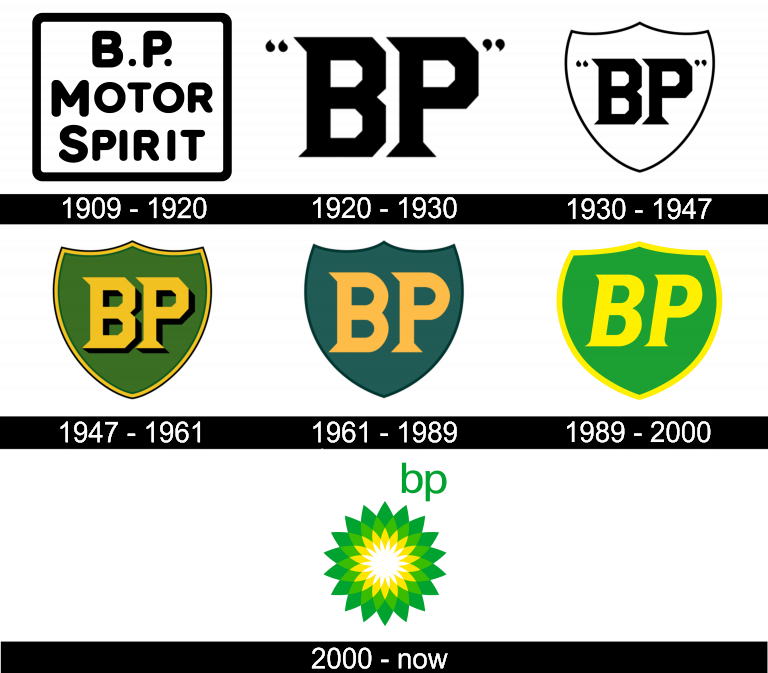
1909 – 1920: The BP Motor Spirit Wordmark
The earliest BP logo appeared on BP Motor Spirit products. It was a heavy, three-line black inscription set in rounded sans-serif lettering and placed inside a black square frame. The design was utilitarian and industrial, reflecting early 20th-century fuel branding.

1920 – 1930: The First “BP” Initials
BP introduced its first true corporate identity with the letters “BP” set in black, framed by quotation marks. The unique serif forms, sharp corners, and diamond-shaped terminals gave the monogram a distinct personality that stood apart from generic fuel signage of the era.

1930 – 1947: The Shield Debuts
In 1930, the monogram was placed inside a shield — a shape that would become synonymous with BP for nearly seven decades. Designed by AR Saunders, the logo introduced the brand’s protective, heraldic look. The shield had a thin outline, while the letters remained bold and dominant.

1947 – 1961: Green and Yellow Enter the Brand
A major shift came in 1947 when BP introduced color for the first time. The iconic green background and yellow lettering debuted here, supported by inner shadowing and multiple outlines that gave the shield more depth. This was the beginning of BP’s color identity, inspired by vitality, growth, and energy.

1961 – 1989: A Cleaner, More Confident Shield
In the early 1960s, BP simplified the shield. The green grew darker and deeper, the yellow became softer, and the letters were redrawn with smoother contours. Decorative shadows were removed, resulting in a more modern and professional appearance fit for the company’s expanding international presence.

1989 – 2000: Siegel & Gale Modernize the Identity
BP commissioned Siegel & Gale to refresh the logo. Lighter shades of green and yellow were introduced, and the “BP” lettering became italicized, giving the shield a sense of movement and approachability. This version represented BP at the height of its late-20th-century expansion.

2000 – Today: The Helios Era Begins
In 2000, BP abandoned the shield entirely and introduced one of the most recognizable corporate symbols of the modern age: the Helios. Designed by Landor Associates, the emblem features a radiant, geometric bloom in green, yellow, and a gradient that blends the two. The lowercase “bp” sits quietly in the upper right corner.
The symbol was meant to signal a new brand philosophy — one centered on energy in all forms, optimism, and environmental responsibility. Inspired by sun imagery, it symbolizes warmth, renewal, and transformation.
Meaning Behind the Design
The evolution of BP’s logo mirrors the company’s changing narrative. Early versions emphasized strength, reliability, and authority through shields and bold lettering. As the energy landscape shifted, BP adopted a softer visual language, leaning into themes of sustainability, nature, and modernity. The Helios emblem marked a clear transition from industrial petro-branding to an identity aspiring toward cleaner, greener innovation.
Font and Color
Across its early decades, BP used a distinctive serif type with sharp corners, echoing refinement and tradition. The current logotype adopts a modern, minimalist sans-serif face — clean, lowercase, and unobtrusive, allowing the symbol to take visual priority.
Color has played a central role in BP’s brand heritage. Before 1947, the logo was entirely black-and-white. With the introduction of green and yellow, BP quickly established a recognizable palette that conveyed freshness and energy. The Helios version deepened this palette through gradients, blending green and yellow to create a dynamic, sun-like effect.
The Heritage Behind the BP Logo
From serif monograms and bold shields to the modern Helios sunburst, BP’s logo history tells a story of reinvention. Each redesign reflects the brand’s ambitions at that moment in time — from industrial fuel supplier to global energy innovator. Today, the BP emblem stands as one of the most distinctive symbols in the energy sector, combining heritage, meaning, and a clear visual identity shaped over more than a century.
FAQ About the BP Logo
What does the BP logo symbolize?
The current BP “Helios” logo symbolizes energy, renewal, and environmental responsibility, inspired by the sun and nature.
Why did BP remove the shield logo?
The shield represented BP’s industrial era. In 2000, the company rebranded to signal a shift toward broader energy initiatives, choosing a modern, eco-themed symbol instead.
Who designed the modern BP logo?
The Helios emblem was created by Landor Associates as part of BP’s global rebranding initiative.
When did BP start using green and yellow?
BP adopted green and yellow in 1947, and the colors have remained essential to the brand ever since.
Why is the logo called “Helios”?
It’s named after the Greek sun god, reflecting the logo’s radiant, sun-inspired geometry and symbolism.