
Booking.com Logo History: Meaning, Symbolism & Brand Heritage

Booking.com stands today as one of the most influential travel technology companies in the world, offering millions of travelers access to hotels, homes, flights, rental cars, and attractions. Founded in 1996 as a small Dutch startup, the platform has evolved into a global giant serving users in more than 40 languages and offering over 28 million listings. What began as an early internet experiment in online reservations has grown into the most widely used hospitality booking service in the world. As the company expanded its reach, refined its services, and developed its travel ecosystem, its logo evolved as well—shifting from simple functional typography into a modern, trustworthy visual identity.
The history, symbolism, and heritage embedded in the Booking.com logo reflect the company’s commitment to accessibility, innovation, and customer trust.
Booking.com Meaning and Symbolism
The Booking.com logo embodies professionalism, reliability, and user-first service. The deep blue color—central to the brand’s visual identity—symbolizes trust, security, and stability, all essential qualities in the global travel industry. The light blue accent adds an element of approachability, suggesting ease of use and friendliness. Together, the two shades reflect the balance Booking.com strives to achieve: high-tech efficiency paired with warm, customer-focused service.
The typography is clean, modern, and simple, reinforcing the idea that travel planning should feel effortless. The inclusion of the “.com” in the logo emphasizes the brand’s digital heritage and its pioneering role as one of the earliest online travel agencies. Every detail of the logo’s design supports the company’s mission—to make travel experiences smooth, convenient, and enjoyable for all.
Booking.com Brand Heritage
The heritage of Booking.com is rooted in innovation and practical problem-solving. When Geert-Jan Bruinsma founded the company in 1996, the idea of booking hotels online was still in its infancy. Over the following decades, Booking.com not only participated in the digital revolution—it helped lead it. The platform introduced customer-centric features that later became industry standards, including transparent pricing, a no-reservation-fee model, and multilingual accessibility.
Becoming part of Booking Holdings Inc. in 2005 marked a pivotal moment in the company’s history, enabling rapid global expansion. What began as a Dutch startup quickly transformed into a worldwide travel marketplace recognized for its service reliability and technological sophistication. This heritage of innovation is reflected in the evolution of the brand’s logo, which grew more polished and modern as Booking.com’s influence expanded.
Booking.com Logo History & Evolution Timeline
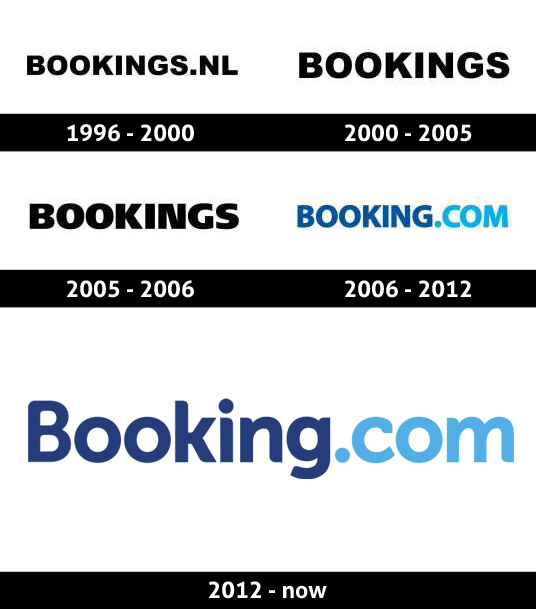
1996 – 2000s: The Early Functional Wordmark
The original Booking.com logo was purely utilitarian, displaying the full website address in black, uppercase sans-serif letters. The design was simple and unembellished, reflecting the early internet era when clarity and functionality were more important than branding symbolism. Though visually plain, the wordmark effectively communicated the service’s online nature.

2000s – 2005: The Name Gains Recognition
As Booking.com grew in popularity, the logo dropped the domain suffix, shortening the wordmark to just “Bookings.” The typeface remained unchanged, but this transition marked a turning point—the brand had become recognizable enough that users no longer needed the full URL.

2005 – 2006: A Heavier, More Assertive Look
The logo received a subtle but meaningful update in 2005. The glyphs became wider and heavier, giving the wordmark a more commanding presence. The “N,” in particular, appeared noticeably broader, contributing to a solid, grounded look that communicated growth and confidence.

2006 – 2012: Introducing Blue and Modern Refinement
The 2006 redesign ushered in a significant shift: the introduction of the blue color palette. The lighter and more sculpted typeface replaced the heavier version, with soft rounding added to the “B.” The dot and “com” returned to the wordmark, reinforcing the platform’s digital identity. This update aligned the logo with a more contemporary, global feel, symbolizing a company stepping into a new phase of expansion.

2012 – Today: A Trusted Global Signature
In its current form, the Booking.com logo embraces two shades of blue—deep navy and a lighter, welcoming tone. This combination conveys trust, professionalism, and comfort, aligning with the emotional experience of booking travel accommodations. Modern, minimal, and internationally friendly, the logo maintains a timeless quality.
For the mobile app, the design is further simplified to a white “Booking” wordmark on a deep blue square, demonstrating how minimalism can enhance recognition in the digital age. This restrained design communicates maturity and authority while keeping the brand visually streamlined.
Typography and Color
Booking.com’s typography is a refined sans-serif typeface with clean lines and rounded edges. Its balanced geometry promotes readability and reinforces the platform’s identity as intuitive and user-friendly. The modern simplicity of the letters reflects a company focused on seamless digital experiences.
Color plays a defining role in the logo’s symbolism. Deep blue conveys trust, intelligence, and stability—qualities essential for a brand facilitating major travel decisions. Lighter blue introduces warmth and approachability, making the brand feel more personal and inviting. The palette’s reliability and versatility have helped Booking.com maintain strong global recognition across cultures and markets.
The Enduring Symbolism of the Booking.com Logo
The Booking.com logo is more than a digital wordmark—it is a visual representation of trust, clarity, and a seamless travel experience. From its early functional beginnings to its polished modern form, the logo reflects a rich history of innovation, global expansion, and dedication to customer comfort. As the travel landscape evolves, the brand’s visual heritage continues to embody professionalism and reassurance, reinforcing Booking.com’s place as a leader in worldwide hospitality and travel services.
Booking.com Logo FAQ
What does the Booking.com logo symbolize?
The logo symbolizes trust, professionalism, and user-friendly travel planning through its blue palette and simple typography.
Why does Booking.com use blue?
Blue communicates reliability, safety, and comfort—qualities essential for a company responsible for travel reservations across the globe.
Why is “.com” included in the logo?
It reflects the brand’s digital origins and reinforces its identity as one of the earliest and most influential online travel platforms.
How has the Booking.com logo changed over time?
The logo evolved from a plain, functional wordmark to a refined blue identity representing modernity, trust, and global accessibility.
When was the current Booking.com logo introduced?
The current logo has been in use since 2012 and continues to represent the brand across both web and mobile platforms.